Introduction: Water Scarcity and Social Conflict in Arizona
Arizona sits at the intersection of a long-running environmental crisis and intensifying social contestation. What began as a slow-moving hydrological stress from prolonged drought and climate change has, over the past two decades, mutated into a set of political struggles — between urban and rural users, agricultural interests and municipal utilities, state governments and the federal bureaucracy, and especially between settler institutions and Indigenous nations whose water rights were often subordinated by earlier legal frameworks. This article approaches Arizona’s water scarcity as a sociological problem: not just a physical lack of water, but a socially produced condition that reshapes power, identity, inequality, and everyday life.
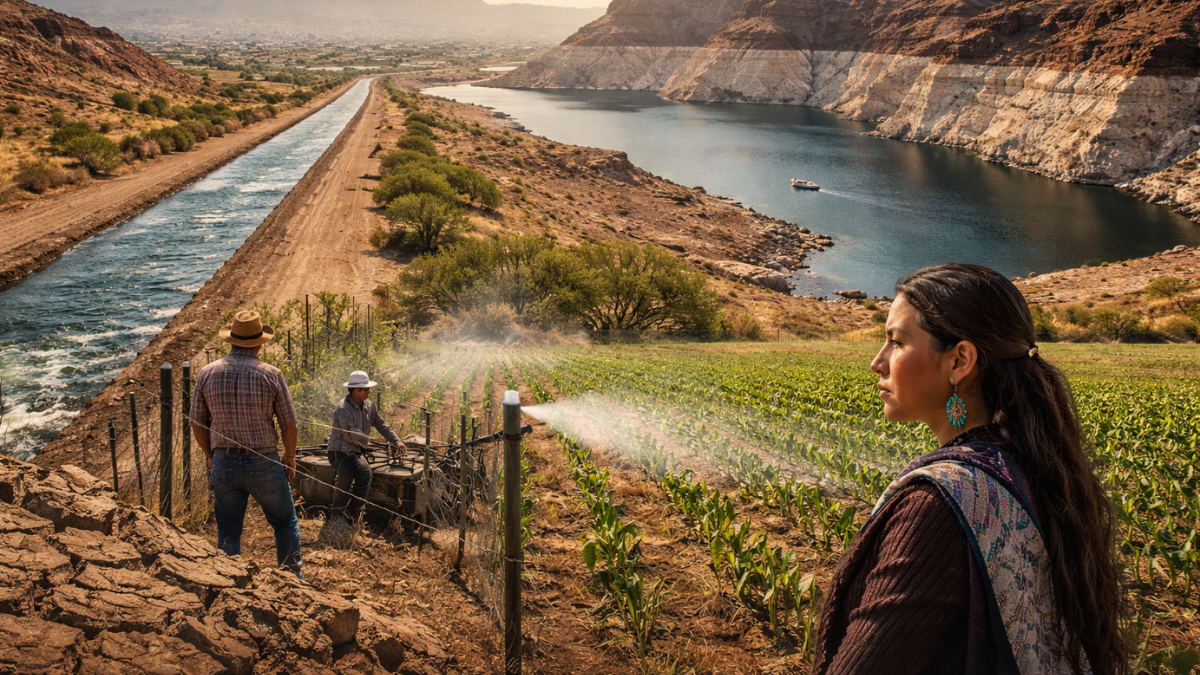
Water Scarcity and Social Conflict in Arizona is reshaping rural livelihoods, Indigenous rights, and urban growth. This sociological study explores inequality, governance challenges, and the future of water politics in Arizona.

The physical context: shrinking supply, rising demand
Arizona’s water troubles are rooted in two basic dynamics: declining supply in the Colorado River basin and steadily increasing demand across an expanding metropolitan and agricultural landscape. The Colorado River — the lifeline for much of the state’s lower-basin water system — has experienced sustained reductions in flow since the late twentieth century. Reservoir levels at Lake Mead and Lake Powell have dropped dramatically, triggering multi-state allocation cuts and a cascade of re-negotiations over who takes less and who bears the burden. Federal declarations of “shortage” and mandated cuts have already produced substantial allocations reductions for Arizona and other lower-basin users.
At the same time, Arizona’s cities — particularly the Phoenix and Tucson metropolitan areas — have grown rapidly. Urban expansion has extended suburban landscapes into desert environments, increasing municipal demand for outdoor landscaping, industry, and household consumption. Agriculture, which consumes a large share of the state’s water, continues to be both an economic anchor for many rural communities and a major point of contention as irrigation allotments shrink. The mismatch between where water is available and where populations and farms are located forces difficult choices about transfers, conservation, and the social costs of reallocation. This imbalance is not only technical; it produces visible winners and losers.
Institutional legacies and legal geography
Water scarcity in Arizona cannot be understood without attending to the legal and institutional arrangements that allocate rights and privileges. The 1922 Colorado River Compact and subsequent interstate agreements distributed rights based on hydrological estimates that are now known to be overly optimistic; these foundational documents embedded seniority and priority rules that advantage some users (notably some California and pre-compact claimants) over others. Overlaid on these interstate rules are state-level water law doctrines — including prior appropriation and groundwater management schemes — and the patchwork of federal policies that affect Indigenous water claims.

Tribal nations hold a particularly fraught and consequential place in this legal geography. Many tribes in Arizona possess “reserved” water rights derived from treaties and federal law, potentially representing substantial portions of the basin’s water. Yet the recognition, quantification, and delivery of those rights have been contested and slow. Recent litigation and policy developments — including Supreme Court decisions that limit federal obligations in certain contexts and negotiating efforts to settle tribal claims — have increased uncertainty while also opening new political fault lines. Tribal communities, long marginalized in federal water politics, now occupy an essential role in any equitable plan for basin-wide sustainability.
Social divisions: urban/rural, agribusiness/household, native/non-native
The everyday politics of water in Arizona play out along multiple social axes.
Urban vs. rural. Urban voters and utilities have the political capital to invest in large-scale infrastructure, conservation programs, and lobbying at state and federal levels. Rural communities, many dependent on agriculture, face immediate economic and cultural threats when irrigation allocations shrink or groundwater pumping is restricted. In several basins, moves to limit groundwater extraction — meant to preserve long-term aquifer health — have provoked fierce resistance from farmers who see restrictions as existential. The resulting tensions are not only economic; they signal competing visions of local identity and entitlement.
Agribusiness vs. small farmers. The agricultural landscape in Arizona includes both family-run farms and large agribusiness operations — sometimes foreign-owned — that command significant water resources. When water becomes scarce, the optics of large-scale, export-oriented agriculture receiving preferential treatment breed resentment among smaller producers and urban residents, especially when regulatory relief or bailouts appear to benefit wealthier entities. Recent regulatory moves that target specific groundwater basins and operations have sparked litigation and public protest, revealing how water policy can amplify perceptions of unfairness.
Native vs. non-native. Indigenous communities contend with a legacy of dispossession and legal marginalization that shapes their contemporary water politics. Tribes hold unextinguished water rights that courts and negotiators are still quantifying; in some cases, settlements have clarified and, in others, complicated intergovernmental water-sharing arrangements. For many tribal communities, water is deeply tied to cultural survival and sovereignty, so disputes over water are also disputes over recognition and justice. As tribes assert their rights more forcefully — through litigation, negotiated settlements, and participation in basin-wide talks — tensions can arise with non-tribal users who fear losing access or political influence.
These cleavages are not static; they intersect with class, race, and political ideology. Water scarcity often magnifies pre-existing inequalities, making low-income households, marginalized rural workers, and small-holder farmers disproportionately vulnerable.
Political economy of scarcity: who pays and who profits?
The distributional consequences of water scarcity are shaped by markets, subsidies, and political choices. In some instances, water is transferred from agricultural to urban uses through market mechanisms or government-facilitated programs; in others, conservation programs create financial incentives for reduced use. These interventions create economic winners (water-rights holders who can sell or lease allocations) and losers (workers and communities dependent on water-intensive production). Moreover, capital-intensive cities can more readily finance long-term infrastructure — desalination, recycling, and aquifer recharge projects — while rural jurisdictions struggle to match those investments.
Large agribusiness firms are often able to absorb regulatory changes or buy alternatives; smaller farms lack that resilience. Where foreign or out-of-state ownership concentrates irrigated land, resentment can coalesce around perceptions of external actors extracting local water to supply distant markets. State-level policy choices — whether to strengthen groundwater regulation, to subsidize certain crops, or to finance urban water projects — thereby have immediate distributional impacts and reshape the political economy of Arizona’s landscapes.
Governance responses and the social consequences of policy
Policy responses to scarcity range from conservation incentives to regulatory limits and legal settlements. Arizona has experimented with groundwater management areas, urban water conservation programs, and negotiated transfers. Municipal water suppliers have launched campaigns to reduce outdoor watering and invest in reuse technologies. Yet governance innovations can generate conflict when they are perceived to impose burdens unevenly.
A clear example is the state’s move to designate active management areas and to impose reporting and use restrictions in basins experiencing subsidence or critical depletion. While these rules aim to prevent long-term collapse of aquifers, they have provoked pushback from agricultural actors who see them as threats to livelihoods. Political leaders must therefore balance technical sustainability with the immediate socio-economic impacts of regulation — a balance that is often contested in public hearings, courts, and state legislatures. Recent actions to curtail groundwater pumping in specific basins illustrate how governance choices can catalyze legal battles and local resistance.
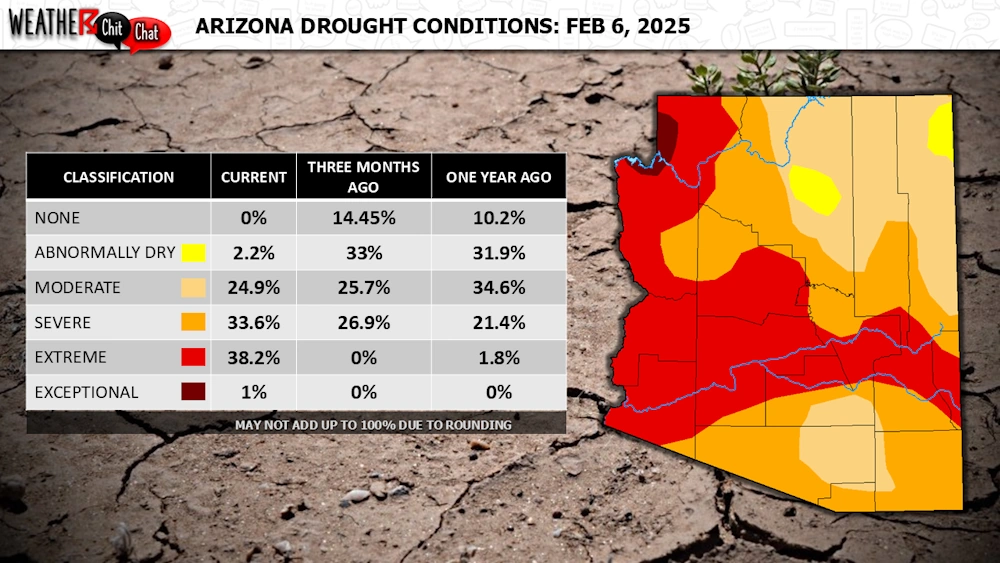
At the interstate level, Colorado River negotiations — fraught with competing claims and historical inequities — have sometimes stalled, forcing federal agencies to intervene or to issue unilateral allocation reductions. Such high-level impasses trickle down to everyday life in Arizona, prompting fears of draconian cuts, rationing, or federal takeover, and stoking political rhetoric that frames conservation as either prudent stewardship or punitive overreach.
Everyday life: practices, meanings, and cultural change
Scarcity reshapes daily behavior and cultural norms. In Phoenix and other cities, conservation campaigns encourage changes in landscaping (shrinking lawns, xeriscaping), domestic habits (shorter showers, efficient appliances), and social norms around visible consumption. For communities with strong ties to farming, reductions in water can mean renegotiating traditions of land use, crop choices, and communal rituals tied to irrigation calendars.
Water conservation also becomes a site of moral discourse: whose habits are framed as wasteful, and whose practices are excused as essential? These moral narratives reflect broader social hierarchies; for example, affluent neighborhoods with private swimming pools or extensive green spaces may be judged differently than lower-income households where outdoor space is scarce. The social visibility of water use — lush lawns versus arid yards — becomes a form of symbolic inequality, communicating status and provoking social judgment.
Conflict, contestation, and social mobilization
Where water scarcity is acute and policy remedies are seen as unfair, social conflict emerges. Protests, lawsuits, and political organizing have all surfaced in Arizona around water-related decisions. Farmers and rural communities have mobilized against groundwater restrictions; environmental and Indigenous groups have mobilized for stronger protections and equitable settlements; and urban constituencies have pushed for investment in infrastructure that secures supply for growing populations.
Legal action remains a central mode of contention. Tribal water rights claims and interstate suits over allocation priorities have tied up negotiations for years, while local litigation over groundwater rules can delay or reshape regulatory action. Courts are arenas where historical legacies of power are litigated and where technical hydrological models meet legal doctrines.
Beyond formal arenas, coalitions form across unexpected lines. Environmental organizations sometimes ally with certain farmers to advocate for market-based transfers that pay farmers to fallow land in exchange for water allocations. Cities may partner with tribes on joint infrastructure projects that respect tribal sovereignty while improving regional resilience. These collaborative forms of problem-solving suggest that while scarcity produces conflict, it can also incentivize novel governance experiments.
Inequality, vulnerability, and the politics of risk
From a sociological perspective, water scarcity is an inequality amplifier. Vulnerable populations — low-income households, undocumented workers, smallholder farm families, and some Indigenous communities — are less able to adapt to shocks. They may lack the resources to invest in efficient technologies, to relocate, or to litigate for rights. Policy responses that prioritize aggregate reductions without tailored protections risk exacerbating social harms.
Moreover, the spatiality of risk matters: communities located in rural basins, on reservation lands with contested access, or on the urban periphery tend to bear disproportionate exposure. Social networks, political representation, and historical marginalization shape both vulnerability and the capacity to resist or negotiate change.
Pathways forward: equity, deliberation, and adaptive governance
If water scarcity is a social problem as much as a physical one, solutions require social as well as technical change. Several principles can guide more equitable and effective governance.
- Prioritize inclusive deliberation. Decisions about reallocations, groundwater restrictions, and conservation incentives should involve the full spectrum of stakeholders — including tribal nations, small farmers, rural communities, and low-income urban residents — in meaningful, not merely consultative, ways. Negotiations that ignore historically marginalized actors will almost certainly generate renewed conflict.
- Use distributive safeguards. Policies that redistribute the costs of cuts more fairly — for example, compensation mechanisms for small farmers, targeted support for low-income households, and job retraining for displaced agricultural workers — can attenuate the social pain of reallocation.
- Invest in shared infrastructure. Regional projects that benefit multiple constituencies (aquifer recharge, wastewater reuse, habitat-friendly transfers) can create cooperation incentives. Co-governance models with tribal partners can also advance mutual trust and legitimacy.
- Emphasize transparency and data democracy. Open access to hydrological models, allocation decisions, and monitoring data reduces suspicion and enables communities to participate knowledgeably in governance.
- Experiment with adaptive institutions. Given climatic uncertainty, fixed legal doctrines may prove brittle. Adaptive rules — with periodic review, trigger mechanisms, and contingency funds — can allow policymakers to respond to new information without ad-hoc or inequitable shortcuts.
These pathways require political will, funding, and humility about trade-offs. They also demand recognition that technical fixes alone (pipelines, desalination, or transfers) cannot substitute for fair processes and social investment.
Conclusion: water as social structure
Arizona’s water scarcity is not an isolated environmental problem; it is a social process that remakes relationships, institutions, and identities. As river flows decline and demands grow, water becomes a mirror reflecting historical inequalities and current political cleavages. The conflicts that follow are therefore about more than liters or acre-feet: they are about recognition, rights, and who counts as a legitimate participant in decisions that shape life in a drying landscape.
Addressing scarcity demands sociological attention: mapping who wins and who loses, understanding the symbolic politics of consumption, and building governance that is both technically robust and socially just. In Arizona, the future of water will hinge not only on the next winter’s snowfall but on the capacity of diverse communities to negotiate shared futures in ways that reckon with history and distribute burdens equitably. The state’s experience offers a cautionary tale and a laboratory for how democracies might — or might not — manage common-pool resources under climate stress.
FAQs
1. What is meant by Social Conflict in Arizona in the context of water scarcity?
Social Conflict in Arizona refers to disputes and tensions among different social groups—urban residents, rural farmers, Indigenous tribes, policymakers, and businesses—over the allocation, control, and management of limited water resources.
2. Why has water scarcity intensified Social Conflict in Arizona?
Water scarcity has reduced available supplies from the Colorado River and groundwater basins, forcing difficult allocation decisions that create competition and mistrust among stakeholders.
3. How does Social Conflict in Arizona affect rural farming communities?
Rural farmers often face groundwater restrictions and irrigation cuts, leading to economic stress, legal battles, and protests that intensify Social Conflict in Arizona.
4. What role do Indigenous tribes play in Social Conflict in Arizona?
Indigenous tribes hold significant but historically contested water rights. Their legal claims and sovereignty movements have become central to Social Conflict in Arizona.
5. How does urban growth contribute to Social Conflict in Arizona?
Rapid expansion of cities like Phoenix increases municipal water demand, creating tensions between urban development priorities and agricultural or rural water needs.
6. Is groundwater depletion a factor in Social Conflict in Arizona?
Yes. Over-extraction of groundwater in certain basins has triggered state intervention, lawsuits, and political disputes, fueling Social Conflict in Arizona.
7. How does climate change impact Social Conflict in Arizona?
Climate change reduces river flow and intensifies drought conditions, increasing scarcity and heightening Social Conflict in Arizona over resource allocation.
8. What economic inequalities are linked to Social Conflict in Arizona?
Wealthier corporations and municipalities can invest in advanced water technologies, while small farmers and low-income communities struggle, deepening Social Conflict in Arizona.
9. Are interstate agreements part of Social Conflict in Arizona?
Yes. Allocation rules under the Colorado River Compact influence Arizona’s water share, creating tensions between states and within Arizona itself.
10. How do legal disputes shape Social Conflict in Arizona?
Court cases regarding tribal rights, groundwater regulation, and allocation priorities significantly shape the trajectory of Social Conflict in Arizona.
11. What cultural factors influence Social Conflict in Arizona?
Water is tied to agricultural heritage, Indigenous identity, and suburban lifestyles, making conflicts not just economic but also cultural.
12. How does water pricing affect Social Conflict in Arizona?
Increasing water costs disproportionately affect low-income households, contributing to economic stress and expanding Social Conflict in Arizona.
13. Can cooperation reduce Social Conflict in Arizona?
Collaborative governance models, tribal-state agreements, and conservation partnerships can reduce Social Conflict in Arizona through shared responsibility.
14. What is the role of state government in managing Social Conflict in Arizona?
The state government regulates groundwater, negotiates interstate agreements, and designs conservation policies that directly influence Social Conflict in Arizona.
15. What is the future outlook for Social Conflict in Arizona?
If equitable and adaptive water policies are not implemented, Social Conflict in Arizona may intensify; however, inclusive governance and sustainable practices could mitigate tensions.