
Social stratification refers to the structured inequalities that exist within a society, shaping people’s access to resources, opportunities, and power. In India, stratification is deeply rooted in historical, cultural, economic, and political systems. The three most powerful dimensions of social stratification in Indian society are caste, class, and gender. These systems overlap and interact, creating complex patterns of privilege and disadvantage. From ancient times to the present, social hierarchies have influenced education, employment, marriage, political participation, and everyday social interactions.
Understanding Social Stratification in India from a sociological perspective helps explain why inequality persists in modern India despite constitutional guarantees of equality.

The Sociological Meaning of Social Stratification
In sociology, social stratification refers to the division of society into different layers based on wealth, status, power, and social prestige. These layers are not random but are systematically organized and reproduced across generations. Stratification determines who gets access to quality education, healthcare, political influence, and economic opportunities. Indian society presents a unique case because traditional systems like caste coexist with modern class structures and deeply rooted gender norms. These three dimensions do not function independently; rather, they reinforce one another.
Indian sociologists such as M. N. Srinivas, Andre Béteille, and G. S. Ghurye have extensively studied how caste, class, and gender shape social life. While economic modernization and urbanization have brought change, social hierarchies continue to affect life chances for millions of people.
Caste as a System of Social Stratification
Caste is the most distinctive feature of Indian social stratification. Traditionally, the caste system was based on the Varna model, which divided society into Brahmins, Kshatriyas, Vaishyas, and Shudras, with Dalits placed outside the system. Over time, thousands of jatis or sub-castes emerged, each associated with specific occupations, social status, and ritual ranking.
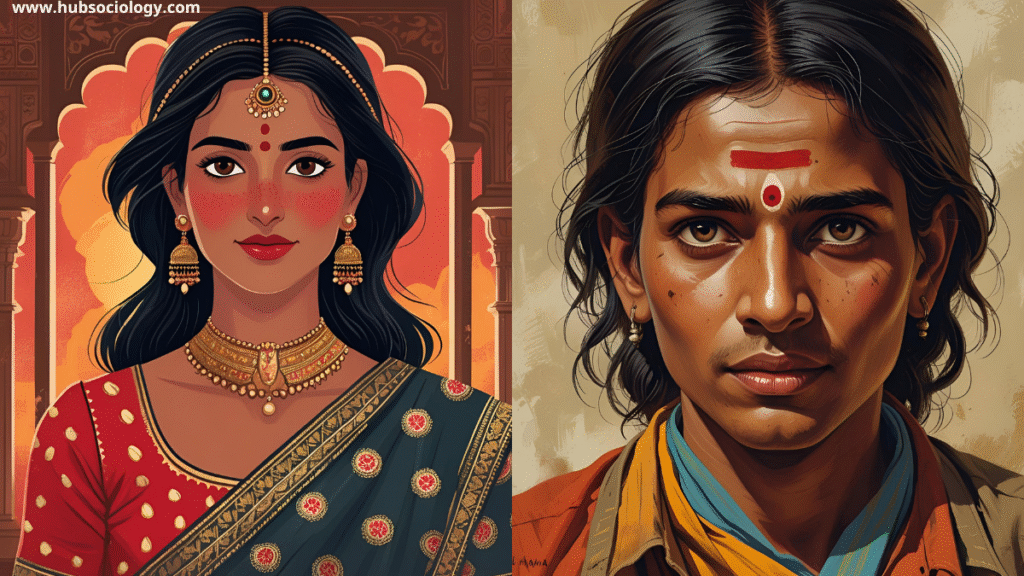
Caste determined almost every aspect of life, including marriage, food habits, residence, and social interactions. Endogamy, or marriage within one’s own caste, ensured that caste boundaries remained rigid. Untouchability practiced against Dalits was one of the most extreme forms of social exclusion in human history. Even basic human contact was restricted in many regions.
From a functionalist perspective, early sociologists argued that caste ensured social order by assigning fixed roles. However, conflict theorists like B. R. Ambedkar viewed caste as a system of exploitation and oppression. Ambedkar argued that caste was not just a division of labor but a division of laborers, where social status was inherited rather than earned.
After independence, the Indian Constitution abolished untouchability and guaranteed equality. Affirmative action policies were introduced for Scheduled Castes, Scheduled Tribes, and Other Backward Classes. These policies improved access to education and jobs, especially in urban areas. However, caste-based discrimination continues in subtle and overt forms, particularly in rural regions.
Caste still influences political mobilization, voting behavior, and social identity. Caste associations, regional caste movements, and identity politics show that caste remains a powerful social force. Even in cities, residential segregation and marriage preferences often follow caste lines.
Class and Economic Inequality in India
While caste is a traditional form of stratification, class represents modern economic divisions based on income, occupation, and wealth. Class stratification has become more visible with industrialization, urbanization, and the growth of capitalism.
Indian society today is divided into the upper class, middle class, working class, and the poor. These divisions are shaped by education, employment opportunities, land ownership, and access to capital. The liberalization of the Indian economy in the 1990s created new opportunities for economic mobility, but it also widened income inequality.
The urban middle class has expanded, enjoying better education, healthcare, and consumer lifestyles. At the same time, millions of people continue to live in poverty, especially in rural areas and urban slums. Informal sector workers, migrant laborers, and agricultural laborers often face job insecurity, low wages, and lack of social protection.
From a Marxist perspective, class stratification reflects unequal control over the means of production. The wealthy elite control industries, land, and financial resources, while the working class sells labor for survival. Economic inequality is not accidental but structured through capitalist systems.
In India, class is closely linked with caste. Upper-caste groups are overrepresented among the wealthy and educated, while lower-caste communities are more likely to experience poverty. Although education and urban jobs offer chances for upward mobility, structural barriers still limit equal opportunities.
Class stratification also affects access to quality education. Elite private schools and universities provide global exposure, while government schools often struggle with infrastructure and teaching quality. This creates a cycle where the privileged continue to succeed, and the disadvantaged remain trapped in poverty.
Gender as a Dimension of Social Stratification
Gender inequality is another major form of stratification in Indian society. Patriarchal norms assign different roles, responsibilities, and expectations to men and women. These norms shape access to education, employment, political power, and personal freedom.
Traditionally, Indian society has valued sons more than daughters. Practices like dowry, child marriage, and restrictions on women’s mobility reflect deep-rooted gender bias. Although legal reforms have improved women’s rights, social attitudes often change slowly.
Women face disadvantages in education, workforce participation, and leadership roles. Female literacy has improved significantly, yet dropout rates remain high in many regions due to early marriage, domestic responsibilities, and safety concerns. In the labor market, women earn less than men and are underrepresented in formal employment.
Sociologically, gender stratification is reinforced through socialization. From childhood, boys and girls are taught different behaviors, ambitions, and roles. Media, family structures, and cultural traditions shape gender expectations.

Feminist sociologists argue that patriarchy operates through institutions like family, religion, and the state. Laws may promote equality, but everyday practices often sustain male dominance. Violence against women, unequal inheritance rights, and limited political representation reflect persistent gender inequality.
Intersectionality is an important concept here. A Dalit woman, for example, faces discrimination based on caste, class, and gender simultaneously. Her experiences are very different from those of an upper-caste urban woman. Social stratification cannot be understood by studying each factor separately.
The Interconnection of Caste, Class, and Gender
In India, caste, class, and gender are deeply interconnected. They do not function as isolated systems but overlap in shaping life chances. A person’s caste background often influences their economic status, while gender norms affect access to resources within each caste and class.
For example, an upper-caste man from an affluent family enjoys multiple privileges, including social respect, financial security, and freedom of choice. In contrast, a lower-caste woman from a poor household faces multiple layers of disadvantage, including discrimination, economic hardship, and restricted opportunities.
Marriage patterns reflect this intersection. Inter-caste marriages remain socially discouraged, and women often have less freedom to choose partners. Dowry practices place financial burdens on families with daughters, reinforcing economic inequality.
Political representation also shows stratified patterns. Although reservation policies have increased representation of marginalized groups, leadership positions are still dominated by elite men. Women’s political participation remains limited, especially at higher levels of power.
Education can challenge stratification, but access remains unequal. Students from privileged backgrounds attend better schools, speak English fluently, and have social networks that help them succeed. Marginalized students often struggle with language barriers, financial constraints, and social exclusion.
Social Change and Challenges to Stratification
Indian society has witnessed significant social change in recent decades. Urbanization, digital media, education, and social movements have challenged traditional hierarchies. Young people increasingly question caste norms, support gender equality, and seek merit-based opportunities.
Social reform movements led by figures like Jyotirao Phule, Periyar, and Ambedkar played a major role in challenging caste oppression. Feminist movements have raised awareness about women’s rights, workplace equality, and gender-based violence.
Government policies such as reservations, women’s empowerment schemes, and poverty alleviation programs aim to reduce inequality. Education campaigns and legal reforms have improved social awareness.
However, resistance to change remains strong. Caste-based violence, honor killings, gender discrimination, and economic inequality continue to affect millions. Social media sometimes amplifies both progressive voices and regressive ideologies.
Sociologists emphasize that structural change requires more than legal reforms. It requires changes in attitudes, values, and everyday practices. Schools, families, and communities play a crucial role in shaping inclusive mindsets.
The Role of Education in Reducing Stratification
Education is one of the most powerful tools for reducing social inequality. It provides knowledge, skills, and confidence to challenge traditional hierarchies. For many marginalized communities, education has been a path to dignity and upward mobility.
However, unequal access to quality education remains a major issue. Rural schools, government institutions, and tribal areas often lack resources. Digital divides further widen educational gaps.
Sociologically, education can both reproduce and challenge inequality. Elite institutions often serve the privileged, while mass education systems struggle to provide equal outcomes. True social transformation requires inclusive, accessible, and culturally sensitive education.
Gender-sensitive education can challenge patriarchal norms. Caste-sensitive curricula can promote social justice awareness. Critical thinking helps students question discrimination and stereotypes.
The Future of Social Stratification in India
India stands at a crossroads. Economic growth, technological change, and global exposure are reshaping society. At the same time, traditional hierarchies continue to influence social life.
The future of social stratification depends on how effectively India addresses inequality. Strengthening public education, ensuring fair employment, promoting gender equality, and challenging caste discrimination are essential steps.
Sociology reminds us that inequality is not natural or permanent. Social structures are created by human actions and can be changed through collective effort. Policies, movements, and cultural shifts can transform society.
A more inclusive India requires recognizing the dignity of every individual, regardless of caste, class, or gender. Only then can the promise of social justice become a reality rather than a constitutional ideal.
Conclusion
Social stratification in India is shaped by the powerful forces of caste, class, and gender. These systems have historical roots and continue to influence modern life. While legal reforms and social movements have brought progress, deep inequalities persist.
From a sociological perspective, stratification is not just about economic differences but about social power, identity, and opportunity. Understanding how caste, class, and gender intersect helps explain why inequality remains complex and persistent.
For true social transformation, India must move beyond symbolic equality and address structural disadvantages. Education, awareness, and inclusive policies can help build a more just and balanced society where every individual has the opportunity to thrive.
FAQs on Social Stratification in India
1. What is Social Stratification in India?
Social Stratification in India refers to the hierarchical division of society based on caste, class, gender, and other social factors that determine people’s status, power, and access to resources.
2. Why is caste important in Social Stratification in India?
Caste plays a central role because it traditionally decides occupation, social status, marriage, and social interactions, making it a key foundation of Social Stratification in India.
3. How does class contribute to Social Stratification in India?
Class contributes through economic inequality, dividing people into rich, middle, and poor based on income, education, and occupation.
4. What is the role of gender in Social Stratification in India?
Gender creates inequality by limiting women’s access to education, employment, and leadership, reinforcing Social Stratification in India.
5. Is Social Stratification in India changing?
Yes, modernization, education, and social movements are reducing some inequalities, but Social Stratification in India still exists in many forms.
6. How does education affect Social Stratification in India?
Education can reduce inequality by providing opportunities, but unequal access to quality education can also reproduce Social Stratification in India.
7. What is the impact of Social Stratification in India on employment?
People from privileged backgrounds get better jobs, while marginalized groups often face discrimination and limited opportunities.
8. How does Social Stratification in India affect women?
Women face double discrimination due to both gender and social background, especially in rural and lower-caste communities.
9. What is intersectionality in Social Stratification in India?
Intersectionality means caste, class, and gender overlap to create multiple layers of inequality in Indian society.
10. How does Social Stratification in India influence marriage?
Most marriages happen within the same caste and class, maintaining social hierarchy.
11. What role does the government play in reducing Social Stratification in India?
The government uses reservation policies, welfare schemes, and legal reforms to reduce inequality.
12. How does urbanization affect Social Stratification in India?
Urbanization creates new opportunities but also increases economic inequality between social groups.
13. What is the sociological view of Social Stratification in India?
Sociologists see it as a structured system of inequality maintained through institutions like family, education, and politics.
14. Can Social Stratification in India be eliminated?
It cannot be eliminated overnight, but social awareness, education, and inclusive policies can reduce it.
15. Why is it important to study Social Stratification in India?
Studying it helps understand inequality, social justice, and ways to build a fairer society.