Introduction
In contemporary American society, social media has become more than a communication tool—it is a central arena where identities are created, negotiated, performed, and sometimes contested. Platforms such as Instagram, Facebook, TikTok, and X (formerly Twitter) shape how individuals understand themselves and how they wish to be perceived by others. From teenagers experimenting with self-presentation to adults managing professional and political personas, social media deeply influences identity formation in America.
Sociologically, identity is not a fixed or purely personal trait; it is a social product shaped through interaction, culture, power relations, and institutions. Social media intensifies these processes by providing constant visibility, feedback, and comparison. This article examines Social Media and Identity Formation in America through key sociological theories, cultural dynamics, class, gender, race, and the broader implications for American society.

Identity Formation: A Sociological Foundation
Identity formation refers to the process through which individuals develop a sense of who they are in relation to society. Classical sociological thinkers emphasized that identity emerges through social interaction rather than isolation.
George Herbert Mead argued that the self develops through symbolic interaction—individuals learn who they are by seeing themselves reflected in others’ responses. Similarly, Erving Goffman described social life as a performance, where individuals manage impressions depending on social context.
In the American digital age, social media functions as a permanent interaction space, where feedback through likes, shares, comments, and views becomes a powerful mirror shaping self-concept. Identity is no longer formed only in families, schools, and workplaces but also through digital audiences that may number in the thousands.
Social Media as a Digital Stage of the Self
Social media platforms operate as virtual stages where individuals perform carefully curated versions of themselves. Profiles, photos, bios, and posts are not random; they are deliberate representations designed to communicate identity traits such as success, happiness, attractiveness, intelligence, or political awareness.
Unlike face-to-face interaction, social media allows:
- Selective self-presentation
- Editing and filtering of personal narratives
- Continuous comparison with others
This creates what sociologists describe as “idealized identities.” In American culture, which already emphasizes individualism and self-branding, social media amplifies the pressure to present a successful and desirable self.
Over time, individuals may begin to internalize their online persona, blurring the boundary between authentic self and performed identity. The digital self becomes not just a reflection but a standard against which people judge their real lives.
Youth, Adolescence, and Digital Identity in America
Identity formation is especially significant during adolescence, a life stage marked by exploration and uncertainty. In America, teenagers and young adults are among the most active social media users, making digital platforms central to their identity development.
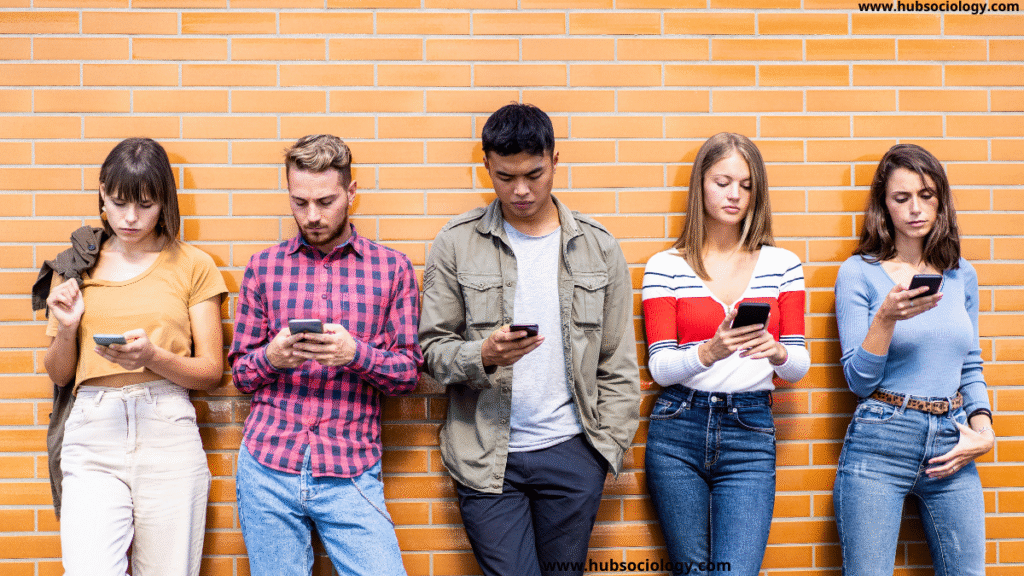
Social media offers youth:
- A space for self-expression
- Peer validation and belonging
- Exploration of gender, sexuality, and interests
However, it also exposes them to:
- Cyberbullying and online harassment
- Unrealistic beauty and lifestyle standards
- Constant surveillance by peers
Sociologically, this creates a paradox. While social media empowers American youth to express identities beyond traditional constraints, it also increases anxiety, self-doubt, and dependency on external validation. Identity becomes fragile when self-worth is measured through metrics such as likes and followers.
Gender, Body Image, and Identity Construction
Social media plays a powerful role in shaping gender identities in America. Platforms visually emphasize appearance, reinforcing cultural norms about beauty, masculinity, and femininity.
Women and girls, in particular, face intense pressure to conform to idealized body images promoted by influencers and celebrities. Filters, editing apps, and algorithm-driven content create unrealistic standards that affect self-esteem and identity.
At the same time, social media has also enabled:
- Feminist activism
- Body positivity movements
- LGBTQ+ visibility and self-definition
From a sociological perspective, social media acts as a site of both domination and resistance. While it reproduces patriarchal norms, it also allows marginalized gender identities to challenge traditional narratives and construct alternative self-definitions in American society.
Race, Ethnicity, and Digital Identity
In a racially diverse society like America, identity formation is deeply influenced by race and ethnicity. Social media has become a crucial space for racial expression, solidarity, and political mobilization.
African American, Latino, Asian American, and Indigenous communities use social media to:
- Preserve cultural identity
- Challenge stereotypes
- Share lived experiences of discrimination
Movements such as Black digital activism illustrate how online identity connects personal experience with collective struggle. However, racial identity online is also shaped by surveillance, trolling, and algorithmic bias, which can marginalize minority voices.
Sociologically, social media reflects existing racial power structures while also offering tools to resist them. Identity formation online is therefore inseparable from broader issues of inequality in America.
Class, Consumption, and Lifestyle Identity
Social class plays a subtle but powerful role in social media identity formation. In America, digital platforms often promote consumerist identities—travel, fashion, technology, and luxury lifestyles become symbols of success.
Middle- and upper-class users are more likely to present aspirational identities that signal status, education, and cultural capital. Meanwhile, working-class identities may be underrepresented or stigmatized.
This reinforces what sociologists call symbolic inequality, where certain lifestyles are normalized and celebrated while others are rendered invisible. Social media thus becomes a space where class identity is not only expressed but hierarchically ranked.
Political Identity and Online Polarization
Social media has transformed political identity formation in America. Political beliefs are no longer confined to voting behavior; they are displayed through profile bios, hashtags, memes, and online debates.
Digital platforms encourage:
- Identity-based politics
- Echo chambers and ideological segregation
- Public performance of moral and political positions
From a sociological viewpoint, political identity on social media becomes part of the self rather than just an opinion. This intensifies polarization, as disagreement is perceived as a threat to personal identity.
At the same time, social media has enabled political participation among groups historically excluded from traditional political spaces, reshaping democratic engagement in America.
Mental Health, Surveillance, and the Fragmented Self
One of the most critical sociological concerns regarding social media and identity formation in America is mental health. Constant visibility creates a culture of self-surveillance, where individuals monitor how they are perceived at all times.

This leads to:
- Anxiety and fear of judgment
- Fragmented identities across platforms
- Pressure to remain constantly relevant
The sociological concept of the fragmented self explains how individuals manage multiple identities—professional on LinkedIn, expressive on Instagram, political on X. While this flexibility can be empowering, it can also create emotional exhaustion and identity confusion.
The Role of Algorithms in Identity Formation
Unlike traditional social interaction, social media identity formation is shaped by algorithms. These invisible systems determine what content users see and what content gains visibility.
Algorithms:
- Reward conformity and engagement
- Amplify extreme or emotional content
- Shape tastes, beliefs, and self-expression
From a sociological lens, algorithms act as non-human social actors, influencing identity without direct human interaction. This raises concerns about autonomy, authenticity, and manipulation in American digital culture.
Conclusion
Social Media and Identity Formation in America is a complex sociological phenomenon rooted in interaction, power, culture, and technology. Social media does not simply reflect who people are—it actively shapes who they become. It offers spaces for creativity, resistance, and connection while simultaneously reinforcing inequality, surveillance, and pressure to perform.
Understanding identity formation in the digital age requires moving beyond individual psychology to examine broader social structures. As social media continues to evolve, its influence on identity will remain one of the most significant sociological issues in contemporary American society.
For sociologists, educators, and policymakers, the challenge lies in fostering digital environments that support authentic self-development rather than reducing identity to performance metrics. In this sense, the study of social media and identity is not only academic—it is essential to understanding the future of American social life.
Frequently Asked Questions
1. What is identity formation in America?
Identity formation in America refers to the social process through which individuals develop a sense of self shaped by culture, social interaction, institutions, and media within American society.
2. How does social media influence identity formation in America?
Social media influences identity formation in America by shaping self-presentation, peer validation, lifestyle aspirations, and public self-expression through likes, comments, and online visibility.
3. Why is identity formation important in sociology?
Identity formation is important in sociology because it explains how individuals connect personal experiences with social structures, norms, power relations, and cultural expectations.
4. How does American culture shape identity formation?
American culture emphasizes individualism, self-expression, and achievement, which strongly affect how identities are constructed and performed both online and offline.
5. What role does youth play in identity formation in America?
Youth play a central role in identity formation in America as adolescence is a critical stage for self-discovery, experimentation, and social belonging, increasingly influenced by digital platforms.
6. How does social media affect youth identity formation in America?
Social media affects youth identity formation in America by increasing peer comparison, shaping self-esteem, influencing body image, and reinforcing the need for social approval.
7. What is the relationship between gender and identity formation in America?
Gender identity formation in America is influenced by social media, cultural norms, and representation, which can both reinforce stereotypes and support alternative gender expressions.
8. How does race impact identity formation in America?
Race impacts identity formation in America by shaping lived experiences, access to representation, exposure to discrimination, and opportunities for cultural expression.
9. Can social media help marginalized identities in America?
Yes, social media can help marginalized identities in America by providing platforms for visibility, community building, activism, and resistance against dominant narratives.
10. How does social class affect identity formation in America?
Social class affects identity formation in America by influencing lifestyle representation, consumption patterns, digital access, and social recognition on online platforms.
11. What is digital identity in the context of identity formation in America?
Digital identity refers to the online version of the self that individuals construct through profiles, posts, and interactions, playing a growing role in identity formation in America.
12. How do algorithms influence identity formation in America?
Algorithms influence identity formation in America by shaping what content people see, encouraging certain behaviors, and reinforcing specific beliefs and interests.
13. What is identity performance on social media?
Identity performance is the act of consciously presenting oneself in a particular way online to gain approval, status, or belonging, a key aspect of identity formation in America.
14. How does social media affect mental health and identity formation?
Social media affects mental health and identity formation in America by increasing self-surveillance, anxiety, comparison, and pressure to maintain idealized identities.
15. What are the future challenges of identity formation in America?
Future challenges of identity formation in America include managing digital surveillance, algorithmic control, identity fragmentation, and maintaining authenticity in online spaces