
Introduction
East Asia is one of the most economically dynamic and culturally rich regions in the world. China, Japan, and South Korea are not only major economic powers but also societies with deep historical roots, shared cultural traditions, and complex political relationships. Regional cooperation among these three countries has become increasingly important in addressing economic integration, security concerns, cultural exchange, and social challenges.
From a sociological perspective, the dynamics of China–Japan–South Korea cooperation go beyond diplomacy and trade. They involve identity, historical memory, nationalism, modernization, and the changing nature of East Asian societies. Understanding these relationships requires examining how social structures, collective consciousness, and cultural narratives shape cooperation and conflict in the region.
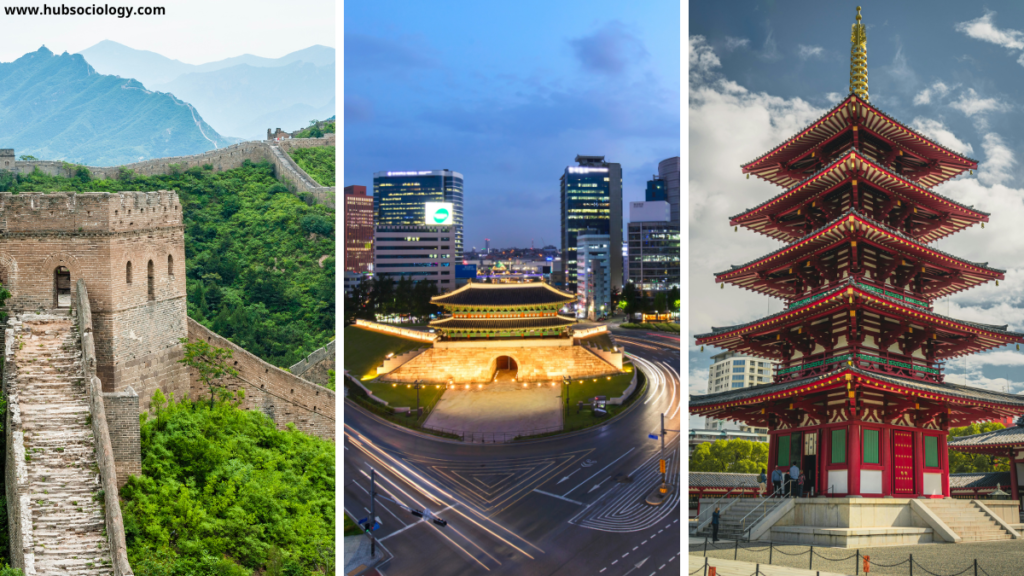
This article explores the sociological dimensions of regional cooperation among China, Japan, and South Korea, focusing on history, culture, economy, politics, and social change.
Historical Roots and Collective Memory
The historical experiences of China, Japan, and South Korea strongly influence their present-day relations. These societies share centuries of interaction through trade, cultural exchange, Confucian values, and political rivalry. However, the 20th century left deep scars, especially due to Japanese colonialism and wartime aggression in China and Korea.
Collective memory plays a major role in shaping public attitudes. In China and South Korea, memories of Japanese imperialism are preserved through education, media, and national narratives. These memories contribute to a sense of historical injustice and moral responsibility. In Japan, the interpretation of wartime history is more contested, with divisions between conservative and progressive views.
From a sociological perspective, these memories form part of national identity. They influence how people perceive each other, how trust is built or broken, and how cooperation is framed. Even when governments promote regional cooperation, public opinion often reflects unresolved historical tensions.
Cultural Similarities and Shared Civilizational Heritage
Despite political differences, China, Japan, and South Korea share many cultural foundations. Confucianism has shaped family structures, education systems, work ethics, and social hierarchies across the region. Respect for elders, emphasis on education, and collective responsibility remain strong social values.
Language, food, art, and social rituals also show interconnected influences. Korean and Japanese writing systems historically borrowed Chinese characters. Traditional festivals, philosophies, and moral values have similar origins.
These shared cultural elements create a sense of regional familiarity. Sociologically, this common heritage supports soft power exchange through popular culture, tourism, education, and media. Korean dramas, Japanese anime, and Chinese historical series circulate widely, shaping regional youth culture and cross-border social imagination.
Cultural diplomacy has become an important tool for cooperation. It allows societies to interact beyond political tensions, fostering people-to-people connections and reducing stereotypes.
Economic Interdependence and Social Transformation
Economic cooperation is a major pillar of China–Japan–South Korea relations. These three economies are deeply interconnected through trade, supply chains, technology, and investment. China is a manufacturing hub, Japan is known for advanced technology, and South Korea excels in electronics and digital industries.
This economic interdependence has social consequences. Industrial growth has transformed class structures, labor markets, and urban lifestyles. Migration for work, education, and business has increased social contact among citizens of the three countries.
Sociologically, regional economic integration contributes to the formation of a shared East Asian middle class with similar consumption patterns, work cultures, and aspirations. At the same time, economic competition creates tensions over employment, innovation, and market dominance.
Globalization has also brought social challenges such as job insecurity, aging populations, and inequality. Regional cooperation offers a platform for sharing policy ideas on welfare, healthcare, education, and labor reforms.
Nationalism and Identity Politics
Nationalism remains a powerful force in East Asia. Each country promotes a strong sense of national pride rooted in history, culture, and economic success. While nationalism can unify societies internally, it often complicates regional cooperation.
In China, nationalism is linked to sovereignty, historical victimhood, and global resurgence. In Japan, debates over constitutional reform and military roles reflect changing national identity. In South Korea, nationalism is influenced by colonial memory and division between North and South Korea.
From a sociological angle, nationalism shapes public discourse, media narratives, and political legitimacy. Leaders often respond to domestic nationalist pressures when dealing with regional disputes. This makes compromise difficult even when cooperation is economically or strategically beneficial.
However, younger generations show more flexible identities. Exposure to global culture, social media, and regional entertainment has created hybrid identities that are less rigidly nationalistic. This social change may gradually support deeper regional understanding.
Political Institutions and Regional Frameworks
China, Japan, and South Korea participate in several regional platforms such as trilateral summits, ASEAN+3, and the Regional Comprehensive Economic Partnership (RCEP). These institutions aim to promote dialogue, economic cooperation, and stability.
Sociologically, institutions reflect shared norms and expectations. They create spaces for regular interaction, trust-building, and problem-solving. Even during political tensions, institutional channels help maintain communication.
However, differences in political systems affect cooperation. China’s centralized socialist governance contrasts with Japan and South Korea’s democratic systems. These differences influence public participation, media freedom, and civil society engagement in regional affairs.
Despite these contrasts, cooperation continues because societies recognize mutual dependence in areas like climate change, public health, disaster management, and technological development.
Youth, Education, and Social Exchange
Youth exchange programs, academic collaboration, and student mobility play an important role in shaping future regional relations. Universities in China, Japan, and South Korea host thousands of students from neighboring countries.

These interactions help reduce prejudice and build cross-cultural understanding. Sociologically, education functions as a socializing institution that transmits values of cooperation, tolerance, and global citizenship.
Young people are also influenced by shared digital culture. K-pop, anime, gaming, and social media create transnational communities that transcend national boundaries. This cultural connectivity encourages empathy and shared identity among East Asian youth.
However, educational narratives about history still differ significantly. Textbook controversies reveal how national memory is institutionalized, affecting how young generations interpret the past.
Media, Public Opinion, and Social Narratives
Media plays a crucial role in shaping public perceptions of regional cooperation. News coverage often highlights conflicts such as territorial disputes, military tensions, and historical controversies. This can reinforce negative stereotypes and nationalist sentiments.
At the same time, cultural media such as films, dramas, and documentaries present more nuanced images of neighboring societies. These representations humanize “the other” and promote cultural curiosity.
From a sociological perspective, media acts as a social mirror that reflects and shapes collective consciousness. Balanced storytelling can support cooperation, while sensationalism can deepen social divisions.
Social media further complicates this landscape. While it enables cross-border communication, it also spreads misinformation and nationalist rhetoric quickly.
Security, Trust, and Social Stability
Security issues such as North Korea’s nuclear program, maritime disputes, and regional military alliances influence cooperation among China, Japan, and South Korea. These concerns shape public anxiety and political priorities.
Trust is a key sociological factor. Historical grievances, territorial conflicts, and alliance politics often undermine mutual trust. Without social trust, institutional cooperation becomes fragile.
However, shared threats also encourage collaboration. Public health crises like COVID-19 demonstrated the importance of information sharing, scientific cooperation, and coordinated responses. Such experiences can strengthen regional solidarity at the societal level.
Social stability depends not only on military security but also on economic security, environmental protection, and public welfare. Regional cooperation in these areas has direct benefits for everyday life.
Gender, Family, and Social Change
East Asian societies are undergoing rapid social change. Declining birth rates, aging populations, changing gender roles, and evolving family structures affect all three countries.

Women’s participation in education and the workforce has increased, but gender inequality remains. Work-life balance, childcare, and elder care are major social concerns.
Regional cooperation allows policymakers to share strategies for addressing these issues. Sociologically, this reflects how social problems are increasingly transnational rather than purely national.
Family values rooted in Confucian tradition are adapting to modern lifestyles. This transformation influences social expectations, marriage patterns, and intergenerational relations across the region.
Environmental Cooperation and Social Responsibility
Environmental challenges such as air pollution, climate change, and marine conservation require regional solutions. Pollution does not respect national borders, making cooperation essential.
Public awareness of environmental issues has grown in China, Japan, and South Korea. Civil society organizations, youth movements, and scientific communities advocate for sustainable development.
From a sociological viewpoint, environmental cooperation reflects the rise of global environmental consciousness. It also shows how shared risks can create collective responsibility beyond national interests.
Green technology, renewable energy, and climate policies are areas where trilateral cooperation can benefit both society and the environment.
Challenges to Deeper Regional Integration
Despite progress, several challenges limit deeper cooperation. Historical disputes, territorial conflicts, economic rivalry, and political mistrust continue to shape relations.
Social inequalities within each country also affect regional dynamics. Migrant workers, aging populations, and rural-urban divides create internal social pressures that influence foreign policy priorities.
Additionally, global power shifts and external alliances complicate regional cooperation. The influence of the United States and other global actors shapes strategic decisions in East Asia.
Sociologically, these challenges show how international relations are deeply rooted in domestic social structures, public opinion, and identity politics.
The Future of East Asian Regional Cooperation
The future of China–Japan–South Korea cooperation depends on both political leadership and social transformation. Younger generations, digital connectivity, and cultural exchange offer hope for greater mutual understanding.
Sociology suggests that long-term cooperation grows through social trust, shared norms, and collective problem-solving. Economic ties alone are not enough; emotional and cultural connections are equally important.
Regional cooperation can strengthen social resilience by addressing common challenges such as climate change, aging societies, technological disruption, and global uncertainty.
By promoting dialogue, education, and cultural exchange, East Asian societies can move beyond historical grievances toward a more cooperative regional identity.
Conclusion
Regional cooperation among China, Japan, and South Korea is not just a matter of diplomacy or economics. It is deeply shaped by social forces such as history, culture, identity, nationalism, and collective memory.
From a sociological perspective, these relationships reflect how societies negotiate their past, adapt to modern challenges, and imagine their future. While tensions remain, shared cultural heritage, economic interdependence, and growing people-to-people exchange provide a foundation for cooperation.
Understanding the social dimensions of East Asian dynamics helps us see regional cooperation not as a fixed outcome, but as an ongoing social process shaped by human interaction, institutional frameworks, and changing values.
In an increasingly interconnected world, the future of China–Japan–South Korea relations will depend on how these societies balance national identity with regional solidarity.
FAQs on Regional Cooperation
1. What is Regional Cooperation in East Asia?
Regional Cooperation in East Asia refers to collaborative efforts among China, Japan, and South Korea to address economic, political, social, and cultural issues for mutual benefit.
2. Why is Regional Cooperation important for China, Japan, and South Korea?
Regional Cooperation helps maintain stability, promote economic growth, and manage shared challenges such as security, trade, and environmental protection.
3. How does history affect Regional Cooperation in East Asia?
Historical conflicts, especially from the 20th century, influence public attitudes and political relations, making Regional Cooperation more complex.
4. What role does culture play in Regional Cooperation?
Shared Confucian values, traditions, and popular culture help strengthen social ties and support Regional Cooperation.
5. How does Regional Cooperation impact the economy?
It enhances trade, technological exchange, and investment, creating economic interdependence among the three countries.
6. What are the main challenges to Regional Cooperation?
Nationalism, territorial disputes, and historical tensions remain key obstacles.
7. How do young people contribute to Regional Cooperation?
Through education exchange, digital culture, and cross-border communication, youth promote mutual understanding.
8. What is the sociological meaning of Regional Cooperation?
It reflects how societies interact, build trust, and manage collective identities beyond national boundaries.
9. How does Regional Cooperation affect social stability?
Cooperation improves crisis management, public health responses, and regional security.
10. What role do institutions play in Regional Cooperation?
Organizations and summits provide platforms for dialogue and policy coordination.
11. How does media influence Regional Cooperation?
Media shapes public opinion, either strengthening cooperation or increasing tensions.
12. Can Regional Cooperation reduce nationalism?
Cultural exchange and education can soften rigid nationalist attitudes over time.
13. How does Regional Cooperation help the environment?
Joint efforts address pollution, climate change, and marine conservation.
14. What is the future of Regional Cooperation in East Asia?
Greater youth engagement, digital connectivity, and cultural exchange may strengthen cooperation.
15. Why is Regional Cooperation important for global society?
It contributes to peace, economic stability, and international understanding.