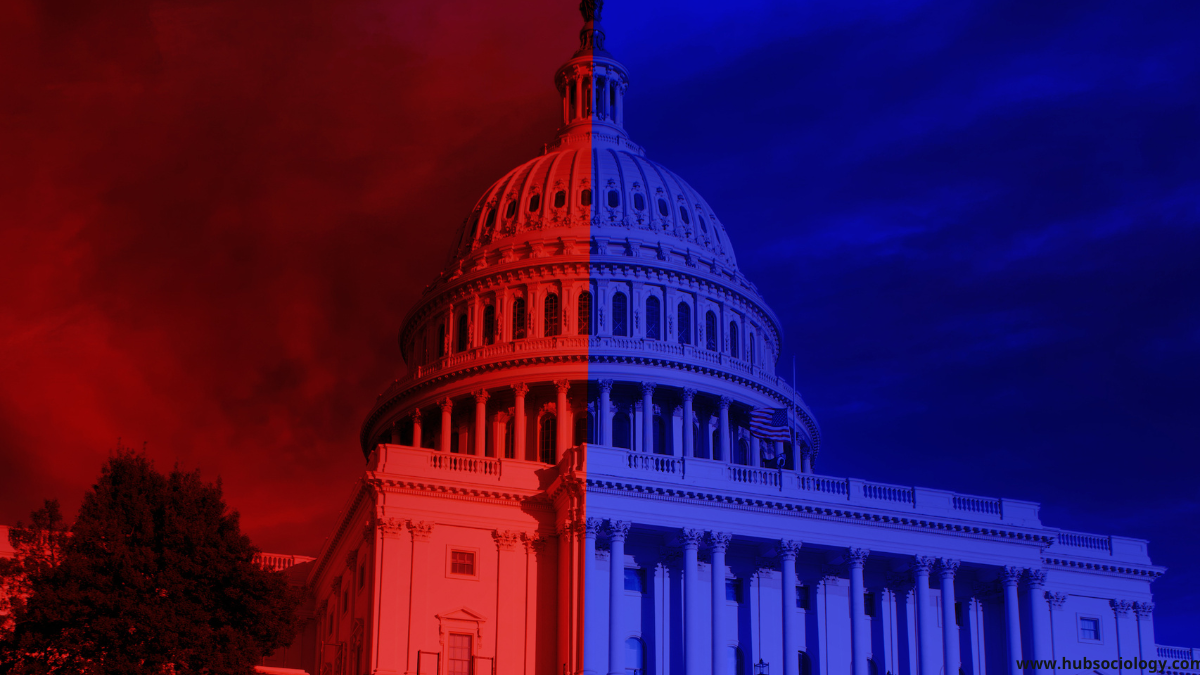
Introduction on Political Polarization and Democracy
Political polarization has become one of the most defining features of contemporary American society. While divisions between political parties have existed throughout U.S. history, the depth, emotional intensity, and social consequences of current polarization represent a significant departure from earlier patterns. Sociologists view polarization not merely as a political issue but as a complex social process involving identity formation, media ecosystems, cultural narratives, economic inequalities, and institutional changes. Understanding political polarization through a sociological lens helps explain how democracy functions—or malfunctions—in the United States today. This article explores the roots, mechanisms, and democratic implications of political polarization in U.S. society, emphasizing structural forces, cultural conflicts, and the role of social institutions.
1. Understanding Political Polarization Sociologically
In sociology, political polarization is defined as the increasing ideological distance and declining willingness of groups to compromise or engage in dialogue. It includes two central forms:
- Ideological Polarization – When political beliefs of conservatives and liberals move further apart.
- Affective Polarization – When people not only disagree but also dislike, distrust, or even dehumanize political opponents.
Sociologically, polarization is not simply about political positions but about identities. It merges with race, religion, class, geography, and lifestyle preferences. Political affiliation becomes an expression of who one is, rather than what one supports. This identity-based polarization intensifies social division because it embeds partisanship within personal, moral, and emotional frameworks.
2. Historical Roots of Political Polarization in U.S. Society
Although political disagreements have been part of American democracy since its founding, polarization intensified dramatically in the late 20th and early 21st centuries. Sociologists trace this to several long-term transformations.
a. The Realignment of Political Parties
The Democratic and Republican parties underwent significant ideological shifts beginning in the 1960s. The Civil Rights Movement and Southern Strategy reshaped racial and geographic bases of party support. Over time, the two parties sorted into ideologically homogeneous groups, reducing overlap and moderating forces.
b. Economic Inequality
Growing inequality since the 1970s has heightened feelings of resentment, insecurity, and distrust. Economic divisions started to overlap with cultural and political divisions, creating symbolic battles between “elites” and “ordinary people,” “cosmopolitans” and “locals,” or “globalists” and “nationalists.”
c. Cultural and Moral Conflicts
Issues such as abortion, LGBTQ+ rights, immigration, and gun ownership became central identity markers. These cultural conflicts are often framed in moral terms, making compromise difficult since parties view issues as existential rather than negotiable.
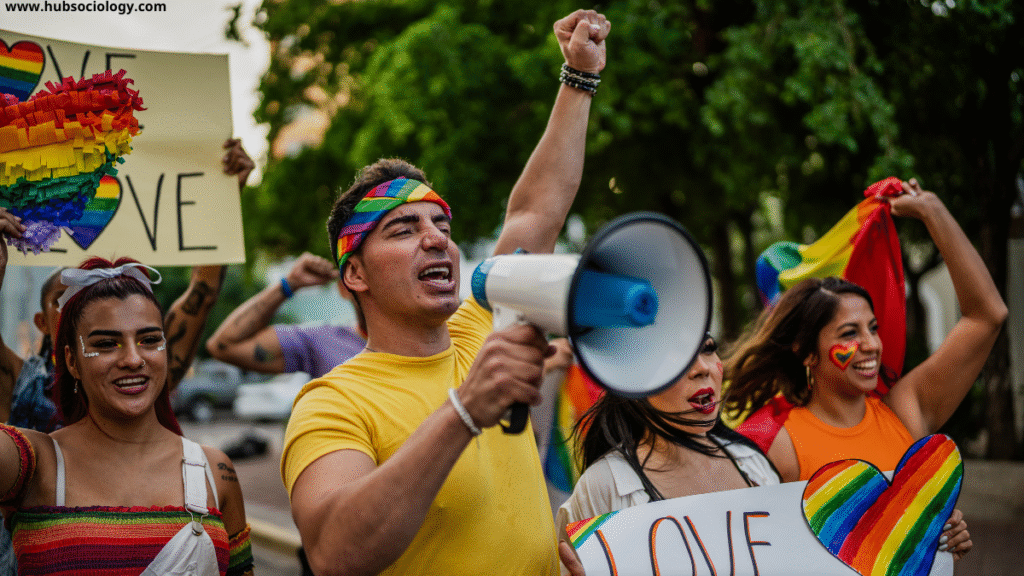
Know More about LGBTQ+ Movements – LGBTQ+ Rights Movement in U.S. Society
d. Media Fragmentation
The rise of cable news, political talk shows, social media, and algorithm-driven content has fragmented information ecosystems. Rather than receiving shared facts, Americans increasingly inhabit “echo chambers” that reinforce prior beliefs and demonize opponents.
3. Sociological Mechanisms Driving Political Polarization
Polarization is intensified by multiple social mechanisms that structure political life.
a. Social Identity and Group Belonging
According to Social Identity Theory, individuals derive self-worth from the groups they belong to. In the U.S., political parties have become powerful identity groups. People increasingly choose where to live, who to befriend, and even whom to marry based on political alignment—a phenomenon known as lifestyle sorting.
b. Echo Chambers and Information Silos
Digital platforms personalize content based on user behavior. Over time, individuals encounter only information aligned with their views and are shielded from alternative perspectives. This selective exposure reinforces extremism and increases dislike of other groups.
c. Moralization of Politics
Political issues have become moral battles. When politics becomes a “struggle between good and evil” rather than a debate about policy, compromise seems unethical. This moralization deepens affective polarization, as opponents are framed not only as wrong but morally corrupt.
d. Elite Rhetoric and Political Incentives
Political leaders often use polarizing language because it mobilizes supporters, attracts media attention, and reinforces loyalty. In congressional politics, gerrymandered districts reduce incentives for bipartisan cooperation, making polarization structurally embedded.
e. Economic and Class-Based Resentment
Sociologists highlight that polarization reflects divergent experiences of globalization, technological change, job loss, and wealth concentration. Communities left behind by economic restructuring may express frustration through populist or anti-establishment politics.
4. Impact of Political Polarization on U.S. Democracy
Political polarization has profound consequences for democratic functioning, civic participation, and trust in institutions.
a. Decline of Compromise and Bipartisanship
Democracy relies on negotiation, coalition-building, and compromise. When parties are polarized, legislative gridlock becomes common. Important issues—immigration, healthcare, climate change—remain unresolved for decades.
b. Erosion of Democratic Norms
Mutual toleration and institutional forbearance are essential democratic norms. But polarization weakens both:
- Parties question the legitimacy of opponents.
- Actions once considered extreme (e.g., government shutdowns, refusal to accept election results) become normalized.
- Institutions appear partisan rather than neutral.
c. Declining Trust in Institutions
Sociological research shows growing distrust in the media, courts, government, scientific institutions, and electoral systems. When trust erodes, conspiracy theories and misinformation flourish, weakening democratic stability.
d. Rise of Populism
Populist rhetoric thrives in polarized contexts. Leaders frame society as divided between “the people” and “the corrupt elite.” Populism can mobilize marginalized voices but can also undermine pluralism and democratic norms by rejecting disagreement as illegitimate.
e. Fragmentation of Social Cohesion
Shared national identity weakens when citizens view each other as opponents rather than fellow members of a political community. Polarization reduces civic friendship, weakens social bonds, and fosters intolerance toward outsiders.
f. Threats to Voting Legitimacy
Controversies over electoral integrity—accusations of fraud, gerrymandering, voter suppression, or biased counting—stem partly from deep mistrust fuelled by polarization. A functioning democracy requires acceptance of electoral outcomes; polarization undermines this foundation.
5. The Role of Media and Digital Platforms
Media plays a central role in shaping how people perceive political reality.
a. Partisan Media Ecosystems
Conservative and liberal media outlets present contrasting interpretations of events, often focusing on conflict and outrage. This “news siloing” fosters misinformation and emotional polarization.
b. Social Media Algorithms
Algorithms prioritize engagement, not truth. Content that triggers strong emotions—fear, anger, humor—is more likely to go viral. This environment amplifies extreme voices and marginalizes moderate ones.
c. Online Communities
Digital communities form around shared ideologies. These communities can support civic participation but can also radicalize individuals through constant reinforcement and lack of dissenting views.
d. Decline of Traditional Journalism
Economic pressures have weakened local news outlets, leaving communities dependent on national and partisan sources. The absence of local journalism reduces cross-cutting interactions and increases ideological isolation.
6. Intersectionality and Political Polarization
Polarization interacts with race, gender, class, and religion. U.S. political identities are intertwined with these social categories:
- Race: Polarization is strongly structured by racial divisions, particularly in debates about immigration, policing, and voting rights.
- Religion: The rise of the Christian Right and increasing secularization have intensified cultural polarization on moral issues.
- Class: Working-class and middle-class Americans often experience polarization differently, shaped by economic insecurity or cultural marginalization.
- Gender: Movements like #MeToo and debates around reproductive rights polarize gender identities and political alignments.
Polarization is not simply ideological; it reflects deeper structural inequalities and cultural conflicts.
7. Sociological Theories Explaining Political Polarization
Several sociological perspectives offer insights:
a. Conflict Theory
Polarization reflects struggles between groups competing for power, resources, and cultural dominance. Elites may fuel conflict to maintain influence or protect economic interests.
b. Symbolic Interactionism
Polarization emerges from meanings attached to political symbols—flags, slogans, identities. Everyday interactions reinforce boundaries between “us” and “them.”
c. Structural Functionalism
Polarization may indicate dysfunction in social institutions. When institutions fail to integrate diverse groups or manage conflict, society becomes unstable.
d. Network Theory
Social networks—both online and offline—shape information flows and create clusters of like-minded individuals. Homophily (preference for similar others) increases group polarization.
8. Is Polarization Always Bad for Democracy?
While often seen as harmful, sociologists recognize that polarization also has potential democratic benefits:
- It mobilizes citizen participation.
- It highlights real social inequalities and injustices.
- It energizes social movements, such as Black Lives Matter or climate activism.
- It forces public debate about moral and political issues.
However, polarization becomes harmful when:
- It delegitimizes opponents.
- It undermines institutions.
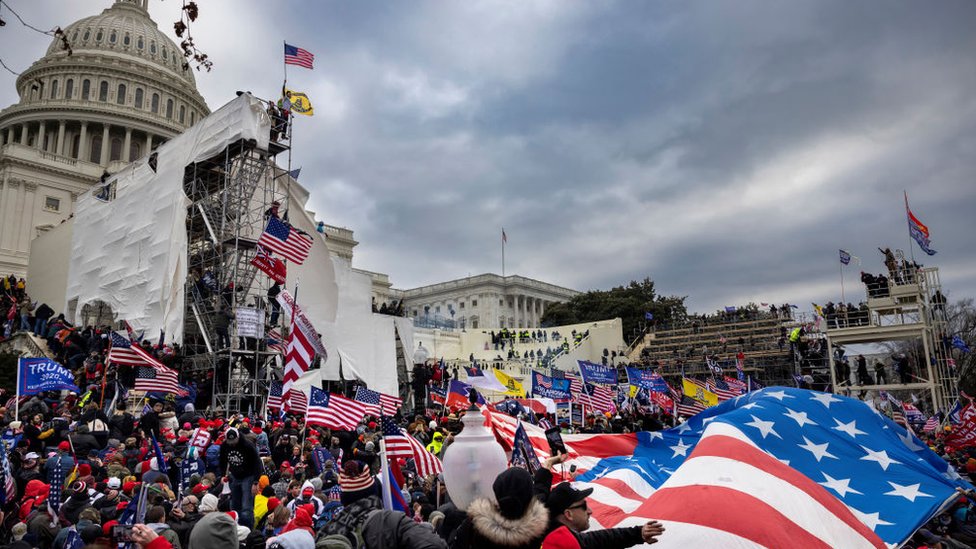
- It fosters violence or anti-democratic actions.
- It prevents compromise on issues essential to public welfare.
Thus, democracy requires a balance: enough conflict to represent diverse interests, but enough cohesion to sustain institutions.
9. How Can U.S. Democracy Respond to Political Polarization?
Sociologists propose several pathways to reduce harmful polarization:
a. Strengthening Civic Education
Civic education can foster critical thinking, empathy, and democratic participation. Programs that emphasize deliberation and respectful dialogue help citizens navigate differences.
b. Reforming Political Institutions
Changes such as independent redistricting commissions, ranked-choice voting, or multi-member districts may reduce incentives for extremism.
c. Supporting Local Journalism
Local news encourages cross-cutting exposure and reduces dependence on polarized national outlets.
d. Digital Platform Regulation
Efforts to reduce misinformation, increase transparency, and modify algorithms could limit the spread of polarizing content.
e. Promoting Intergroup Dialogue
Community organizations, religious groups, and schools can create spaces for constructive dialogue across political differences.
f. Addressing Inequality
Reducing economic inequality, improving healthcare access, and strengthening social safety nets can reduce resentment and the appeal of polarizing rhetoric.
10. The Future of Democracy in a Polarized America
Political polarization is unlikely to disappear entirely, given the diversity and complexity of U.S. society. However, its direction and intensity will shape the future of American democracy.
If polarization continues to deepen, the U.S. may face:
- Increasing institutional gridlock
- More contested elections
- Declining trust in democratic processes
- Rising political violence
- Fragmentation of social cohesion
Alternatively, polarization could stimulate reforms, innovation, and new forms of democratic participation. Young Americans, more diverse and digitally connected, may forge new political identities less tied to traditional party structures.
Ultimately, the resilience of U.S. democracy will depend on the ability of institutions and citizens to negotiate differences while upholding democratic norms.
Conclusion on Political Polarization and Democracy
Political polarization in the United States is a sociological phenomenon deeply rooted in historical, cultural, economic, and institutional forces. It extends beyond political disagreement to encompass identity, morality, and social belonging. While polarization can energize political engagement, it also threatens democratic norms, institutional trust, and social cohesion. Sociological perspectives reveal that polarization is not merely a failure of politics but a reflection of broader transformations in American society—media fragmentation, inequality, identity politics, and shifting values.
Addressing polarization requires a combination of institutional reforms, civic engagement, economic justice, and cultural understanding. The future of American democracy depends on rebuilding trust, fostering dialogue, and strengthening the social foundations that enable diverse groups to share a democratic space.
FAQs on Political Polarization and Democracy
1. What is political polarization in U.S. sociology?
Political polarization refers to the growing ideological and emotional distance between political groups, especially Democrats and Republicans, driven by identity, media, and social conditions.
2. What is affective polarization?
Affective polarization is when citizens not only disagree with the opposing party but also distrust, dislike, or view them as morally wrong.
3. How does media contribute to political polarization?
Fragmented media ecosystems, partisan news, and social media algorithms reinforce ideological bubbles, increasing division and limiting shared factual understanding.
4. What sociological factors led to polarization in the U.S.?
Key factors include racial and regional realignment, economic inequality, cultural conflicts, identity politics, and institutional changes over decades.
5. How does political polarization threaten democracy?
It undermines compromise, delegitimizes institutions, fosters misinformation, increases hostility, and weakens citizens’ trust in democratic processes.
6. What role does identity play in polarization?
Political identity now overlaps with race, religion, gender, and lifestyle, transforming politics into a social identity rather than just policy preference.
7. How does economic inequality influence polarization?
Rising inequality fuels resentment and divides communities along class lines, allowing political actors to exploit economic frustration for partisan gain.
8. What is the impact of polarization on policymaking?
Polarization leads to legislative gridlock, preventing bipartisan cooperation on issues such as healthcare, immigration, and climate change.
9. Can political polarization ever benefit democracy?
Yes. Polarization can mobilize participation, highlight injustices, and fuel important social movements—if it does not undermine democratic norms.
10. How does social media intensify affective polarization?
By prioritizing emotionally charged content, social media amplifies outrage, reduces exposure to diverse opinions, and encourages moralized views.
11. How is polarization connected to race and ethnicity?
U.S. political divisions are strongly shaped by racial inequalities, civil rights history, immigration debates, and differing experiences with state institutions.
12. What institutional reforms can reduce polarization?
Reforms like independent redistricting, ranked-choice voting, stronger civic education, and healthier media ecosystems can reduce structural incentives for division.
13. What is lifestyle sorting and why does it matter?
Lifestyle sorting occurs when people choose neighborhoods, schools, relationships, and workplaces aligned with their political views, deepening social homogeneity.
14. How does polarization impact election legitimacy?
High distrust leads to accusations of fraud, contested results, and declining acceptance of electoral outcomes—dangerous for democratic stability.
15. What can individuals do to reduce polarization?
Practicing empathy, consuming diverse media sources, engaging in respectful dialogue, and supporting community-based initiatives can reduce affective division.
2 thoughts on “Political Polarization and Democracy in U.S. Sociology”