
Introduction
Masculinity and gender roles have long occupied a central place in sociological debates about identity, power, inequality, and social change. In American culture, masculinity is not merely a biological attribute associated with men but a socially constructed set of expectations, behaviors, and norms that shape how individuals understand themselves and relate to others. These expectations influence family life, education, work, politics, media representation, and even mental health.
From the ideal of the self-reliant breadwinner to contemporary discussions of emotional vulnerability and gender fluidity, masculinity in the United States has undergone significant transformations. A sociological examination reveals that masculinity is neither fixed nor universal; instead, it is historically produced, culturally regulated, and deeply intertwined with structures of power such as class, race, and sexuality.
This article explores masculinity and gender roles in American culture from a sociological perspective. It examines the historical evolution of masculine ideals, theoretical approaches to masculinity, the role of institutions in shaping gender roles, and the challenges facing traditional masculinity in contemporary American society.

Sociological Understanding of Masculinity
In sociology, masculinity is understood as a social construct rather than a natural or purely biological reality. While biological sex refers to physical differences between males and females, gender refers to the meanings, roles, and expectations societies attach to those differences. Masculinity, therefore, is a pattern of practices through which men and boys are expected to behave in ways considered appropriate within a given cultural context.
One influential concept in this field is “hegemonic masculinity,” developed by R. W. Connell. Hegemonic masculinity refers to the culturally dominant ideal of manhood that legitimizes male dominance and justifies the subordination of women and alternative masculinities. In the American context, this ideal has often emphasized traits such as strength, independence, competitiveness, emotional restraint, and heterosexuality. Importantly, most men do not fully embody this ideal, yet it remains powerful in shaping social norms and expectations.
Masculinity is also relational. It gains meaning in contrast to femininity and is reinforced through social interactions. Men are often encouraged to distance themselves from traits culturally labeled as feminine, such as emotional expressiveness or dependence, which further reinforces rigid gender boundaries.
Historical Evolution of Masculinity in American Culture
Masculine ideals in the United States have changed significantly over time. In the early colonial and agrarian periods, masculinity was closely linked to physical labor, land ownership, and patriarchal authority within the family. Men were expected to be providers and moral leaders, while women were associated with domestic and caregiving roles.
The rise of industrial capitalism in the nineteenth century transformed gender roles. As work moved out of the household and into factories and offices, masculinity became increasingly associated with wage labor and public life. The “breadwinner model” emerged as a dominant masculine ideal, positioning men as economic providers and women as homemakers. This model reinforced a sharp division between the public and private spheres, a theme widely analyzed by feminist sociologists.
In the mid-twentieth century, particularly after World War II, American masculinity was strongly tied to stability, family responsibility, and national strength. The suburban nuclear family became a symbol of successful masculinity, supported by steady employment and home ownership. However, this ideal was largely accessible only to white, middle-class men, highlighting the role of race and class in shaping masculine norms.
From the late twentieth century onward, social movements such as feminism, civil rights activism, and LGBTQ+ movements challenged traditional gender roles. Economic restructuring, deindustrialization, and the rise of service-sector employment also weakened the breadwinner model. As a result, masculinity in America entered a period of uncertainty and renegotiation.
Institutions and the Socialization of Masculinity
Masculinity is produced and reproduced through key social institutions, including the family, education system, media, religion, and the workplace. These institutions play a crucial role in gender socialization, the process by which individuals learn and internalize societal norms.
In the family, boys are often socialized differently from girls from an early age. They may be encouraged to be assertive, independent, and emotionally tough, while emotional vulnerability is discouraged. Such patterns reinforce the idea that masculinity requires control over emotions, which can have long-term consequences for men’s mental health.
Schools also contribute to the construction of masculinity. Sports culture, peer interactions, and disciplinary practices often reward aggressive or competitive behavior among boys while penalizing traits associated with sensitivity or cooperation. Sociological studies show that boys who do not conform to dominant masculine norms may face bullying or social exclusion.
The media plays a particularly powerful role in shaping images of masculinity in American culture. Films, television, advertising, and digital platforms frequently portray men as strong, dominant, sexually assertive, and emotionally distant. Although recent media representations have become more diverse, traditional masculine stereotypes remain influential, especially in action films, sports coverage, and political imagery.
Masculinity, Power, and Inequality
From a sociological perspective, masculinity is closely linked to power relations. Patriarchy, a system in which men collectively hold more power than women, is sustained in part through dominant masculine norms. Traditional masculinity often legitimizes male authority in politics, the economy, and the family, while marginalizing women and non-conforming men.
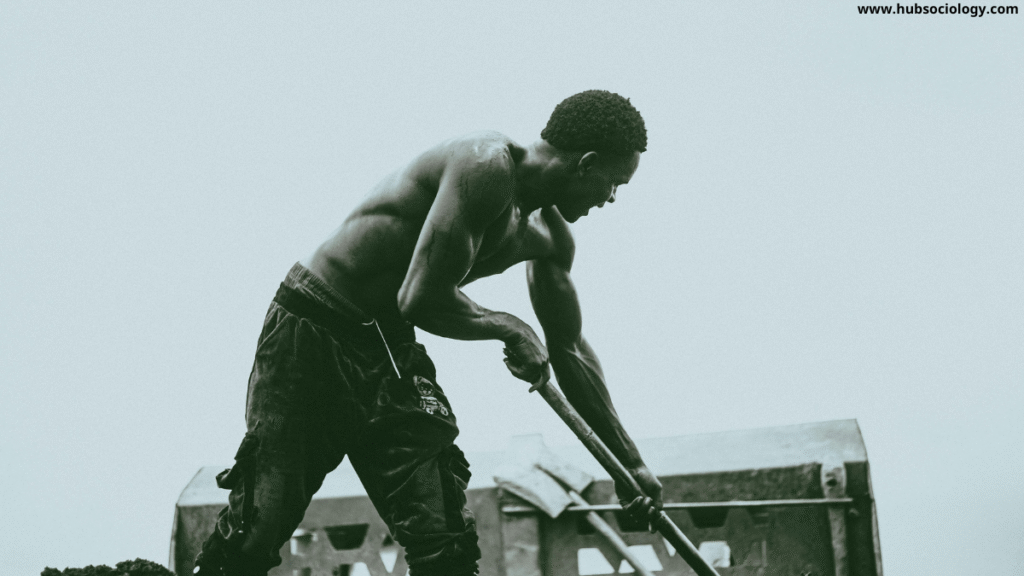
However, not all men benefit equally from dominant masculinity. Sociologists emphasize the existence of multiple masculinities shaped by race, class, ethnicity, and sexuality. For example, African American masculinity has been historically shaped by racism, economic exclusion, and criminalization, producing experiences and expressions of masculinity that differ from white, middle-class norms. Similarly, working-class masculinity often emphasizes physical strength and resilience in response to economic insecurity.
Sexuality is another critical dimension. Heteronormativity has long been a core component of dominant masculinity in America. Gay, bisexual, and transgender men have frequently been stigmatized for challenging traditional gender norms. The growing visibility of LGBTQ+ communities has expanded the range of acceptable masculine identities, but social resistance and discrimination persist.
Crisis and Transformation of Masculinity
In recent decades, scholars and commentators have spoken of a “crisis of masculinity” in American culture. This notion reflects anxieties about changing gender roles, declining male dominance in certain areas, and shifting expectations of men. Economic changes, such as job losses in manufacturing and increased participation of women in the workforce, have challenged traditional provider roles.
At the same time, cultural conversations around masculinity have intensified. Issues such as male mental health, emotional expression, fatherhood, and toxic masculinity have entered public discourse. The term “toxic masculinity” is used to describe aspects of traditional masculinity that promote aggression, emotional suppression, and dominance, often harming both men and women.
Sociologically, this moment can be understood not simply as a crisis but as a transformation. Masculinity is being renegotiated in response to broader social changes. New models of manhood emphasize emotional openness, caregiving, gender equality, and respect for diversity. These alternative masculinities challenge the idea that strength and vulnerability are incompatible.
Masculinity and Gender Roles in Contemporary America
In contemporary American society, gender roles are more fluid than in the past, yet inequalities remain. Many men now participate actively in domestic labor and childcare, challenging traditional divisions of labor. However, women still perform a disproportionate share of unpaid care work, indicating that changes in masculinity have been uneven.
Workplace cultures are also evolving. While leadership has traditionally been associated with masculine traits such as assertiveness and authority, there is growing recognition of the value of collaboration, empathy, and emotional intelligence. These shifts suggest a gradual redefinition of what counts as “masculine” success.
At the cultural level, younger generations are increasingly questioning rigid gender norms. Social media has provided spaces for alternative expressions of masculinity, allowing men to share experiences related to mental health, identity, and vulnerability. From a sociological standpoint, these developments highlight the dynamic and contested nature of gender roles in American culture.
Conclusion
Masculinity and gender roles in American culture cannot be understood as static or purely individual phenomena. They are deeply social, shaped by historical forces, institutional practices, and power relations. Sociology reveals that masculinity is constructed, maintained, and transformed through everyday interactions and structural conditions.

While traditional models of masculinity have emphasized dominance, emotional restraint, and economic provision, these ideals are increasingly being challenged by social change. The diversification of masculine identities reflects broader struggles over gender equality, social justice, and cultural meaning. Understanding masculinity sociologically allows us to see not only how gender roles constrain individuals but also how they can be reshaped to promote more inclusive and equitable social relations.
In this sense, the study of masculinity is not simply about men; it is about society as a whole and the possibilities for creating a culture in which gender roles no longer limit human potential.
Frequently Asked Questions
1. What are gender roles in American culture?
Gender roles in American culture refer to socially constructed expectations about behaviors, responsibilities, and identities considered appropriate for men and women within society.
2. How have gender roles in American culture changed over time?
Gender roles in American culture have shifted from rigid, traditional divisions of labor toward more flexible and egalitarian roles due to industrialization, feminism, and social movements.
3. Why are gender roles in American culture considered social constructs?
Sociologists view gender roles in American culture as social constructs because they are shaped by social norms, institutions, and historical contexts rather than biology alone.
4. How do gender roles in American culture affect masculinity?
Gender roles in American culture often define masculinity in terms of strength, independence, and emotional control, influencing how men perceive themselves and others.
5. What is the role of family in shaping gender roles in American culture?
The family plays a key role in shaping gender roles in American culture by socializing children into expected masculine and feminine behaviors from an early age.
6. How does education reinforce gender roles in American culture?
Schools may reinforce gender roles in American culture through classroom interactions, sports culture, disciplinary practices, and gendered expectations of behavior.
7. What role does media play in gender roles in American culture?
Media significantly shapes gender roles in American culture by portraying stereotypical images of men and women that influence public perceptions and identity formation.
8. How are gender roles in American culture linked to power and inequality?
Gender roles in American culture often support patriarchal power structures that privilege men over women and marginalize non-conforming gender identities.
9. Do gender roles in American culture affect men negatively?
Yes, rigid gender roles in American culture can negatively affect men by discouraging emotional expression, increasing stress, and limiting acceptable identities.
10. How do race and class influence gender roles in American culture?
Gender roles in American culture vary across race and class, with different communities experiencing distinct expectations shaped by economic conditions and social inequalities.
11. What is hegemonic masculinity in relation to gender roles in American culture?
Hegemonic masculinity refers to the dominant form of masculinity that reinforces traditional gender roles in American culture and legitimizes male dominance.
12. How has feminism impacted gender roles in American culture?
Feminism has challenged traditional gender roles in American culture by advocating gender equality, workplace rights, and shared domestic responsibilities.
13. Are gender roles in American culture becoming more flexible today?
Yes, gender roles in American culture are becoming more flexible, especially among younger generations, though traditional norms still persist.
14. How do gender roles in American culture influence the workplace?
Gender roles in American culture influence hiring, leadership styles, wage gaps, and expectations about work-life balance for men and women.
15. Why is it important to study gender roles in American culture sociologically?
Studying gender roles in American culture sociologically helps understand inequality, identity formation, and the possibilities for social change and gender justice.