
Introduction
The idea of a “post-racial society” gained global attention in the early twenty-first century, particularly after the election of Barack Obama as President of the United States in 2008. Many commentators claimed that America had finally moved beyond race, discrimination, and structural inequality. According to this view, race no longer significantly shaped social opportunities, political power, or everyday interactions. Instead, merit, individual effort, and shared national identity were believed to dominate social life.
However, sociology approaches such claims with caution. Sociologists emphasize that race is not merely about individual prejudice but is deeply embedded in social institutions, power relations, historical legacies, and cultural meanings. This article critically examines whether America can truly be described as a post-racial society by analyzing racial inequality, structural racism, political discourse, cultural narratives, and everyday social realities.
:max_bytes(150000):strip_icc()/BarackObama-799035cd446c443fb392110c01768ed0.jpg)
Understanding the Concept of a Post-Racial Society
A post-racial society is commonly defined as a social order in which race no longer plays a significant role in determining life chances, social status, or access to power. In such a society, racial identities may exist culturally, but they do not produce systematic inequality or discrimination.
From a sociological perspective, this concept is controversial. Race is understood not as a biological fact but as a social construct that has been historically used to justify unequal treatment, exploitation, and exclusion. Sociologists argue that for a society to be genuinely post-racial, it must dismantle not only overt racism but also the structural systems that reproduce racial inequality across generations.
Historical Roots of Racial Inequality in America
To assess whether America is post-racial, it is essential to consider its historical foundations. American society was shaped by slavery, settler colonialism, segregation, and racial exclusion. The legacy of slavery did not end with abolition; it continued through Jim Crow laws, racial violence, housing segregation, and unequal education.
Even after the victories of the Civil Rights Movement, racial inequality persisted in more subtle and institutionalized forms. Sociologists emphasize that history matters because social structures created in the past continue to shape present outcomes. Wealth gaps, neighborhood segregation, and educational disparities are not accidental but rooted in long-standing racial policies and practices.
Structural Racism and Institutional Inequality
One of the strongest sociological arguments against the post-racial claim is the persistence of structural racism. Structural racism refers to the ways in which social institutions—such as education, healthcare, housing, policing, and the labor market—systematically disadvantage certain racial groups.

In education, schools serving predominantly minority communities often receive fewer resources, have overcrowded classrooms, and face higher dropout rates. In the labor market, racial minorities frequently encounter wage gaps, employment discrimination, and limited access to high-paying jobs. Housing patterns remain racially segregated, affecting access to quality schools, healthcare, and safe environments.
These inequalities exist even in the absence of explicit racist intent, demonstrating that racism is embedded in social systems rather than solely in individual attitudes.
Race, Policing, and the Criminal Justice System
The criminal justice system provides another crucial lens for evaluating the post-racial claim. Sociological research consistently shows that racial minorities, particularly African Americans, are disproportionately targeted by law enforcement, more likely to be arrested, and receive harsher sentences compared to white Americans for similar offenses.
Mass incarceration has become a defining feature of modern American society, with profound racial implications. The overrepresentation of minority groups in prisons reinforces social exclusion, economic marginalization, and political disenfranchisement. These patterns suggest that race continues to play a central role in state power and social control.
Political Representation and the Illusion of Equality
The election of minority leaders is often cited as evidence of a post-racial America. While symbolic representation is important, sociology distinguishes between symbolic progress and structural transformation. The presence of individuals from marginalized groups in elite positions does not necessarily eliminate systemic inequality.
Political institutions may become more diverse while still operating within frameworks that disadvantage racial minorities. Moreover, racialized voting patterns, voter suppression efforts, and unequal political influence reveal that race remains deeply intertwined with political power in America.
Media, Culture, and Racial Narratives
Cultural representations play a significant role in shaping public perceptions of race. Media narratives often promote the idea that America has moved beyond racism, emphasizing individual success stories while ignoring structural barriers. This creates what sociologists describe as “color-blind ideology,” which downplays race and frames inequality as a result of personal failure rather than systemic injustice.
Popular culture may celebrate diversity while simultaneously reinforcing stereotypes and racial hierarchies. These contradictions highlight how race operates subtly through symbols, language, and representation, even when explicit racism is publicly condemned.
Color-Blind Racism and Denial of Inequality
One of the most influential sociological critiques of the post-racial idea is the concept of color-blind racism. This ideology argues that ignoring race is the best way to achieve equality. However, sociologists contend that refusing to acknowledge race actually allows racial inequality to persist unchallenged.
Color-blind discourse often opposes policies like affirmative action by framing them as unfair advantages, while ignoring the historical and structural disadvantages faced by racial minorities. In this sense, the post-racial narrative can function as a tool that legitimizes inequality rather than eliminating it.
Economic Inequality and Racial Stratification
Economic data further challenge the notion of a post-racial society. Wealth inequality between racial groups remains substantial, with minority households possessing significantly less wealth than white households. This gap affects access to education, healthcare, housing, and intergenerational mobility.
Sociologists emphasize that wealth is more important than income because it provides long-term security and opportunities. Racial wealth gaps are the result of historical exclusion from property ownership, credit access, and economic resources, making them difficult to erase through individual effort alone.
Intersectionality: Race, Class, and Gender
Modern sociological analysis also highlights the importance of intersectionality—the idea that race interacts with class, gender, and other social identities to produce complex forms of inequality. Experiences of race are not uniform; they vary depending on socioeconomic status, gender, immigration status, and geographic location.
For example, middle-class racial minorities may experience less economic hardship but still face discrimination in professional and social settings. Women of color often confront both racial and gender-based inequalities simultaneously. These intersecting forms of disadvantage contradict the simplicity of the post-racial narrative.
Everyday Racism and Social Interaction
Beyond institutions, race continues to shape everyday social interactions. Microaggressions, implicit bias, and racial profiling affect daily life for many Americans. These experiences may appear minor individually, but collectively they contribute to psychological stress, social exclusion, and diminished well-being.
Sociologists argue that everyday racism reveals how deeply race is embedded in social consciousness. Even when people consciously reject racist beliefs, unconscious biases and cultural stereotypes continue to influence behavior.
The Role of Social Movements
The emergence of contemporary racial justice movements demonstrates that race remains a central social issue. These movements highlight police violence, economic inequality, and systemic discrimination, challenging claims that America has moved beyond race.
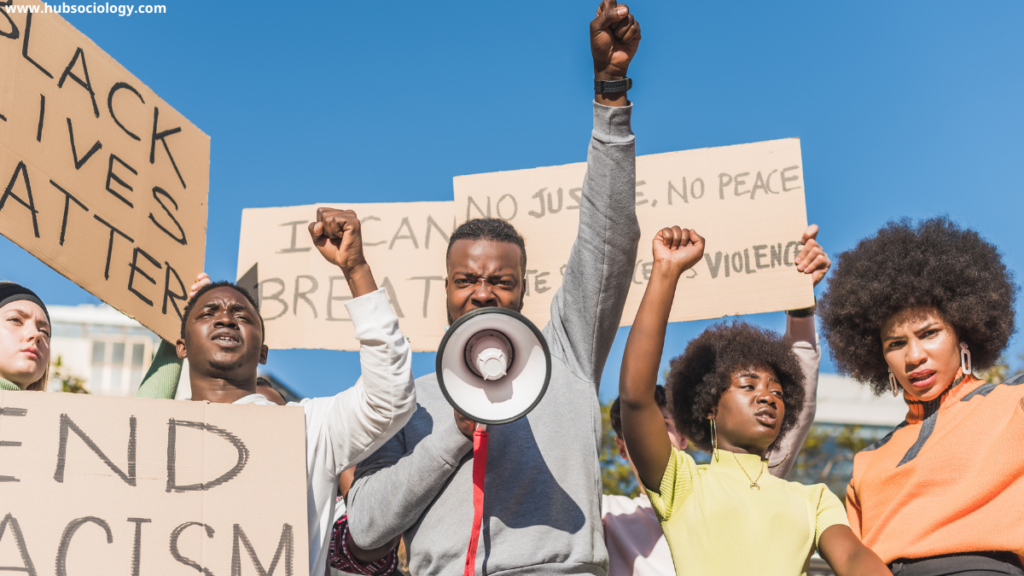
From a sociological standpoint, the existence of widespread racial activism suggests that large segments of the population experience ongoing racial injustice. Social movements often arise not in post-racial contexts but in societies where inequality remains deeply entrenched.
Is America Moving Toward a Post-Racial Future?
While America has made undeniable progress in reducing formal racial discrimination, sociology suggests that progress should not be confused with completion. The decline of overt racism does not mean the disappearance of racial inequality. Instead, racism has evolved, becoming more subtle, institutional, and difficult to confront.
A truly post-racial society would require structural reforms in education, housing, healthcare, criminal justice, and economic policy. It would also demand a collective willingness to confront historical injustice rather than deny its ongoing consequences.
Conclusion
From a sociological perspective, America cannot yet be described as a post-racial society. Although significant advances have been made in legal equality and representation, race continues to shape social outcomes, institutional practices, and everyday experiences. The post-racial narrative often obscures structural inequalities and discourages meaningful engagement with racial injustice.
Rather than asking whether America is post-racial, sociology encourages a more critical question: how can American society address the deep-rooted racial structures that continue to produce inequality? Only by acknowledging and confronting these realities can the possibility of a genuinely equitable society emerge.
Frequently Asked Questions (FAQs): Post-Racial Society
1. What is meant by a Post-Racial Society?
A Post-Racial Society refers to a social condition where race no longer plays a significant role in determining social status, opportunities, or life chances, and racial discrimination is minimal or absent.
2. Why did the idea of a Post-Racial Society become popular in America?
The idea gained popularity after major symbolic events, such as the election of minority leaders, which led many to believe that racial barriers in American society had largely disappeared.
3. Is America truly a Post-Racial Society?
From a sociological perspective, America is not a Post-Racial Society, as racial inequality continues to exist in areas like education, employment, housing, and criminal justice.
4. How do sociologists define a Post-Racial Society?
Sociologists define a Post-Racial Society as one where race does not influence institutional structures, social interactions, or access to power—conditions that are not fully met in contemporary America.
5. What is the difference between Post-Racial Society and color-blind ideology?
A Post-Racial Society implies the absence of racial inequality, while color-blind ideology ignores race altogether, often masking ongoing structural racism rather than eliminating it.
6. Does the decline of overt racism mean society is post-racial?
No, the decline of open or explicit racism does not mean a Post-Racial Society exists, because racism can persist in subtle, institutional, and systemic forms.
7. How does structural racism challenge the idea of a Post-Racial Society?
Structural racism shows that even without racist individuals, institutions can still produce unequal outcomes, proving that society has not reached a Post-Racial stage.
8. Can symbolic representation create a Post-Racial Society?
Symbolic representation alone cannot create a Post-Racial Society unless it is accompanied by deep structural changes that address long-standing racial inequalities.
9. What role does economic inequality play in debates on Post-Racial Society?
Economic inequality highlights persistent racial wealth gaps, suggesting that America lacks the economic equality necessary to be considered a Post-Racial Society.
10. How does the criminal justice system affect the Post-Racial Society argument?
Racial disparities in policing, sentencing, and incarceration indicate that race still shapes state power, contradicting claims of a Post-Racial Society.
11. What is everyday racism, and why does it matter?
Everyday racism includes microaggressions and implicit bias, which demonstrate that racial consciousness continues to shape daily life even in societies claiming to be post-racial.
12. How do social movements question the idea of a Post-Racial Society?
The rise of racial justice movements suggests that many citizens experience ongoing racial injustice, challenging the belief that society has moved beyond race.
13. Can education help in achieving a Post-Racial Society?
Education can play a crucial role by promoting critical awareness of race, history, and inequality, but it must be paired with institutional reforms.
14. Is a Post-Racial Society possible in the future?
Sociologists argue that a Post-Racial Society is possible only through sustained efforts to dismantle structural inequality and confront historical injustices.
15. Why is the concept of Post-Racial Society controversial in sociology?
The concept is controversial because it often overlooks systemic racism and can be used to deny or minimize real experiences of racial inequality.