Introduction
Alaska occupies a unique position in the social geography of the United States. Vast in territory, extreme in climate, and rich in natural resources, it is also home to some of the oldest Indigenous communities in North America. The Indigenous peoples of Alaska—often collectively referred to as Alaska Natives—have maintained distinct social systems, cultural practices, and worldviews that are deeply rooted in land, kinship, and collective survival. From a sociological perspective, the study of Indigenous communities in Alaska offers valuable insights into social organization, identity, inequality, cultural resilience, and the effects of colonialism and modernization.
Understanding Indigenous social life in Alaska requires moving beyond stereotypes and romanticized narratives. It involves examining how traditional institutions interact with modern state structures, how communities adapt to economic and environmental change, and how social life is shaped by both continuity and disruption. This article explores Indigenous communities and social life in Alaska through key sociological themes such as kinship, subsistence economy, culture, colonial impact, social stratification, education, health, and contemporary challenges.

Indigenous Peoples of Alaska: A Social Overview
Alaska is home to diverse Indigenous groups, including the Inupiat, Yupik, Aleut, Athabaskan, Tlingit, Haida, and Tsimshian. Each group possesses its own language, customs, and social traditions, shaped by geography and ecological conditions.
Sociologically, these communities are not homogeneous. Coastal societies traditionally developed social systems based on marine resources, while interior groups depended more on hunting and fishing in forest and river ecosystems. Despite differences, most Indigenous societies in Alaska emphasize communal living, collective responsibility, and strong kinship bonds. Social identity is closely tied to ancestry, clan membership, and connection to land rather than individual achievement.
Kinship and Social Organization
Kinship forms the foundation of Indigenous social life in Alaska. Extended family networks often function as primary social institutions, providing emotional support, economic cooperation, and cultural transmission. Unlike nuclear family models common in Western societies, Indigenous kinship systems emphasize interdependence among relatives across generations.
From a functionalist perspective, kinship ensures social stability and continuity. Elders hold respected positions as knowledge keepers, storytellers, and moral guides. Children are socialized not only by parents but by grandparents, aunts, uncles, and the broader community. This collective child-rearing system strengthens social cohesion and reinforces shared values.
Clan systems, particularly among Southeast Alaska Native groups, play an important role in regulating marriage, leadership, and conflict resolution. These social structures create a sense of belonging and define social responsibilities, illustrating how traditional institutions continue to organize social life even in modern contexts.
Subsistence Economy and Social Life
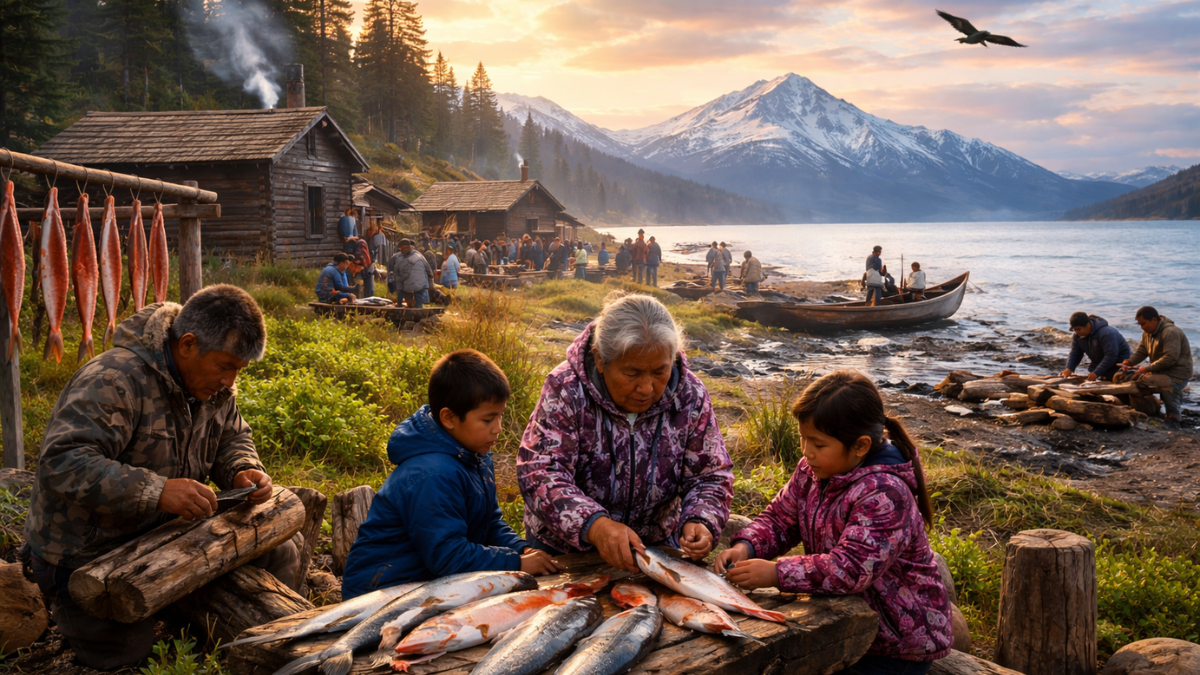
The subsistence economy is central to Indigenous social life in Alaska. Hunting, fishing, and gathering are not merely economic activities; they are social practices embedded with cultural meaning. Sharing food within the community reinforces social bonds and redistributes resources, reducing inequality.

From a sociological lens, subsistence activities represent an alternative economic system that contrasts sharply with capitalist market economies. Rather than profit maximization, the guiding principles are sustainability, reciprocity, and respect for nature. The act of sharing harvested food strengthens social solidarity and reinforces moral obligations among community members.
However, modernization and state regulations have increasingly affected subsistence lifestyles. Restrictions on hunting and fishing, climate change, and industrial development have disrupted traditional practices, leading to tensions between Indigenous communities and external authorities. These changes highlight conflicts between traditional social systems and modern economic structures.
Culture, Language, and Social Identity
Culture plays a crucial role in shaping social identity among Indigenous communities in Alaska. Language, oral traditions, ceremonies, and artistic expressions such as carving, weaving, and dance are essential means of preserving collective memory and social values.
Symbolic interactionism helps explain how cultural symbols and rituals contribute to identity formation. Through storytelling and ceremonial practices, individuals learn who they are, where they come from, and how they relate to others. Cultural participation reinforces a sense of pride and resistance against historical marginalization.
Language loss, however, poses a serious challenge. Many Indigenous languages in Alaska are endangered due to decades of assimilation policies and the dominance of English. Sociologically, language loss is not merely a communication issue; it represents a breakdown in cultural transmission and social continuity. In response, language revitalization programs have emerged as important social movements aimed at reclaiming identity and cultural autonomy.
Colonialism and Social Disruption
The social life of Indigenous communities in Alaska has been profoundly shaped by colonialism. Russian and later American expansion introduced new political, economic, and religious systems that disrupted traditional social structures. Missionary schools, forced assimilation, and relocation policies weakened kinship systems and cultural practices.
Conflict theory provides a useful framework for understanding these processes. Colonialism created power imbalances that benefited external groups while marginalizing Indigenous populations. Land dispossession, resource exploitation, and political exclusion contributed to long-term social inequality.
The legacy of colonialism is evident in contemporary social issues such as poverty, unemployment, substance abuse, and intergenerational trauma. These problems should not be viewed as cultural deficiencies but as structural outcomes of historical oppression. Sociological analysis emphasizes the importance of addressing these issues through systemic change rather than individual blame.
Education and Social Change
Education has been a double-edged institution for Indigenous communities in Alaska. Historically, formal education systems were tools of assimilation, discouraging Indigenous languages and cultural practices. Many elders recall experiences of discrimination and cultural erasure in boarding schools.
In recent decades, however, education has become a site of resistance and empowerment. Culturally responsive schooling and tribal colleges aim to integrate Indigenous knowledge with modern education. Sociologically, this represents a shift toward decolonizing education and reclaiming control over socialization processes.
Education also plays a key role in social mobility. While access to higher education has increased, structural barriers such as geographic isolation and economic inequality continue to limit opportunities for many Indigenous youth. The tension between preserving cultural identity and pursuing economic advancement remains a central social dilemma.
Health, Well-Being, and Community Life
Health and well-being are deeply interconnected with social life in Indigenous communities. Traditional concepts of health emphasize balance among physical, emotional, spiritual, and environmental dimensions. Community well-being is often prioritized over individual health.
Despite this holistic worldview, Indigenous communities in Alaska face significant health disparities. Higher rates of chronic illness, mental health challenges, and limited access to healthcare services reflect broader patterns of social inequality. Rural isolation and underfunded infrastructure exacerbate these problems.
From a sociological standpoint, health disparities are social rather than purely medical issues. They result from unequal access to resources, historical trauma, and ongoing marginalization. Community-based health initiatives that incorporate traditional knowledge have shown promise in addressing these challenges.
Gender Roles and Social Relations
Gender roles in Indigenous communities in Alaska have traditionally been complementary rather than strictly hierarchical. Men and women often held distinct but equally valued responsibilities within the social and economic system. Women played central roles in family organization, cultural transmission, and community leadership.

Colonial influences and modern economic changes have altered gender relations, sometimes reinforcing patriarchal norms unfamiliar to traditional societies. Sociological analysis reveals how external power structures reshaped internal social dynamics, often to the detriment of women’s status.
Today, Indigenous women in Alaska are at the forefront of social activism, cultural preservation, and political advocacy. Their leadership challenges stereotypes and highlights the dynamic nature of Indigenous social life.
Contemporary Challenges and Social Resilience
Indigenous communities in Alaska face numerous contemporary challenges, including climate change, economic marginalization, and cultural erosion. Melting ice, changing wildlife patterns, and environmental degradation directly threaten subsistence lifestyles and community stability.
Yet, resilience is a defining feature of Indigenous social life. Community organizing, legal activism, and cultural revitalization movements demonstrate the capacity to adapt while preserving core values. Sociologically, resilience emerges from strong social networks, shared identity, and collective memory.
The Alaska Native Claims Settlement Act reshaped land ownership and economic organization, introducing corporate structures into Indigenous societies. While controversial, it illustrates how communities negotiate modern institutions while seeking to protect collective interests.
Conclusion
From a sociological perspective, Indigenous communities and social life in Alaska represent a complex interplay between tradition and change. Kinship systems, subsistence economies, cultural practices, and collective values continue to shape daily life, even as communities navigate the pressures of modernization and globalization.
Understanding these societies requires recognizing the historical roots of social inequality and the ongoing impact of colonialism. It also demands respect for Indigenous knowledge systems and social institutions that offer alternative models of social organization and sustainability.
Indigenous communities in Alaska are not relics of the past; they are dynamic societies actively shaping their futures. Their experiences provide important lessons for sociology, particularly in understanding resilience, cultural survival, and the possibility of social systems grounded in cooperation rather than competition.
Frequently Asked Questions (FAQs): Social Life in Alaska
1. What is meant by Social Life in Alaska from a sociological perspective?
Social Life in Alaska refers to the patterns of relationships, cultural practices, economic activities, and community structures that shape everyday life, especially among Indigenous and rural populations.
2. How does Indigenous culture influence Social Life in Alaska?
Indigenous culture strongly influences Social Life in Alaska through kinship systems, subsistence practices, communal values, and close connections to land and nature.
3. Why is kinship important in the Social Life in Alaska?
Kinship provides social support, identity, and stability. Extended family networks play a central role in childcare, resource sharing, and cultural transmission.
4. How does geography shape Social Life in Alaska?
Harsh climate, remoteness, and vast distances encourage cooperation, community dependence, and self-sufficiency, shaping a collective form of social life.
5. What role does subsistence economy play in Social Life in Alaska?
Subsistence activities like hunting and fishing are social practices that promote sharing, reciprocity, and social cohesion rather than individual profit.
6. How has colonialism affected Social Life in Alaska?
Colonialism disrupted traditional institutions, weakened Indigenous languages, and introduced social inequalities that continue to affect community life today.
7. Is Social Life in Alaska different from the rest of the United States?
Yes, Social Life in Alaska is more community-oriented, land-based, and culturally rooted compared to the individualistic and urban-centered social life in much of the U.S.
8. How does education influence Social Life in Alaska?
Education has shaped social life both negatively through assimilation policies and positively through culturally responsive schooling and Indigenous knowledge revival.
9. What are the major social challenges affecting Social Life in Alaska?
Key challenges include poverty, health disparities, climate change, cultural erosion, and limited access to services in remote areas.
10. How does climate change impact Social Life in Alaska?
Climate change disrupts subsistence activities, housing stability, and traditional knowledge systems, directly affecting social relationships and community survival.
11. What role do elders play in Social Life in Alaska?
Elders serve as cultural custodians, moral guides, and educators, playing a vital role in maintaining social continuity and identity.
12. How are gender roles structured in Social Life in Alaska?
Traditionally, gender roles were complementary, with both men and women holding socially valued responsibilities within family and community life.
13. How does modernization affect Social Life in Alaska?
Modernization introduces wage labor, technology, and external values, creating tension between economic survival and cultural preservation.
14. What is the importance of community in Social Life in Alaska?
Community is central, as cooperation and mutual support are essential for survival, cultural continuity, and emotional well-being.
15. Why is Social Life in Alaska important for sociological studies?
Social Life in Alaska offers insights into resilience, alternative economic systems, cultural survival, and the long-term effects of colonialism.
2 thoughts on “Indigenous Communities and Social Life in Alaska: A Sociological Perspective”