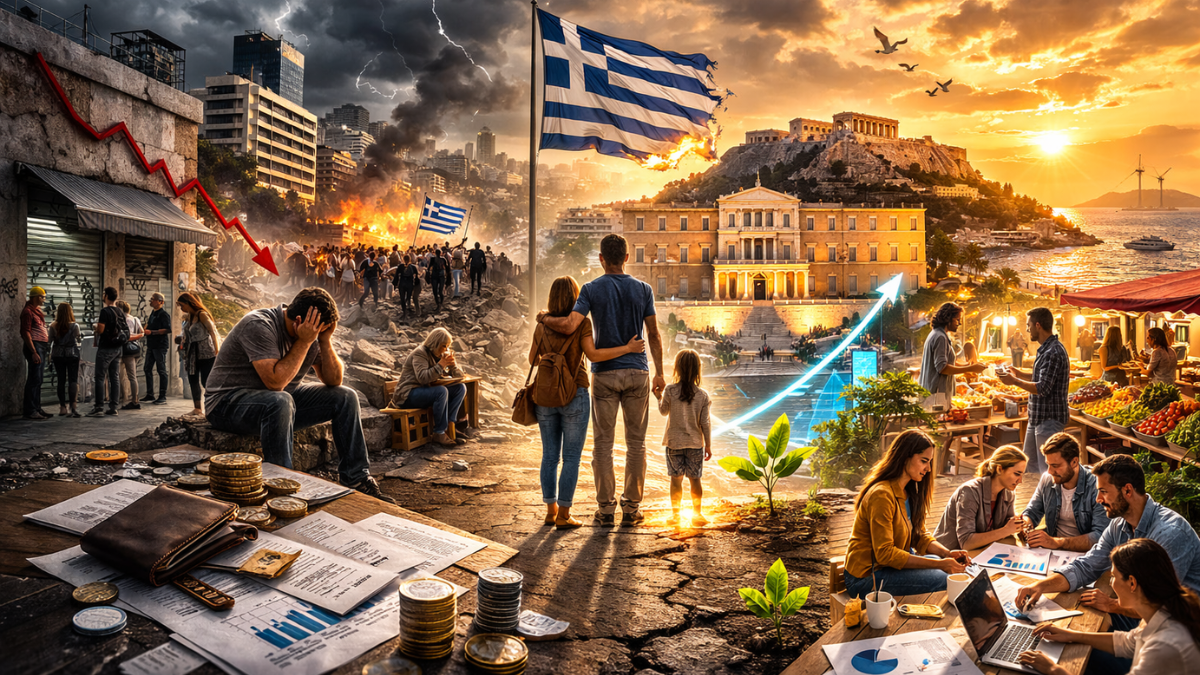
The economic crisis that struck Greece in 2009 was not merely a financial collapse; it was a profound social rupture. What began as a sovereign debt crisis soon transformed into a structural crisis of institutions, family life, employment patterns, political legitimacy, and collective identity. From a sociological perspective, the crisis revealed deep-seated inequalities within Greek society and exposed the tensions between national sovereignty and global economic governance.
This article examines Greek society after the economic crisis, analyzing its transformation through sociological lenses such as class conflict, social stratification, migration, family restructuring, political polarization, and cultural change.
1. Background: The Crisis and Its Structural Roots
Greece experienced a severe debt crisis beginning in 2009, when it was revealed that previous governments had significantly underreported budget deficits. The crisis intensified due to global recessionary pressures following the 2008 financial crash. As a member of the European Union and the International Monetary Fund bailout programs, Greece was subjected to strict austerity measures.
These measures included:
- Cuts in public sector wages and pensions
- Privatization of state-owned enterprises
- Tax increases
- Reductions in social welfare spending
From a structural-functionalist perspective, the crisis represented a breakdown in institutional balance. Economic institutions failed to regulate debt and expenditure, political institutions lost legitimacy, and social institutions like family and education faced severe strain.
2. Austerity and Social Stratification
Austerity policies reshaped social stratification in Greece. The middle class, once a stabilizing force in Greek society, experienced significant downward mobility. Sociologically, this can be interpreted through Marxian theory: economic crises intensify class divisions and reveal contradictions within capitalism.
Unemployment reached over 27% at its peak, with youth unemployment exceeding 50%. Such figures transformed the labor market and increased precarity. Temporary contracts, informal labor, and underemployment became common.
This led to:
- Expansion of the “precariat” class
- Shrinking middle class
- Intensification of poverty among working-class families
From a Weberian perspective, not only economic class but also status and life chances declined for many Greeks. Education no longer guaranteed stable employment, weakening the traditional meritocratic narrative.
3. Youth Unemployment and the “Lost Generation”

Greek youth were disproportionately affected. Many educated young people emigrated to countries like Germany, the UK, and Australia. This “brain drain” represented not only economic loss but also a demographic and cultural shift.
Sociologically, this phenomenon can be analyzed through:
- Human capital theory
- Migration theory
- Generational conflict
The crisis widened generational inequality. Older generations often retained pensions (though reduced), while younger Greeks struggled to enter the labor market. This created tensions within families and society.
4. Family as a Shock Absorber
In Southern European societies, the family plays a crucial welfare role. In Greece, families absorbed much of the crisis impact. Adult children moved back with parents, and grandparents’ pensions supported entire households.
From a sociological standpoint, this reinforced the Mediterranean welfare model, where informal support networks compensate for weak state welfare systems.
However, this also:
- Delayed marriage and childbirth
- Reduced fertility rates
- Increased psychological stress within households
Family solidarity strengthened in some ways, yet economic dependency also created intergenerational pressure.
5. Political Polarization and Crisis of Legitimacy

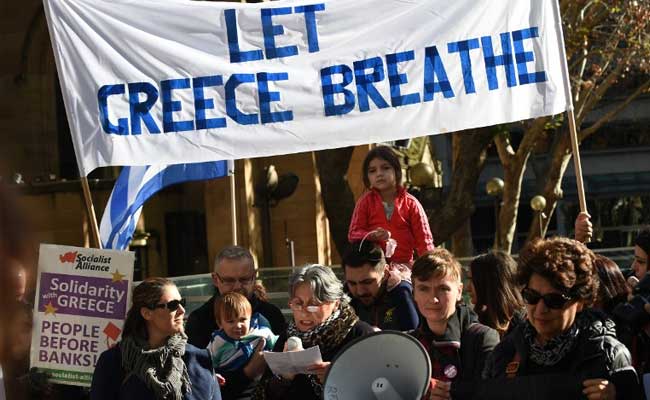
Public trust in political institutions collapsed during the crisis. Protests erupted in Syntagma Square, and anti-austerity movements gained momentum.
The rise of parties such as Syriza reflected popular resistance to austerity policies imposed by European institutions. On the other hand, far-right groups like Golden Dawn gained temporary support, indicating political radicalization.
This polarization can be explained using:
- Conflict theory
- The concept of anomie (Durkheim)
- Political opportunity structure theory
Citizens experienced a sense of normlessness, where traditional political parties failed to represent their interests.
6. Poverty, Inequality, and Social Exclusion
The crisis significantly increased poverty rates. Homelessness rose in urban centers such as Athens and Thessaloniki. Soup kitchens and solidarity networks emerged as grassroots responses.
Social exclusion intensified among:
- Migrants
- Roma communities
- Elderly people
- Single-parent households
From the lens of social exclusion theory, economic deprivation was accompanied by reduced access to education, healthcare, and social participation.
The crisis also revealed gendered inequalities. Women were disproportionately affected due to cuts in public sector jobs, where female employment was relatively high.
7. Health and Psychological Consequences
Economic hardship has measurable social consequences. Studies reported increases in depression, anxiety, and suicide rates during the peak years of the crisis.
Healthcare spending cuts reduced hospital capacity and access to medicines. Vulnerable populations faced barriers to treatment.
From a sociological perspective:
- Economic instability produces social stress
- Social stress leads to deteriorating mental health
- Weak institutional trust exacerbates collective insecurity
This illustrates the connection between economic systems and social well-being.
8. Migration and Refugee Dynamics
Greece also became a frontline state during the European refugee crisis beginning in 2015. Despite its economic struggles, Greece hosted large numbers of refugees from Syria, Afghanistan, and Iraq.
The intersection of economic crisis and refugee inflows created:
- Competition over limited resources
- Rise of xenophobic narratives
- Emergence of solidarity movements
Civil society organizations played a crucial role in humanitarian assistance, demonstrating social resilience even amid hardship.
9. Cultural Change and Collective Identity
The crisis altered Greek collective identity. For many citizens, the crisis challenged national pride and sovereignty, especially under supervision from European creditors.
There was a cultural shift toward:
- Renewed interest in local production
- Growth of cooperative enterprises
- Alternative economies (barter systems, social solidarity networks)
Cultural sociology suggests that crises can produce identity renegotiation. Greeks redefined their relationship with Europe, capitalism, and national self-understanding.
10. Recovery and Ongoing Challenges
By the late 2010s, economic indicators began stabilizing. Tourism recovered, GDP growth resumed modestly, and unemployment declined.
However, structural problems persist:
- Public debt remains high
- Youth emigration continues
- Wage stagnation affects living standards
Sociologically, post-crisis Greece represents a society in transformation rather than full recovery. The social scars of austerity remain visible in institutions and everyday life.
Conclusion
The Greek economic crisis was not only a financial collapse but a profound social transformation. It reshaped class structures, weakened political legitimacy, intensified inequality, and altered family dynamics. Yet, it also generated resilience, solidarity networks, and new forms of civic engagement.
From a sociological perspective, Greek society after the economic crisis illustrates how economic systems deeply influence social structures. It reveals the interconnectedness of economy, politics, family, and culture. The crisis serves as a case study of how global capitalism, austerity governance, and national institutions interact to reshape social life.
For sociologists, Greece provides a powerful example of how societies respond to structural shocks — through conflict, adaptation, resilience, and redefinition of collective identity.
FAQs on Greek Society After the Economic Crisis
1. How did the economic crisis reshape Greek Society?
The crisis deeply transformed Greek Society by increasing unemployment, weakening the middle class, and reducing trust in political institutions.
2. What happened to the middle class in Greek Society after austerity?
Greek Society witnessed significant downward mobility, as many middle-class families lost stable incomes and social security protections.
3. Why is youth unemployment significant in Greek Society?
Youth unemployment created a “lost generation,” leading to migration, delayed marriage, and long-term demographic challenges in Greek Society.
4. How did families function during the crisis in Greek Society?
In Greek Society, families acted as informal welfare systems, supporting unemployed members through shared housing and pension income.
5. Did poverty increase in Greek Society after the crisis?
Yes, poverty and social exclusion rose sharply in Greek Society, especially among migrants, elderly people, and low-income households.
6. How did austerity policies influence inequality in Greek Society?
Austerity widened economic inequality in Greek Society by reducing public services and cutting wages and pensions.
7. What political changes occurred within Greek Society?
Greek Society experienced political polarization, with the rise of anti-austerity and far-right movements.
8. How did migration affect Greek Society during the crisis?
Greek Society faced both emigration of skilled youth and immigration of refugees, creating demographic and social tensions.
9. What was the impact on healthcare in Greek Society?
Budget cuts weakened public healthcare systems, increasing stress and limiting access for vulnerable groups in Greek Society.
10. Did the crisis change social values in Greek Society?
Yes, Greek Society saw renewed emphasis on solidarity networks, local production, and cooperative economic practices.
11. How did gender roles shift in Greek Society after the crisis?
Women in Greek Society faced job losses and increased unpaid care responsibilities, intensifying gender inequality.
12. Is Greek Society fully recovered from the crisis?
While economic indicators have improved, Greek Society still struggles with high debt, wage stagnation, and demographic decline.
13. How did the crisis affect trust in institutions within Greek Society?
Trust in political parties, banks, and European institutions declined significantly in Greek Society.
14. What sociological theories explain changes in Greek Society?
Conflict theory, social stratification theory, and social exclusion theory help explain transformations in Greek Society.
15. Why is Greek Society important for sociological research?
Greek Society provides a case study of how economic crises reshape social structures, institutions, and collective identity.