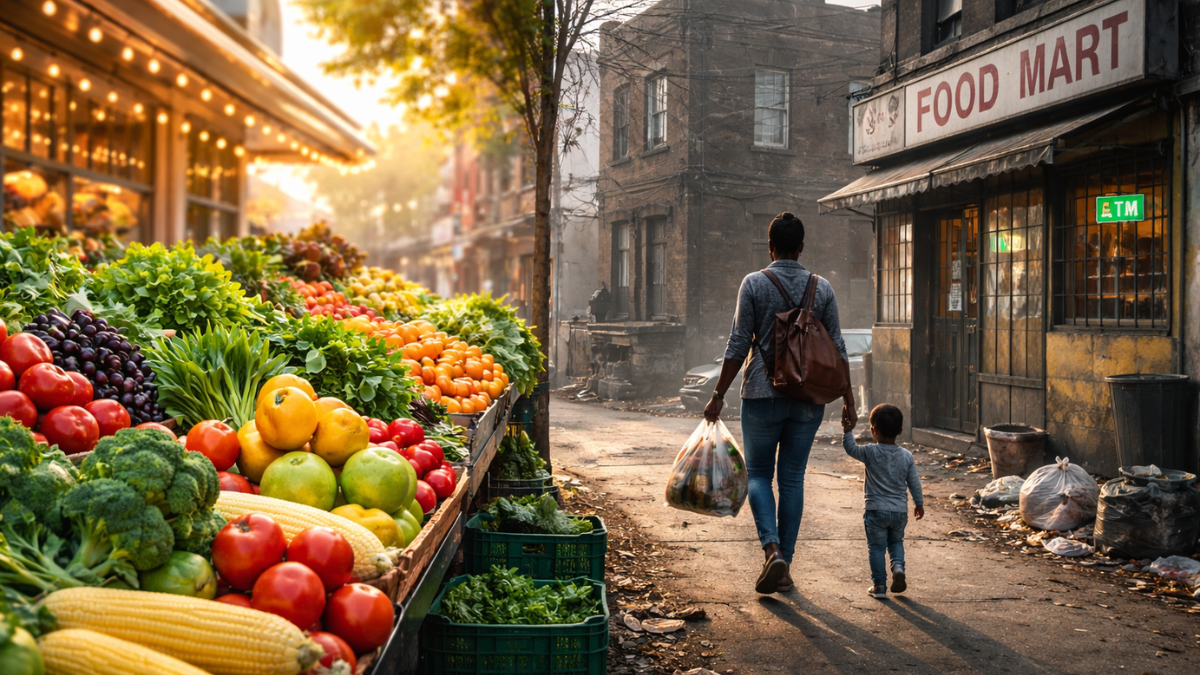
Food deserts—places where residents have limited physical or economic access to affordable, nutritious food—are more than a public-health label. They are social symptoms: the visible outcomes of historical disinvestment, segregationist policies, market logics, and everyday inequalities that shape what, how, and whether people eat. This article examines the causes, mechanisms, and social consequences of food deserts in the United States, situating them within broader structures of class, race, and urban/rural geography. It also sketches policy and community responses that move beyond technical fixes toward structural transformation.
Explore the sociological roots of Nutritional Inequality in America, examining food deserts, poverty, race, and public policy. This in-depth analysis explains how structural inequality shapes food access and health outcomes across the United States.

Defining the problem: what we mean by “food desert”
Scholars and practitioners use a variety of definitions for “food deserts,” but a useful operational one comes from the mapping work of the federal research apparatus: the United States Department of Agriculture’s Food Access Research Atlas identifies low-income census tracts where a significant share of residents live beyond a threshold distance (commonly more than one mile in urban areas, or twenty miles in rural areas) from a supermarket or large grocery store. This definition bundles together geographic and economic barriers—distance plus poverty—so a neighborhood with a supermarket nearby but where most households cannot afford healthy food would also be captured by complementary measures of food insecurity.
The phrase “food desert” is contested. Some activists and scholars argue it suggests natural scarcity—as if produce failed to grow there—when in fact the condition is produced by policy and market choices; these critics prefer “food apartheid” to emphasize racialized patterns of disinvestment. The naming debate reveals a larger sociological point: how we describe a social problem shapes the solutions we propose.
Historical and structural roots
Food deserts don’t appear spontaneously. Their roots lie in intersecting historical processes:
- Urban disinvestment and suburbanization. Post-World War II housing and highway policies, along with white flight and mortgage discrimination, drained investment from many central city neighborhoods. Large grocery chains followed population and profit—moving to suburbs or to wealthier urban districts—leaving smaller stores, convenience outlets, and dollar stores to fill the gaps. This retail sorting is not a mere coincidence but a market response to profitability shaped by policy choices.
- Racialized segregation and redlining. Segregationist housing policies and redlining restricted capital flows into Black and Brown neighborhoods. These practices shaped patterns of retail location: neighborhoods deemed “high-risk” received fewer financial services and lower commercial investment, including grocery stores. Contemporary research finds clear links between historic redlining maps and current disparities in food retail and health outcomes.
- Rural decline and infrastructure gaps. Rural food deserts reflect different dynamics: population loss, long distances between towns, and thin retail markets make supermarket operation difficult. Transport options are limited; households without cars face extreme barriers. For rural residents, the cost of nutritious food is often higher, both in money and time.
- Privatized food systems and retail consolidation. The consolidation of grocery retail (fewer chains controlling larger shares of the market) and the rise of just-in-time logistics prioritize efficiency and scale. Stores locate where they can maximize turnover and minimize risk, which often excludes economically marginalized neighborhoods.
Together, these historical and economic forces produce spatial patterns in retail food access—patterns that then feed back into social and health inequalities.
Mechanisms linking food deserts to nutritional inequality
Understanding how limited access translates into poorer diets and health requires unpacking mechanisms at household and neighborhood levels:
- Affordability and choice. Where healthy options are scarce, households rely on calorie-dense, nutrient-poor processed foods that are cheaper per calorie and require less time to prepare. Even where fresh produce is present, prices and portion sizes often make it unaffordable for families on tight budgets.
- Retail mix and marketing. Neighborhoods with few supermarkets tend to have many convenience stores, small grocers, and fast-food outlets that promote ultra-processed products. Marketing practices, placement of items, and the absence of culturally relevant healthy foods shape consumption choices.
- Transportation and time poverty. For households without reliable vehicles, traveling to a distant supermarket is costly in time and money. Time poverty—caused by long hours, multiple jobs, and caregiving duties—makes lengthy grocery trips unrealistic, steering families toward quick purchases. Technology-mediated solutions (grocery delivery apps) remain unevenly accessible where broadband and payment options are limited.
- Food insecurity and stress. Economic insecurity forces households into cyclical patterns—periods of scarcity followed by stocking up when resources are available. Such patterns encourage high-calorie purchases and reduce dietary variety. Food insecurity is also associated with poorer management of chronic conditions like diabetes, creating a vicious cycle between poverty, diet, and health.
- Social norms and cultural fit. When community food retail does not reflect cultural taste or cooking practices, residents may feel alienated or unable to use what’s available. Food is culturally embedded; that means interventions must align with local preferences to be effective.
Empirical studies show that lack of access correlates with poorer diet quality and higher rates of obesity, diabetes, and cardiovascular disease, though causality is complex and mediated by income, education, and other structural factors.
Who is most affected?
While food deserts can occur in many contexts, their burdens are unevenly distributed along class, race, and geography:

- Low-income households are most vulnerable because price sensitivity shapes purchases; SNAP and other benefits help, but do not fully overcome barriers of availability or convenience.
- Communities of color—especially Black and Hispanic neighborhoods—experience higher rates of limited supermarket access and exposure to retail environments dominated by unhealthy options. These patterns map onto long histories of segregation and economic exclusion.
- Rural residents face unique challenges: longer distances, fewer delivery options, and a smaller retail base. For them, solutions must contend with sparse infrastructure rather than simple urban proximity.
- People with chronic illnesses, older adults, and those with mobility limitations are disproportionately harmed, as diet quality is central to disease management and functional independence.
Sociological consequences beyond health
Food deserts matter not only because of measurable health outcomes but because they reshape social life and civic conditions.
- Social capital and community cohesion. Local food retailers can be social hubs. Their absence reduces places for casual interaction, eroding social networks that support mutual aid. Farmers’ markets and cooperatives can rebuild such ties, but they require investment and trust.
- Economic opportunity and local multiplier effects. Supermarkets and fresh-food retailers create jobs and can stabilize local economies. Where chains avoid neighborhoods, local entrepreneurs face barriers to entry, and the circulation of money within communities weakens.
- Symbolic segregation. The distribution of food retail signals how society values different communities. When certain neighborhoods are saturated with fast food and convenience outlets while others enjoy high-end grocers and farmers’ markets, the contrast carries moral and political messages about worth and inclusion. Brookings scholars and community advocates have stressed that this retail geography reflects deeper patterns of devaluation and underinvestment.
- Political mobilization and policy understanding. The experience of limited food access shapes political claims-making: communities organize around access, nutrition, and public benefits. How policymakers frame the issue—consumer choice vs. structural neglect—affects policy responses and the political identities formed around these struggles.
Policy responses: limitations of narrow fixes
Over the past two decades, a range of interventions have been attempted: incentivizing grocery store placement in underserved areas, supporting farmers’ markets, corner-store conversions to stock produce, mobile markets, and SNAP expansions. Many are beneficial, but sociological scrutiny shows limits when interventions focus narrowly on proximity.
- Supermarket attraction programs can place a store in a food-insecure neighborhood, but without addressing affordability, wages, or transportation, their impact on diets is modest. Stores may also fail if local purchasing power is insufficient.
- Nutrition education programs improve knowledge, but knowledge alone cannot overcome economic constraints or cultural misalignment.
- Technology solutions such as online grocery ordering and delivery hold promise, especially after COVID-19 accelerated adoption. Yet digital divides—lack of broadband, credit cards, or delivery zones—mean such innovations often leave the most marginalized behind.
- Short-term charity models (food pantries, emergency food aid) are essential safety nets, but they do not transform structural drivers of food insecurity or create sustainable diets.
These limitations underscore a key sociological lesson: interventions that ignore the political economy and everyday lifeways of affected communities risk being superficial or even paternalistic.
Towards structural solutions: a sociological agenda
If food deserts are produced by social structures, eliminating them requires structural thinking. A sociologically informed policy mix would include:
- Economic revitalization and living wages. Addressing poverty is central. Without improving household purchasing power through living wages, employment, or stronger social protection, access improvements will have limited dietary effects.
- Place-based investment tied to community control. Public incentives for grocery stores should be coupled with community ownership models—co-ops, nonprofit grocers, and tenant ownership—that keep profits local and respond to cultural needs.
- Integrated urban planning. Land-use, transit, and retail policy must be coordinated so low-income neighborhoods are connected to jobs and stores. Public transit expansions and subsidized delivery systems can mitigate mobility barriers.
- Addressing structural racism. Reconciling food access means confronting historic segregation and discriminatory lending and zoning practices that shaped current retail geographies. Reparative policies—for housing, business development, and infrastructure—are part of a long-term approach.
- Strengthening safety nets and cash support. Programs like SNAP are essential; expanding benefits, improving benefit adequacy, and reducing administrative friction directly improve food security and diet quality.
- Regulating corporate practices. Where market concentration leads to retail deserts, antitrust enforcement and incentives for diverse retail models can rebalance supply. Policies that address pricing, marketing to children, or location decisions may also be warranted.
- Investing in local food systems. Agroecological support for regional supply chains, urban agriculture where appropriate, and food hubs that link local producers to underserved markets can increase nutritious availability while supporting local economies.

Community innovation and everyday resistance
Across the country, communities are not passive. They are innovating:
- Corner-store conversions that stock affordable produce while training owners in inventory and marketing.
- Mobile markets and pop-up produce stands that bring fresh food to transit hubs, churches, and workplaces.
- Food co-ops and community-owned grocery stores that put governance and profits in local hands.
- Mutual aid and urban agriculture initiatives that combine social solidarity with practical food provisioning.
These efforts illustrate sociological principles: collective action, networks, and local knowledge can reconfigure material conditions when supported by policy and resources.
Measuring success: what counts?
Evaluating interventions requires more than counting stores. Sociologists argue for multidimensional metrics: diet quality, affordability, cultural appropriateness, household food security, health outcomes, employment created, and community perceptions of dignity and control. The United States Department of Agriculture’s mapping tools are helpful for locating risk, but deeper evaluation demands mixed methods—quantitative trends plus qualitative insights about lived experience.
The role of research and evidence
Recent peer-reviewed reviews and public-health syntheses underscore complex relationships between access and health: access matters, but its effects are mediated by income, education, and broader social determinants. Multi-disciplinary work—combining sociology, public health, urban planning, and economics—yields the richest policy guidance. Scholars also stress the need to document how historical policies created present conditions; such evidence strengthens arguments for reparative and structural interventions.
Conclusion: food access as a sociological lens into inequality
Food deserts are an entry point for understanding how structural inequalities translate into embodied outcomes. They reveal how policies, markets, and everyday life intersect to shape who eats what, where, and why. Addressing nutritional inequality requires more than delivering produce; it demands confronting the social architecture—poverty, segregation, labor markets, corporate power—that produces scarcity in the midst of plenty.
Solutions must be plural: economic policies that raise incomes, planning decisions that reconnect neighborhoods, community-led retail models that restore agency, and public investments that correct historical disinvestment. In short, ending food deserts is not only a matter of public health—it is a matter of social justice.
FAQs on Nutritional Inequality in America
1. What is Nutritional Inequality in America?
Nutritional Inequality in America refers to the unequal access to affordable, healthy, and culturally appropriate food among different social groups, particularly along lines of income, race, and geography.
2. How are food deserts connected to Nutritional Inequality in America?
Food deserts contribute to Nutritional Inequality in America by limiting physical access to supermarkets and fresh produce, forcing residents to rely on processed and unhealthy food options.
3. Who is most affected by Nutritional Inequality in America?
Low-income households, racial minorities, rural communities, elderly individuals, and people with disabilities are disproportionately affected by Nutritional Inequality in America.
4. What role does poverty play in Nutritional Inequality in America?
Poverty is a central factor in Nutritional Inequality in America because limited income restricts food choices, even when healthy food is geographically available.
5. How does race relate to Nutritional Inequality in America?
Historical segregation, redlining, and systemic discrimination have led to racially concentrated neighborhoods with fewer healthy food outlets, reinforcing Nutritional Inequality in America.
6. Does Nutritional Inequality in America affect children differently?
Yes, Nutritional Inequality in America significantly impacts children’s physical growth, cognitive development, and academic performance due to poor diet quality.
7. What is the relationship between Nutritional Inequality in America and chronic diseases?
Nutritional Inequality in America increases risks of obesity, diabetes, hypertension, and cardiovascular diseases due to higher consumption of processed and low-nutrient foods.
8. Are rural communities affected by Nutritional Inequality in America?
Yes, rural areas often experience Nutritional Inequality in America because of long travel distances to grocery stores and limited public transportation.
9. How does transportation influence Nutritional Inequality in America?
Lack of reliable transportation intensifies Nutritional Inequality in America by making it difficult for residents to reach full-service supermarkets.
10. What role do government programs play in addressing Nutritional Inequality in America?
Programs like SNAP, WIC, and school meal initiatives aim to reduce Nutritional Inequality in America, though structural barriers still limit their full effectiveness.
11. Can education alone solve Nutritional Inequality in America?
While nutrition education helps, it cannot fully solve Nutritional Inequality in America without addressing income inequality, food pricing, and retail access.
12. How does urban planning impact Nutritional Inequality in America?
Zoning laws, transportation infrastructure, and commercial development decisions significantly shape Nutritional Inequality in America.
13. Is Nutritional Inequality in America only an urban issue?
No, Nutritional Inequality in America affects both urban and rural communities, though the causes and patterns differ.
14. How does food pricing contribute to Nutritional Inequality in America?
Healthy foods often cost more than processed foods, reinforcing Nutritional Inequality in America among low-income populations.
15. What long-term solutions can reduce Nutritional Inequality in America?
Comprehensive strategies including living wages, improved public transportation, community-owned grocery stores, stronger social safety nets, and anti-racist urban policies can reduce Nutritional Inequality in America.