
Introduction
Family is recognized as the primary unit of social structure in societies across the world. In India, the traditional family system was predominantly joint, where extended members across generations lived together, shared resources, and maintained strong emotional and economic bonds. Over the last few decades, however, India has experienced a significant shift from joint families toward nuclear families. This shift is not merely a change in living arrangements but reflects deep social, economic, cultural, and demographic transformations. From rural villages to urban metropolises, contemporary Indian family systems are undergoing reconfiguration due to modernization, industrialization, urbanization, and globalization.
This article examines Changing Family Structure in India through a sociological lens, exploring causes, implications, challenges, and broader societal impacts.

Understanding Family Structure: Joint vs. Nuclear
Joint Family:
A joint family is an extended family system characterized by multiple generations living under one roof or in close proximity. It typically includes grandparents, parents, unmarried children, married sons with their wives and children, and sometimes other relatives. Members share economic resources, responsibilities, and decision-making.
Nuclear Family:
A nuclear family comprises only parents and their unmarried children. In this structure, each family unit is independent, focusing on the immediate family rather than extended relatives.
Historical Context of Family in India
Historically, Indian society emphasized family collectivism rather than individualism. The joint family was sustained by agrarian economies where land, labor, and subsistence activities required collective input. Culturally, ancient scriptures and religious beliefs reinforced family unity, patriarchal authority, and interdependence among kin.
Sociologists like M. N. Srinivas highlighted how the joint family served not only as an economic unit but also as a mechanism for socialization, transmission of culture, and emotional support.
Causes of the Shift from Joint to Nuclear Families
The transition from joint to nuclear families in India is multi-dimensional. Several interrelated factors contribute to this change:
1. Urbanization and Industrialization
With rapid industrial growth and urbanization, employment opportunities have shifted from rural areas to urban centers. This has resulted in the migration of young adults seeking jobs, education, and livelihood, often away from their ancestral homes.
Urban life—characterized by high living costs, limited housing space, and competitive employment—makes the maintenance of large joint families difficult. Consequently, nuclear families become a more practical form of household organization in cities.
2. Economic Mobility and Occupational Shifts
As education levels rise and professional opportunities diversify, Indian families increasingly prioritize individual economic mobility. Young adults pursue careers that demand geographic mobility, making the traditional joint family less functional.
Nuclear families provide flexibility for members to shift locations, accept job transfers, or pursue higher education without the burden of accommodating extended kin.
3. Modernization and Changing Values
Modernization brings changes in attitudes, values, and lifestyles. Western influences, media, and consumer culture emphasize individualism, privacy, and personal ambition. In contrast to the collective orientation of joint families, nuclear families align better with modern values of autonomy, self-fulfillment, and privacy.
Individuals increasingly view marriage as a union based on personal compatibility rather than an obligatory alliance between extended families. This cultural shift further erodes the practice of maintaining joint households.
4. Education and Awareness
Education plays a central role in transforming family structures. With increased literacy and exposure to global ideologies, individuals are more inclined to question traditional norms. Educated couples may choose to live independently to pursue career aspirations and cultivate personal identities, moving away from hierarchical family norms.

5. Economic Constraints and Resource Allocation
Contrary to the assumption that joint families are economically advantageous due to shared expenses, rising costs of living—especially in urban areas—make resource pooling less feasible. Housing scarcity, real estate prices, and maintenance costs prompt families to adopt smaller household units.
Additionally, economic competition creates pressures for nuclear setups where decision-making is quicker and financial responsibilities are more focused.
6. Legal and Social Reforms
Legal reforms, such as inheritance laws and the recognition of women’s rights, have empowered individuals—especially women—within family structures. These transformations reduce dependency on joint family authority, encouraging independent living arrangements.
Sociological Perspectives on the Family Transition
Understanding the shift requires engaging sociological theories that explain structural change, social interaction, and adaptation.
Functionalist Perspective
From a functionalist standpoint, family serves key roles: socialization of children, emotional support, economic cooperation, and regulation of sexual behavior. Functionalists argue that changes in family structures reflect adaptation to changing needs of society.
In the Indian context, nuclear families better suit modern industrial societies by providing mobility, efficient decision-making, and flexibility in a competitive economy. While joint families were functional in agrarian settings, nuclear families are more suited to urbanized, individualistic contexts.
Conflict Perspective
Conflict theorists focus on power dynamics within families. They argue that family structures reflect broader inequalities in society, such as class stratification and gender roles. The transition to nuclear families may reduce traditional patriarchal authority, as decision-making becomes shared between spouses rather than dominated by elders.
However, this shift can also exacerbate inequalities by isolating individuals without extended social support. For instance, care for the elderly or children becomes a private burden rather than a collective responsibility.
Symbolic Interactionism
Symbolic interactionists emphasize the meanings and interactions that individuals attach to family roles. With changing family structures, the meanings of relationships, parental authority, and gender roles are renegotiated. In nuclear families, spouses interact as primary social units, shaping identities based on mutual expectations rather than predetermined family norms.
Implications of the Shift
The move from joint to nuclear families has widespread social, psychological, and economic implications for Indian society.
1. Changes in Social Support Systems
Joint families traditionally offered social support—especially in times of crisis, illness, or economic hardship. With nuclear families, such support becomes limited. Individuals often rely on external networks like friends, institutions, or paid services, which may not provide the same emotional depth.
Elders living alone may face loneliness, while young parents may struggle with childcare without extended family assistance.
2. Role of Women
The nuclear family has dual implications for women. On one hand, nuclear families can elevate women’s autonomy and decision-making power. Educated, working women may exercise greater freedom in personal and professional choices.
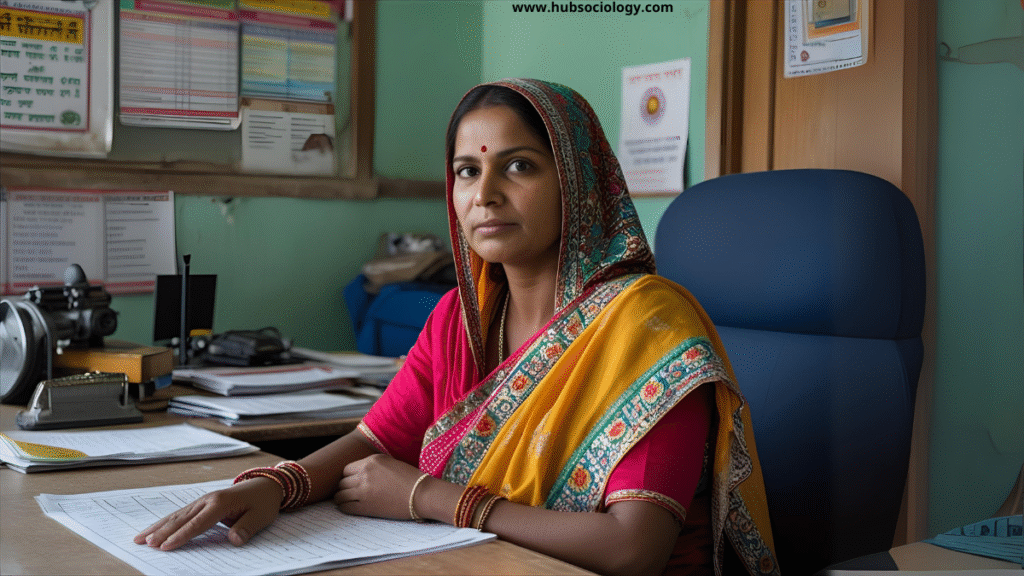
On the other hand, the burden of domestic responsibilities often increases as family support systems shrink. Without the presence of older female kin to share household tasks, women may experience higher stress levels.
3. Child Rearing and Socialization
In joint families, child socialization includes multiple adult influences—grandparents, uncles, aunts—providing diverse role models. Nuclear families limit this interaction, placing greater responsibility on fewer caregivers. While this can promote closer parent–child bonds, it may also reduce exposure to extended family values and collective wisdom.
4. Intergenerational Relations
Joint families inherently involve intergenerational connections. Living together fosters respect for elders, shared traditions, and continuity of cultural practices. Nuclear families risk weakening these bonds, as physical distance and differing lifestyles impact family cohesion.
The absence of joint living may result in alienation between generations and loss of collective family memory.
5. Economic Impact
Economically, nuclear families operate independently, leading to individualized financial planning, consumer-oriented lifestyles, and investment in personal aspirations. While this supports upward mobility, it can increase financial vulnerability in the absence of shared resources during crises.
Joint families traditionally acted as economic safety nets, mitigating financial risks through collective pooling.
6. Cultural Transformation
The decline of joint families influences cultural practices such as festivals, rituals, and ceremonies. Joint families often observe collective religious and cultural rites, reinforcing community identity. Nuclear families may adapt these practices selectively, leading to fragmentation in cultural continuity.
Case Studies: Urban vs. Rural Patterns
Urban India
In urban centers like Mumbai, Delhi, and Bangalore, nuclear families are prevalent. Young professionals migrate for employment, and high living costs discourage large households. Urban lifestyles value privacy, individual ambitions, and smaller family units. Consequently, nuclear families dominate the social fabric of cities.
Rural India
Rural areas continue to house joint families more frequently due to agrarian lifestyles and traditional norms. However, even villages are not immune to change. With increased education, migration of youth, and exposure to media, nuclear families are emerging in rural regions, particularly among economically upward groups.
Challenges and Social Issues Arising from the Shift
1. Elderly Care Crisis
One of the most pressing challenges is the care of elderly family members. In joint families, elders enjoy respect, collective attention, and care. Nuclear families often lack the time, space, or resources to adequately care for aging parents, resulting in isolation or institutionalization.
2. Emotional and Mental Health
Nuclear family members may experience stress due to reduced social support. Issues such as loneliness, depression, and anxiety can emerge when individuals lack strong family networks, especially in urban contexts.
3. Rising Consumerism and Individualism
Nuclear families are more receptive to consumer culture and individualistic values, sometimes at the expense of communal values and social responsibilities. This shift affects priorities related to family commitments, community involvement, and interdependence.
Future Outlook: What Lies Ahead?
India’s family structure is not static—it is shaped by socio-economic trends, government policies, technology, and cultural negotiations. While nuclear families are gaining predominance, hybrid or modified forms of extended families may emerge in response to evolving needs.
For example, joint family values may be sustained through frequent communication, shared celebrations, and cooperative support networks even when family members live separately. Technological connectivity (social media, video calls) enables extended family ties to persist despite geographic distance.
Moreover, co-housing models and multi-generational neighborhoods may foster collective living without strict joint family arrangements. In this way, the essence of family solidarity may adapt to contemporary contexts.
Policy Implications and Social Support Systems
To effectively address the challenges of shifting family structures, policymakers and social institutions must respond through supportive measures:
1. Social Security for the Elderly
Governments can expand pension schemes, healthcare support, and community care programs for older adults to counterbalance diminished family care.
2. Childcare Support
Accessible and affordable childcare services can assist nuclear families, especially working parents, reducing the burden of care responsibilities.
3. Community-Based Support Centers
Neighborhood support centers, elder clubs, counseling services, and family support networks can strengthen social integration and mental well-being.
4. Family Counseling and Education
Community programs that encourage healthy communication, conflict resolution, and intergenerational understanding can bridge gaps introduced by changing family norms.
Conclusion: Balancing Change with Continuity
The transition from joint to nuclear families in India is a reflection of the country’s dynamic social evolution. This change brings opportunities for individual autonomy, economic mobility, and personal fulfilment. Yet it also challenges traditional support systems, emotional bonds, and shared cultural identities. A sociological perspective reveals that family structures are not inherently better or worse but adaptive responses to changing social realities.
India’s family evolution underscores the resilience of social institutions and the capacity of individuals to redefine kinship in ways that preserve connection even amid transformation. As the traditional joint family coexists with nuclear and hybrid models, the core essence of family—love, support, and belonging—remains central to Indian society.
FAQs: Family Structure in India
1. What is meant by Family Structure in India?
Family Structure in India refers to the organization of family relationships, including joint families, nuclear families, and emerging hybrid forms shaped by social, economic, and cultural factors.
2. What are the main types of Family Structure in India?
The main types of Family Structure in India are joint families, nuclear families, and extended or modified joint families.
3. Why was the joint family dominant in traditional Indian society?
The joint family was dominant due to agrarian economy, collective ownership of property, strong kinship ties, and cultural emphasis on interdependence.
4. How is urbanization affecting Family Structure in India?
Urbanization promotes nuclear families by encouraging migration, limited housing space, and employment patterns that favor small, independent households.
5. What role does modernization play in changing Family Structure in India?
Modernization introduces individualism, privacy, and new lifestyles, reducing dependence on extended family systems.
6. How has education influenced Family Structure in India?
Education increases awareness, career mobility, and personal autonomy, leading many individuals to prefer nuclear family arrangements.
7. Is the joint family system completely disappearing in India?
No, the joint family system still exists, especially in rural areas, though it is gradually transforming into modified or semi-joint forms.
8. How does Family Structure in India affect women’s roles?
Changing family structures can increase women’s autonomy in nuclear families but may also increase domestic responsibilities due to reduced family support.
9. What impact does Family Structure in India have on child socialization?
Joint families offer collective socialization, while nuclear families provide closer parental attention but limited exposure to extended kin.
10. How does the shift in Family Structure in India affect the elderly?
The decline of joint families has reduced traditional elderly care, leading to issues like loneliness and reliance on social institutions.
11. What sociological theories explain changes in Family Structure in India?
Functionalist, conflict, and symbolic interactionist theories explain how family structures adapt to economic change, power relations, and social interactions.
12. How does globalization influence Family Structure in India?
Globalization encourages mobility, consumer culture, and individual aspirations, accelerating the shift toward nuclear families.
13. Are rural areas also experiencing changes in Family Structure in India?
Yes, rural India is also witnessing a gradual shift due to education, migration, and exposure to mass media.
14. What are hybrid family forms in the Indian context?
Hybrid families maintain emotional and financial ties of joint families while living separately due to practical constraints.
15. What is the future of Family Structure in India?
The future of Family Structure in India lies in coexistence—where nuclear, joint, and hybrid families adapt to social change while preserving core family values.