Introduction
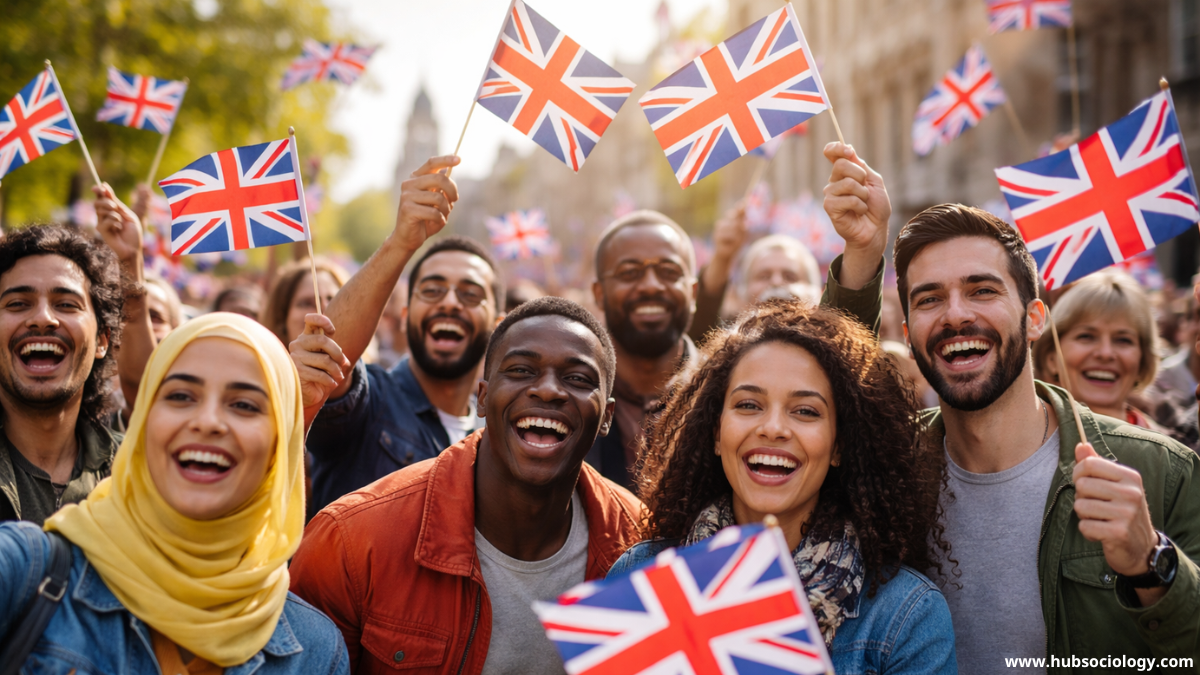
The United Kingdom is often described as one of the most culturally diverse societies in Europe. This diversity is the result of centuries of migration, imperial history, globalization, and social transformation. Issues of race, ethnicity, and multiculturalism have played a central role in shaping British society, politics, and everyday life. From post-war immigration to contemporary debates on national identity, the UK provides a rich context for sociological analysis.
Sociology helps us understand how racial and ethnic identities are socially constructed, how power relations operate between groups, and how multicultural policies influence social cohesion. This article examines race, ethnicity, and multiculturalism in the United Kingdom through historical, structural, and contemporary sociological lenses.

Understanding Race and Ethnicity in Sociology
In sociological terms, race refers to socially constructed categories based on perceived physical differences such as skin color, while ethnicity relates to shared cultural characteristics including language, religion, traditions, and historical experiences. Modern sociology rejects the biological basis of race and instead emphasizes its social and political construction.
In the UK context, racial categories such as “White,” “Black,” “Asian,” and “Mixed” are used in official statistics, yet these categories often oversimplify complex identities. Ethnicity in Britain is deeply shaped by colonial history, migration patterns, and institutional classifications.
Race and ethnicity are not merely personal identities; they are embedded within social structures that influence access to resources, opportunities, and power. Sociologists study these concepts to understand inequality, discrimination, and social stratification.
Historical Roots of Racial and Ethnic Diversity in the UK
Colonial Legacy and Empire
The British Empire played a crucial role in shaping racial and ethnic diversity in the UK. Colonization of Asia, Africa, and the Caribbean created long-lasting economic, political, and cultural connections. Colonial subjects were often encouraged or required to migrate to Britain, especially during periods of labor shortage.
Colonial ideologies also produced racial hierarchies that positioned white British identity as superior, an attitude that continues to influence social relations today. Sociologists argue that contemporary racism in the UK cannot be understood without acknowledging this imperial past.
Post-War Immigration
After World War II, Britain faced severe labor shortages. To rebuild the economy, workers were recruited from former colonies, particularly from the Caribbean, South Asia, and Africa. The arrival of the Windrush generation in 1948 symbolized the beginning of large-scale non-white immigration.
While migrants contributed significantly to British society, they also faced hostility, exclusion, and discrimination. Early race relations were marked by segregation in housing, employment, and education, leading to the emergence of racialized urban spaces.
Immigration Policies and Racialization
British immigration laws gradually became more restrictive from the 1960s onward. Sociologists argue that these policies often racialized immigration, implicitly favoring white European migrants over non-white Commonwealth citizens. Immigration control became a key mechanism through which race and national identity were defined.
Multiculturalism in the United Kingdom

Meaning of Multiculturalism
Multiculturalism refers to the recognition, accommodation, and celebration of cultural diversity within a society. In the UK, multiculturalism developed as both a social reality and a public policy approach, particularly from the 1970s onwards.
Rather than expecting minority groups to assimilate fully into dominant British culture, multiculturalism promoted cultural pluralism, allowing ethnic communities to maintain their languages, religions, and traditions.
Multicultural Policies and Institutions
The UK implemented various multicultural policies, including:
- Anti-discrimination laws such as the Race Relations Acts
- Equal opportunity policies in employment and education
- Recognition of religious and cultural practices
These measures aimed to promote equality and reduce racial exclusion. Sociologists note that multiculturalism in Britain was often pragmatic rather than ideological, focused more on managing diversity than transforming power relations.
Criticism of Multiculturalism
Despite its intentions, multiculturalism has faced strong criticism. Some argue that it encourages segregation, weakens national identity, and prevents social integration. Political leaders in the 2000s declared that “state multiculturalism” had failed, particularly after incidents of terrorism and urban unrest.
Critical sociologists respond that the problem lies not in multiculturalism itself, but in structural inequalities, racism, and economic marginalization. Cultural difference becomes a scapegoat for deeper social problems.
Race Relations and Racism in British Society
Institutional Racism
One of the most significant sociological debates in the UK concerns institutional racism. The Macpherson Report (1999), following the murder of Stephen Lawrence, officially recognized institutional racism within the Metropolitan Police.
Institutional racism refers to discriminatory practices embedded within organizations, even without overtly racist intentions. It affects policing, education, healthcare, and the criminal justice system, disproportionately disadvantaging ethnic minorities.
Everyday Racism
Beyond institutions, racism is experienced in everyday interactions. Verbal abuse, stereotyping, microaggressions, and exclusion remain common experiences for many minority groups. Sociologists emphasize that racism is not only individual prejudice but a social process reinforced through media, language, and cultural norms.
Islamophobia and Anti-Immigrant Sentiment
In recent decades, Muslims in the UK have faced increasing levels of discrimination, particularly after events such as 9/11 and 7/7. Islamophobia intersects with race, religion, and national security discourses, leading to surveillance, stigmatization, and social exclusion.
Anti-immigrant sentiment has also intensified, especially during debates surrounding Brexit. Migrants are often portrayed as threats to jobs, welfare, and cultural cohesion, reinforcing racialized boundaries of belonging.
Ethnicity, Identity, and Belonging

British Identity and Ethnic Diversity
British national identity has historically been associated with whiteness, Englishness, and Christianity. However, increasing diversity has challenged narrow definitions of what it means to be British.
Second and third-generation ethnic minorities often negotiate hybrid identities, combining British culture with ancestral traditions. Sociologists describe this as diasporic identity, reflecting multiple cultural attachments.
Youth, Culture, and Hybridization
Young people from ethnic minority backgrounds play a key role in reshaping British culture. Music, fashion, language, and social media reflect hybrid cultural forms such as British Asian culture and Black British identity.
These cultural expressions challenge stereotypes and demonstrate that multiculturalism is not static but dynamic and evolving.
Education, Employment, and Social Inequality
Education and Ethnic Inequality
Educational outcomes in the UK vary significantly by ethnicity. While some minority groups perform well academically, others face persistent disadvantages due to poverty, school exclusion, and racial bias.
The curriculum has also been criticized for being Eurocentric, marginalizing the histories and contributions of minority communities. Sociologists argue for a more inclusive education system that reflects Britain’s diverse society.
Employment and Economic Inequality
Ethnic minorities are more likely to experience unemployment, low pay, and insecure work. Discrimination in recruitment and promotion remains a significant barrier. Even highly qualified individuals often face a “ethnic penalty” in the labor market.
These economic inequalities reinforce cycles of disadvantage and contribute to spatial segregation in urban areas.
Media Representation and Race
The media plays a powerful role in shaping public perceptions of race and ethnicity. Ethnic minorities are often underrepresented or portrayed negatively, particularly in news coverage related to crime, immigration, and terrorism.
Sociologists highlight how media narratives reinforce racial stereotypes and moral panics, contributing to public fear and hostility. However, digital media has also created new spaces for minority voices and counter-narratives.
The Future of Multicultural Britain
The future of race and multiculturalism in the UK remains contested. While diversity continues to grow, social cohesion depends on addressing structural inequalities rather than merely celebrating cultural difference.
Contemporary sociological debates emphasize intersectionality, recognizing that race intersects with class, gender, religion, and migration status. Policies that focus only on culture without tackling economic and political inequalities are unlikely to succeed.
A more inclusive vision of British society requires confronting racism, reforming institutions, and redefining national identity in ways that reflect lived realities.
Conclusion
Race, ethnicity, and multiculturalism are central to understanding the social fabric of the United Kingdom. Sociological analysis reveals that diversity is not simply a cultural issue but a deeply structural one, shaped by history, power, and inequality.
While multiculturalism has provided a framework for managing diversity, its limitations highlight the need for deeper social transformation. Addressing racism, promoting social justice, and fostering genuine inclusion remain critical challenges for British society.
The UK’s experience demonstrates that multiculturalism is an ongoing process rather than a finished project. Sociology plays a vital role in critically examining this process and imagining more equitable futures in an increasingly diverse nation.
FAQs on Multiculturalism in the United Kingdom
1. What is meant by Multiculturalism in the United Kingdom?
Multiculturalism in the United Kingdom refers to the coexistence of diverse racial, ethnic, religious, and cultural groups within British society, along with policies that recognize and accommodate this diversity.
2. When did multiculturalism begin to develop in the United Kingdom?
Multiculturalism in the United Kingdom began to develop significantly after World War II, following large-scale immigration from former British colonies in Asia, Africa, and the Caribbean.
3. How is multiculturalism different from assimilation in the UK context?
Multiculturalism in the United Kingdom allows minority groups to maintain their cultural identities, whereas assimilation expects them to adopt the dominant British culture entirely.
4. Why is multiculturalism important in the United Kingdom?
Multiculturalism in the United Kingdom is important because it promotes social inclusion, cultural recognition, and equality in a society shaped by long-term migration and diversity.
5. What role did the British Empire play in multiculturalism in the UK?
The British Empire created historical links that encouraged migration to Britain, making multiculturalism in the United Kingdom closely connected to colonial history.
6. How does multiculturalism affect national identity in the United Kingdom?
Multiculturalism in the United Kingdom has challenged traditional ideas of British identity by encouraging more inclusive and plural understandings of belonging.
7. What are the main challenges to multiculturalism in the United Kingdom?
Key challenges to multiculturalism in the United Kingdom include racism, social inequality, residential segregation, and political resistance to immigration.
8. Is multiculturalism officially supported by the British government today?
While early policies supported multiculturalism in the United Kingdom, recent governments have emphasized integration and social cohesion over explicit multicultural policies.
9. How does multiculturalism influence education in the United Kingdom?
Multiculturalism in the United Kingdom has influenced education through inclusive curricula, anti-racist policies, and recognition of cultural diversity in schools.
10. What is the relationship between multiculturalism and racism in the UK?
Multiculturalism in the United Kingdom aims to reduce racism, but sociologists argue that structural and institutional racism continues despite multicultural policies.
11. How does multiculturalism shape youth culture in the United Kingdom?
Multiculturalism in the United Kingdom has strongly shaped youth culture, especially in music, fashion, language, and hybrid cultural identities.
12. What criticisms exist against multiculturalism in the United Kingdom?
Critics argue that multiculturalism in the United Kingdom can encourage segregation and weaken social unity, though sociologists often link these issues to inequality rather than culture.
13. How is multiculturalism linked to immigration debates in the UK?
Multiculturalism in the United Kingdom is closely linked to immigration debates, particularly concerning border control, national identity, and social integration.
14. Does multiculturalism contribute to social cohesion in the United Kingdom?
Multiculturalism in the United Kingdom can strengthen social cohesion when combined with equality, economic inclusion, and anti-discrimination measures.
15. What is the future of multiculturalism in the United Kingdom?
The future of multiculturalism in the United Kingdom depends on addressing racial inequality, reforming institutions, and promoting inclusive national identity.