Introduction
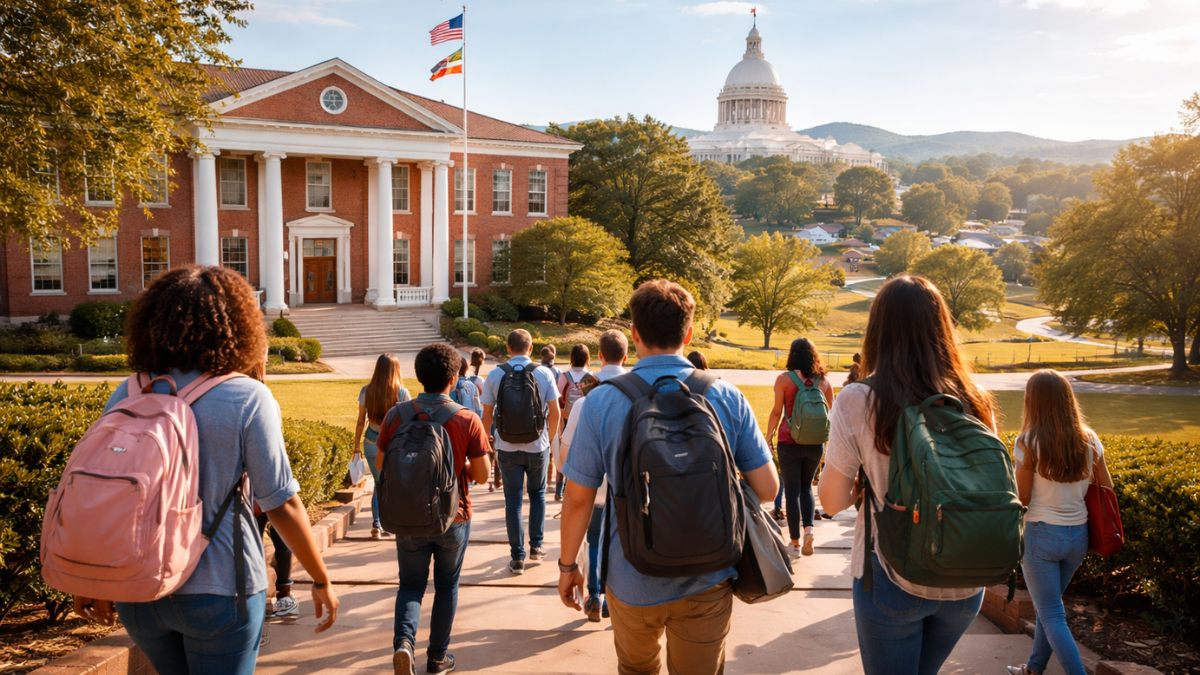
Education is widely regarded as one of the primary engines of social mobility: a pathway through which individuals and families can improve economic standing, expand opportunities, and reshape life trajectories. Yet access to that pathway and the returns it yields are unevenly distributed. In Alabama, historical legacies, economic structures, demographic patterns, and contemporary policy choices combine to produce a distinctive education landscape with direct implications for social mobility. This article examines Alabama’s education system from a sociological perspective, tracing how institutional arrangements, cultural forces, and structural inequalities interact to shape life chances. It addresses K–12 schooling, postsecondary options, and the broader social mechanisms that connect schooling to occupational outcomes.
Explore how the education system shapes Social Mobility in Alabama. A sociological analysis of inequality, higher education, rural challenges, and economic opportunity in Alabama.

Historical and structural context
To understand current dynamics, we must situate Alabama within its historical context. Like many southern states, Alabama’s modern education system was shaped by a legacy of racial segregation, underfunding of schools in Black communities, and patterns of rural poverty. These historical inequities did not simply vanish with legal desegregation; they produced durable patterns of residential segregation, differences in property wealth, and political dynamics that affect taxation and resource allocation. Over time, industrial shifts—declines in manufacturing and changes in agricultural employment—altered local labor markets and the kinds of educational credentials that translate into stable middle-class jobs.
Equally important is geography. Alabama contains both concentrated urban centers and large rural regions. Rural school districts often face chronic resource shortages, teacher recruitment challenges, and limited access to supplemental educational programming. Urban districts may have higher per-student spending in some contexts but also contend with concentrated poverty, fragmented social services, and school choice dynamics that can re-segregate enrollment. These spatial differences matter sociologically because they create divergent life-course contexts for children raised in different parts of the state.
K–12 education: organization, funding, and stratification
Alabama’s K–12 system, like most U.S. states, is decentralized: local school districts, state agencies, and federal programs interact to shape curricula, standards, and funding. Public education funding relies heavily on a combination of state allocations and local revenue, primarily property taxes. Because property wealth varies across communities, districts with higher property values can offer richer programming, better facilities, smaller class sizes, and higher teacher pay—advantages that translate into better educational outcomes. Conversely, districts in low-wealth rural or postindustrial towns struggle to attract and retain experienced teachers and to offer advanced courses.
Stratification within the K–12 system takes several forms. Academic tracking and course-gating patterns—often justified as matching instruction to ability—can reproduce social inequalities when students from disadvantaged backgrounds are disproportionately placed in lower-level tracks. Access to Advanced Placement, dual-enrollment, and gifted programs is unevenly distributed, which means that students with similar potential may receive very different opportunities to accrue college-ready credentials. Discipline policies, special education identification practices, and differential counseling resources also contribute to unequal educational trajectories. When disciplinary practices push students out of school or into alternative placements, the effect is a reduced likelihood of completing college-preparatory coursework and lower rates of postsecondary enrollment.
Race and class intersect throughout these processes. Historical segregation and ongoing residential patterns mean that many Black and low-income students are concentrated in under-resourced schools. Cultural capital—familial experience with navigating school bureaucracies, knowledge about college admissions, and familiarity with educational norms—differs by social class and shapes how families access supports. Sociologically, these differences reflect broader systems of advantage and disadvantage: schooling is not a neutral meritocratic filter but an institution embedded in unequal social structures.
Early childhood and pre-K: the first step in mobility
A growing body of sociological research emphasizes early childhood education as an inflection point for social mobility. Access to high-quality pre-K and early intervention programs helps close achievement gaps that are present by kindergarten. For Alabama, expanding early childhood programs in communities with concentrated poverty is a strategic lever for leveling the playing field. However, supply constraints, uneven program quality, and the affordability of childcare complicate universal access. Parental leave policies, maternal employment patterns, and community-level supports also affect early cognitive and socioemotional development—factors that, over time, translate into differential school readiness.

Higher education and postsecondary pathways
The state’s postsecondary landscape includes community colleges, broad-access public universities, selective institutions, and Historically Black Colleges and Universities (HBCUs). These institutions play different roles in shaping mobility. Community colleges and technical programs are crucial pathways for working-class students, offering occupational training and opportunities for credentialing that can improve earnings. Public flagship universities and selective institutions, by contrast, are more likely to open doors to high-status professions and graduate study. HBCUs hold a special sociological significance: they have historically provided access to higher education for Black students in the face of segregation and remain important centers of social capital, mentorship, and professional networks.
Credential inflation and the labor market complicate postsecondary returns. As more jobs require college credentials, the value of different degrees becomes a central question: Which diplomas actually improve upward mobility? Vocational and technical credentials can lead to stable middle-income jobs, but only when they align with local labor-market demand. Bachelor’s degrees generally confer higher average returns, but the cost of college—and student debt burdens—can offset those gains for low-income students who do not complete degrees. Thus, the sociology of education in Alabama must consider not only access to college but also completion, debt, and labor-market alignment.
Social capital, networks, and non-academic resources
Beyond formal schooling, social mobility is shaped by social capital: the networks, norms, and relationships that facilitate access to information, jobs, and supports. In some Alabama communities, familial and community networks provide strong informal economies and job-placement pathways. In others, isolation and the outmigration of skilled workers deplete local networks, making upward mobility more difficult. Schools can serve as loci for building social capital—through extracurriculars, internships, and alumni networks—but only when they are connected to community institutions and employers.
Mentoring programs, community partnerships, and school–business collaborations are sociological mechanisms that expand opportunities. When schools partner with local industry to offer apprenticeships or when universities create bridge programs for first-generation students, they create institutional pathways that compensate for gaps in familial social capital. Conversely, the absence of such linkages leaves students dependent on brittle labor markets or forced to relocate to access opportunities—a structural constraint on mobility.
Policy, governance, and political economy
State-level policy choices shape the contours of educational opportunity. Decisions about school funding formulas, teacher compensation, accountability regimes, and charter-school policies have distributive consequences. For instance, funding formulas that emphasize equalization can mitigate resource disparities, while policies that allow broad school choice without safeguards can accelerate stratification by enabling more privileged families to exit underperforming schools.
Alabama’s political economy—tax bases, policy priorities, and budgetary trade-offs—matters here. Investment in K–12 infrastructure, early childhood programs, and community college systems requires political will and revenue commitment. Similarly, targeted support for rural broadband and transportation can expand educational access in underserved areas, facilitating distance learning and access to hybrid postsecondary programs. At the same time, contested debates—about standardized testing, curriculum content, and the role of private choice—reflect cultural struggles that influence policy outcomes.
Inequality across multiple dimensions
Gender, race, disability status, and migration background intersect with class to shape educational access and returns. For example, gendered occupational segregation may channel women and men into different postsecondary pathways with uneven returns. Disability services and inclusive education are critical for ensuring that students with special needs receive supports that enable completion and labor-market participation. Racial disparities—rooted in historical segregation and present-day discrimination—manifest in differential disciplinary rates, advanced-course access, and college counseling.
A sociological lens emphasizes that these unequal outcomes are not simply the result of individual choices but the product of institutional patterns. Structural interventions—broad-based and targeted—are therefore necessary to alter trajectories.
Mechanisms linking education to social mobility
How exactly does education translate into mobility in Alabama? Several mechanisms are central:
- Human capital formation: acquiring cognitive and technical skills that raise productivity and earnings potential.
- Signaling and credentialing: diplomas serve as signals to employers about an individual’s competence and persistence.
- Social capital: networks formed in school can open doors to internships and jobs.
- Institutional linkage: partnerships between schools and employers can provide direct pathways into employment.
- Redistribution: progressive funding and student supports (scholarships, grants, counseling) reduce barriers to upward movement.
These mechanisms interact with broader labor-market structures and local economies. In regions where high-value employers are scarce, even well-educated workers may face limited returns, leading to outmigration. Conversely, where employers value locally provided credentials, community colleges and vocational programs can generate substantial mobility.
Case studies and illustrative dynamics (without naming specific districts)
Consider two stylized community contexts within the state. In a suburban district with rising property values, schools benefit from robust tax bases, well-funded extracurricular programs, and active parental engagement. Students there are more likely to take advanced courses, participate in internships, and receive college counseling—factors that increase college enrollment and completion rates. In a rural district reliant on an industry in decline, schools face budget constraints, teacher shortages, and limited course offerings. Students may have fewer role models who have completed college, fewer transportation options to attend community college campuses, and a local labor market that emphasizes low-wage work. Even when individual ambition is high, structural constraints reduce the likelihood that schooling alone will produce upward mobility.
These contrasting dynamics highlight a key sociological insight: education can be a vehicle for mobility, but its effectiveness depends on the supporting ecosystem—familial resources, institutional linkages, local labor markets, and public policy.
Policy implications and interventions
If the goal is to enhance social mobility through education, policy should be multi-pronged and empirically informed. Several interventions stand out sociologically:
- Invest in early childhood education at scale, prioritizing program quality and access in high-poverty areas. Early gains in readiness compound across the life course.
- Reform school funding to reduce dependence on local property taxes and allocate additional resources to districts with concentrated needs. Targeted investments in teacher pay, counseling, and advanced-course access can reduce in-school stratification.
- Strengthen community-college systems and vocational training aligned with regional labor markets. Expand work-based learning and apprenticeships so credentials translate into local job opportunities.
- Expand supports for first-generation and low-income college students—wraparound services, mentoring, remedial bridge programs—to increase degree completion and reduce debt burdens.
- Build school–community–business partnerships that create internships, mentorships, and hiring pipelines, especially in regions with declining industries.
Address non-academic barriers to mobility: healthcare access, transportation, broadband connectivity, and family supports that enable sustained engagement with education.
These policy directions recognize that education policy cannot be siloed; it must connect to labor-market development, social services, and community vitality.
Sociological critiques and cautions
While education is a powerful tool, sociologists caution against over-optimistic narratives that cast schooling as a panacea. Placing the burden of mobility solely on individual students—through rhetoric about “pulling oneself up by the bootstraps”—obscures the structural barriers facing many families. Moreover, policy designs that increase credential requirements without creating corresponding job opportunities can produce credential inflation and deepen debt burdens.

Equity-minded reform must balance universality and targeted support. Universal quality improvements raise the floor for all students, while targeted interventions address concentrated disadvantage. Moreover, evaluation and iterative learning are essential: policies should be accompanied by rigorous assessment to ensure intended effects on completion, employment, and well-being.
Conclusion
Education in Alabama plays a central but complicated role in social mobility. Historical legacies, spatial divides, funding mechanisms, and labor-market structures shape how educational credentials translate—or fail to translate—into improved life chances. A sociological perspective directs attention away from individual blame and toward institutional arrangements, community contexts, and policy choices that produce unequal opportunities. Enhancing mobility requires coordinated investments across the life course: early childhood programs, equitable K–12 funding, robust postsecondary pathways, and stronger links between education and employment. Only by addressing education as part of a broader social ecosystem can policymakers, educators, and communities make schooling a more effective engine of upward mobility in Alabama.
FAQs on Social Mobility in Alabama
1. What is meant by Social Mobility in Alabama?
Social Mobility in Alabama refers to the ability of individuals or families to improve their socio-economic status through education, employment, and access to opportunities within the state.
2. How does the education system influence Social Mobility in Alabama?
The education system influences Social Mobility in Alabama by providing skills, credentials, and networks that help individuals secure better-paying and stable jobs.
3. Why is K–12 education important for Social Mobility in Alabama?
K–12 education lays the foundation for literacy, numeracy, and social skills, which are essential for long-term Social Mobility in Alabama.
4. Does higher education increase Social Mobility in Alabama?
Yes, completing degrees or technical certifications significantly improves Social Mobility in Alabama by increasing earning potential and employment stability.
5. How does rural poverty affect Social Mobility in Alabama?
Rural poverty limits access to quality schools, broadband, transportation, and job markets, which can slow Social Mobility in Alabama.
6. What role do community colleges play in Social Mobility in Alabama?
Community colleges offer affordable technical and vocational training, making them crucial pathways for improving Social Mobility in Alabama, especially for first-generation students.
7. How does racial inequality impact Social Mobility in Alabama?
Historical segregation and ongoing disparities in school funding and employment opportunities create structural barriers to equal Social Mobility in Alabama.
8. Is early childhood education linked to Social Mobility in Alabama?
Yes, access to quality pre-K programs improves school readiness and long-term educational outcomes, strengthening Social Mobility in Alabama.
9. How does social capital affect Social Mobility in Alabama?
Networks, mentorship, and community connections significantly shape Social Mobility in Alabama by providing access to information and job opportunities.
10. Does school funding inequality influence Social Mobility in Alabama?
Unequal school funding contributes to differences in academic resources and opportunities, directly affecting Social Mobility in Alabama.
11. How do vocational programs support Social Mobility in Alabama?
Vocational programs align education with labor market needs, helping students secure stable employment and enhancing Social Mobility in Alabama.
12. What challenges do first-generation college students face regarding Social Mobility in Alabama?
First-generation students may lack financial resources, academic guidance, and family experience with higher education, which can slow Social Mobility in Alabama.
13. Can policy reforms improve Social Mobility in Alabama?
Yes, reforms in education funding, workforce development, and student support services can significantly improve Social Mobility in Alabama.
14. How does student debt affect Social Mobility in Alabama?
High student debt can delay home ownership, business investment, and wealth accumulation, limiting long-term Social Mobility in Alabama.
15. What are the future prospects for Social Mobility in Alabama?
With targeted investments in equitable education, workforce alignment, and community development, Social Mobility in Alabama can improve in the coming decades.