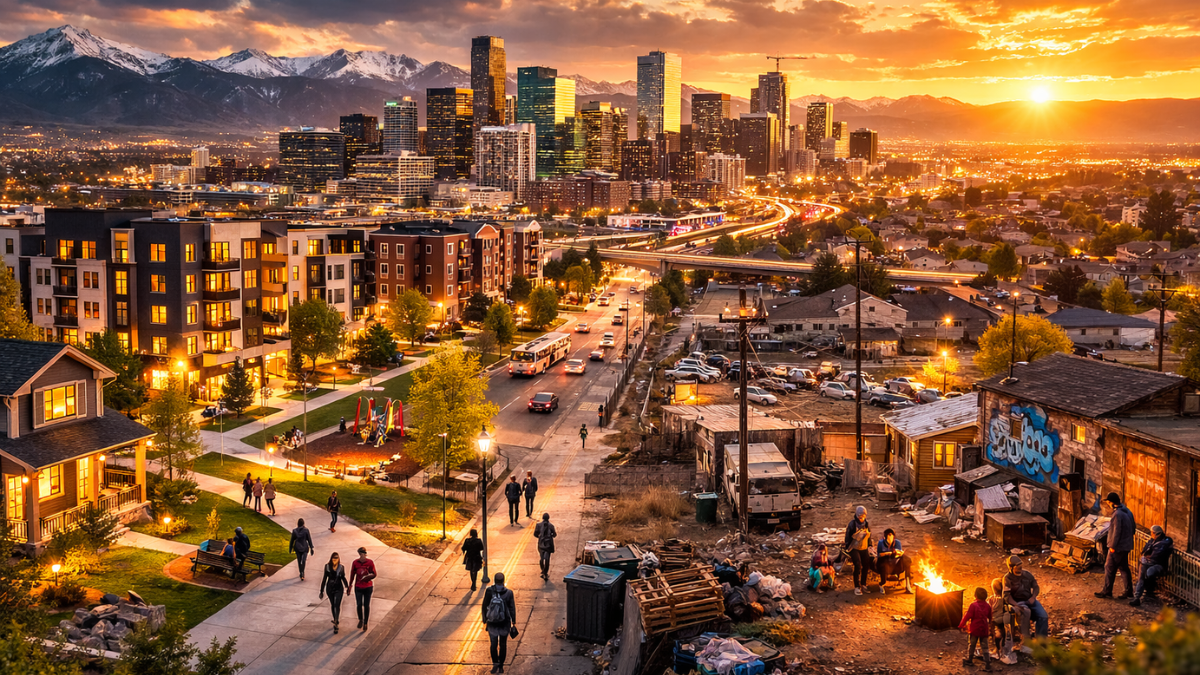
Introduction on Social Stratification in Colorado
Urbanization has long been one of the most transformative processes in modern society. In the American West, the state of Colorado provides a compelling case study of how rapid urban growth intersects with patterns of social stratification. Over the past century—especially since the late twentieth century—Colorado has shifted from a largely rural, mining- and agriculture-based economy to a diversified urban society cantered around technology, tourism, energy, higher education, and service industries.
Cities such as Denver, Colorado Springs, Boulder, Aurora, and Fort Collins have grown rapidly, reshaping economic opportunities, housing markets, cultural life, and political alignments. Yet urbanization has not benefited all groups equally. It has intensified income inequality, racial and ethnic disparities, housing segregation, and class polarization.
From a sociological perspective, urbanization in Colorado illustrates how economic development, migration, demographic change, and policy decisions interact to produce new forms of social stratification. This article explores these dynamics by examining historical patterns of urban growth, economic restructuring, housing inequality, racial stratification, suburbanization, education, labor markets, and emerging socio-spatial divides.
Historical Foundations of Urban Growth
Colorado’s urbanization began in the nineteenth century during the mining booms that led to the establishment of Denver as a commercial and transportation hub. The arrival of railroads integrated the region into national markets, encouraging population growth and urban concentration.
During the twentieth century, federal investment in military installations and infrastructure strengthened urban centers. Colorado Springs, for example, developed around defense-related industries, while Denver expanded as a financial and administrative center for the Rocky Mountain region.
Post–World War II suburbanization transformed Colorado’s urban landscape. Like many American states, Colorado experienced the growth of automobile-dependent suburbs, shopping malls, and decentralized employment centers. However, the pace of urban growth accelerated dramatically in the 1990s and 2000s due to technology-sector expansion, lifestyle migration, and population inflows from other states.
Urbanization in Colorado is therefore not merely demographic growth—it represents a structural transformation from a frontier economy to a globalized, knowledge-driven urban society.
Theoretical Framework: Urbanization and Stratification
Urbanization refers to the increasing concentration of populations in cities and metropolitan areas. Social stratification refers to structured inequalities in wealth, income, education, occupation, power, and status.
Sociologists analyze these processes through several theoretical lenses:
- Marxist perspective: Urban growth reflects capitalist development, concentrating capital and labor while generating class inequality.
- Weberian perspective: Stratification is multidimensional, involving class, status, and power. Urban life intensifies competition for resources such as housing, education, and employment.
- Urban ecology theory: Cities develop through spatial competition, leading to socio-economic segregation.
- Growth machine theory: Urban development is shaped by coalitions of business elites and political leaders who prioritize economic expansion, often at the expense of social equity.
Applying these frameworks to Colorado reveals how economic prosperity can coexist with deepening inequality.
Economic Transformation and Class Structure
Colorado’s economy has diversified significantly over the last three decades. Technology companies, aerospace firms, renewable energy enterprises, and research institutions have concentrated in metropolitan corridors along the Front Range. Boulder and Denver, in particular, have become hubs for startups and high-tech employment.
This transformation has produced a growing professional and managerial class characterized by high educational attainment and substantial income. Simultaneously, service-sector employment—hospitality, retail, food services, and tourism—has expanded to support urban growth and the state’s recreation-based economy.
The result is a polarized labor market. On one end are highly paid software engineers, executives, and researchers; on the other are low-wage service workers facing precarious employment. Middle-income manufacturing and industrial jobs have declined, shrinking the traditional middle class.
Urbanization thus reinforces a dual labor market structure, where economic opportunities are unevenly distributed. Income inequality in Colorado has widened, particularly in metropolitan areas where housing and living costs have risen sharply.
Housing Inequality and Gentrification
One of the most visible consequences of urbanization in Colorado is housing inequality. Rapid population growth has driven up property values and rents, especially in Denver and Boulder.
Gentrification—defined as the influx of higher-income residents into previously lower-income neighborhoods—has reshaped urban cores. Historically working-class and minority neighborhoods in Denver have experienced redevelopment, rising rents, and displacement pressures.
From a sociological perspective, housing markets function as mechanisms of stratification. Access to homeownership builds wealth, while renters remain vulnerable to market fluctuations. Rising housing costs disproportionately affect low-income households, immigrants, and communities of color.
Suburbanization, meanwhile, has created socio-economic segmentation. Affluent suburbs offer high-performing schools and amenities, while lower-income communities face limited resources. This spatial inequality contributes to long-term stratification across generations.
Racial and Ethnic Stratification
Colorado’s demographic profile has changed significantly. The growth of Latino, Black, Asian, and immigrant populations has diversified urban areas. Aurora, for example, is one of the most diverse cities in the state.
Despite diversity, racial inequality persists. Residential segregation patterns—though less rigid than in some older industrial cities—remain evident. Latino and Black households are more likely to live in neighborhoods with lower median incomes and fewer resources.

Structural factors such as historical discrimination, unequal access to credit, and disparities in educational opportunity shape these outcomes. Urbanization can exacerbate these divides when redevelopment displaces minority residents from central neighborhoods.
Sociologists emphasize that stratification is not only economic but also racialized. Intersectionality—where race, class, gender, and immigration status intersect—helps explain the varied experiences of urban residents in Colorado.
Education and Social Mobility
Education plays a central role in stratification. Colorado is home to prestigious institutions and research universities that attract students and professionals. However, disparities in K–12 education funding and school quality reflect broader socio-economic divides.
Urban school districts serving low-income neighborhoods often face resource constraints. Suburban districts with higher property tax bases provide more educational opportunities.
As Colorado’s economy becomes increasingly knowledge-based, educational credentials determine access to high-paying jobs. Individuals without college degrees face limited upward mobility in urban labor markets.
Thus, while urbanization generates new opportunities, it also creates barriers for those lacking educational capital.
Migration and Lifestyle Urbanism
Colorado has experienced significant in-migration from other states, especially California and Texas. Many newcomers are attracted by outdoor recreation, environmental quality, and economic opportunity.
This “lifestyle migration” contributes to rising housing costs and cultural change. Long-term residents sometimes perceive newcomers as driving up prices and altering community character.
Sociologically, migration reshapes social networks and class composition. Highly educated migrants strengthen the professional class, while immigrant workers fill service-sector roles. This dual migration pattern reinforces stratification.
Suburbanization and Spatial Inequality
Urbanization in Colorado is not confined to central cities. Metropolitan expansion has extended into surrounding counties, producing suburban sprawl.
Affluent enclaves with access to amenities contrast sharply with lower-income suburban areas lacking public transportation and social services. Spatial inequality manifests in commuting patterns, environmental exposure, and infrastructure access.
The geography of opportunity becomes uneven, influencing life chances. Children growing up in resource-rich suburbs are more likely to achieve upward mobility than those in under-resourced neighborhoods.
Homelessness and Urban Marginality
Rapid urban growth has coincided with rising homelessness in cities like Denver and Colorado Springs. High housing costs, mental health challenges, and limited affordable housing contribute to urban marginality.
From a conflict perspective, homelessness reflects systemic inequality rather than individual failure. Urban redevelopment often prioritizes economic growth over social welfare, marginalizing vulnerable populations.

Public debates over encampments and housing policy reveal tensions between market-driven development and social justice concerns.
Political and Cultural Dimensions
Urbanization also reshapes political dynamics. Colorado has transitioned from a traditionally conservative state to a more politically competitive and increasingly Democratic-leaning state in national elections.
Urban areas tend to support progressive policies related to environmental protection, social services, and diversity. Rural areas, by contrast, often favor conservative positions.
This urban-rural divide represents another dimension of stratification—cultural and political polarization rooted in differing economic and social experiences.
Environmental Inequality
Urban expansion along the Front Range has environmental consequences. Air quality issues, water scarcity, and land-use conflicts affect communities unevenly. Lower-income neighborhoods may experience greater environmental burdens, such as proximity to highways or industrial sites.
Environmental justice scholarship highlights how ecological risks intersect with social inequality. Urbanization thus creates both economic growth and environmental stratification.
Toward Inclusive Urban Development
Addressing stratification in Colorado requires policy interventions that promote equitable growth. Affordable housing initiatives, public transportation investment, inclusive zoning policies, and expanded social services can mitigate inequality.
Education reform, workforce development programs, and immigrant integration policies also support upward mobility.

Urban sociologists argue that sustainable cities must balance economic competitiveness with social inclusion. Without intentional policy action, urbanization may deepen stratification.
Conclusion
Urbanization and social stratification in Colorado are deeply interconnected processes. Rapid metropolitan growth has transformed the state’s economy, culture, and demographics. While cities have generated prosperity and innovation, they have also intensified inequality in income, housing, education, and opportunity.
Colorado’s experience illustrates a broader sociological truth: urbanization is not inherently equalizing or unequalizing—it depends on how economic resources, political power, and social institutions distribute opportunities.
As Colorado continues to grow, the challenge lies in fostering inclusive urban development that reduces disparities rather than reinforcing them. Sociological analysis provides critical insight into how class, race, space, and power shape the lived realities of urban residents. Understanding these dynamics is essential for building a more equitable future in Colorado’s rapidly evolving urban landscape.
FAQs on Social Stratification in Colorado
1. What is social stratification in Colorado?
Social stratification in Colorado refers to the structured inequalities in income, wealth, education, occupation, housing, and political power among different groups within the state.
2. How has urbanization influenced social stratification in Colorado?
Urbanization has intensified social stratification in Colorado by increasing housing costs, expanding income inequality, and concentrating wealth in metropolitan regions like Denver and Boulder.
3. What role does housing play in social stratification in Colorado?
Housing is central to social stratification in Colorado because rising property values and rents limit access to stable living conditions for low- and middle-income families, widening wealth gaps.
4. Is income inequality a major factor in social stratification in Colorado?
Yes, income inequality is a key driver of social stratification in Colorado, especially between high-income tech professionals and low-wage service workers.
5. How does education affect social stratification in Colorado?
Educational attainment strongly influences social stratification in Colorado, as access to quality schools and higher education determines entry into high-paying job sectors.
6. Does racial inequality contribute to social stratification in Colorado?
Racial and ethnic disparities contribute significantly to social stratification in Colorado, particularly in housing access, employment opportunities, and income levels.
7. How does migration impact social stratification in Colorado?
Migration, especially of highly educated professionals, has reinforced social stratification in Colorado by increasing demand for housing and intensifying competition for urban resources.
8. What is the connection between homelessness and social stratification in Colorado?
Homelessness reflects extreme forms of social stratification in Colorado, often linked to rising housing costs, wage stagnation, and limited affordable housing.
9. How does suburbanization affect social stratification in Colorado?
Suburban growth has created spatial inequality, contributing to social stratification in Colorado through unequal access to schools, transportation, and public services.
10. Are rural and urban differences part of social stratification in Colorado?
Yes, the divide between urban and rural communities is an important dimension of social stratification in Colorado, influencing economic opportunities and political representation.
11. How does the labor market structure shape social stratification in Colorado?
A dual labor market—with high-paying professional jobs and low-wage service work—reinforces social stratification in Colorado.
12. What role does public policy play in social stratification in Colorado?
Public policies regarding housing, taxation, education funding, and social welfare significantly influence patterns of social stratification in Colorado.
13. How does environmental inequality relate to social stratification in Colorado?
Lower-income communities often face greater environmental risks, linking environmental justice issues to social stratification in Colorado.
14. Can social mobility reduce social stratification in Colorado?
Improved access to education, affordable housing, and stable employment can reduce social stratification in Colorado by expanding upward mobility.
15. Why is studying social stratification in Colorado important?
Studying social stratification in Colorado helps policymakers, researchers, and citizens understand how urban growth shapes inequality and how inclusive policies can create more equitable communities.