
Introduction
Domestic violence in India is not merely a personal or family issue; it is a deeply rooted social problem shaped by historical, cultural, economic, and structural inequalities. From a sociological perspective, domestic violence reflects unequal power relations within households, particularly gender-based hierarchies reinforced by patriarchy, tradition, and social norms. Despite constitutional guarantees of equality and multiple legal safeguards, domestic violence continues to affect millions of women across rural and urban India, cutting across class, caste, religion, and education levels.
Sociology helps us move beyond individual explanations and understand domestic violence as a systemic phenomenon—one that is produced and sustained by social institutions such as family, marriage, economy, religion, and the state. This article critically examines domestic violence in India by focusing on its causes and far-reaching social impacts.
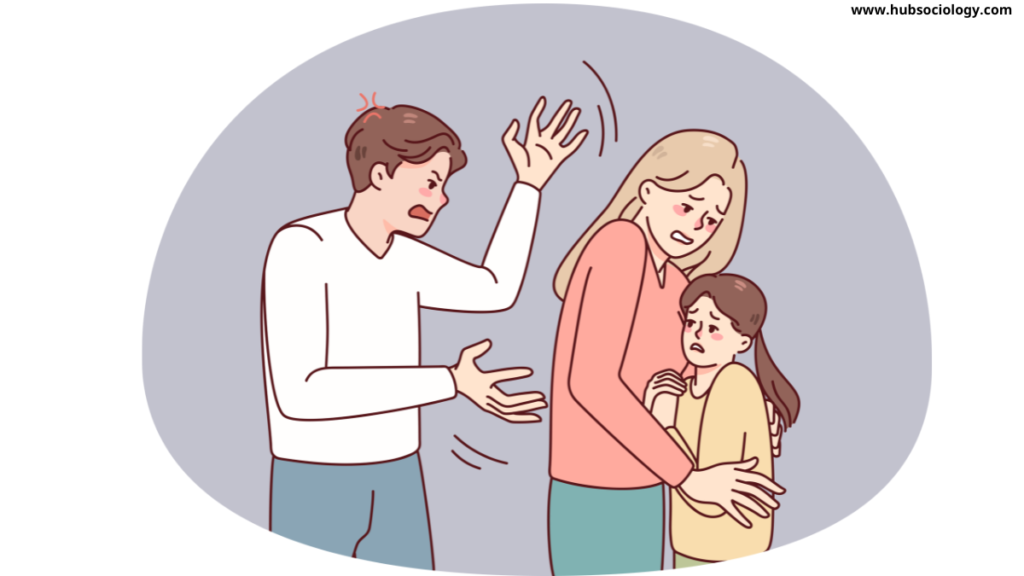
Understanding Domestic Violence: A Sociological Meaning
Domestic violence refers to any form of physical, emotional, psychological, sexual, or economic abuse that occurs within the domestic sphere, primarily by intimate partners or family members. Sociologically, it is understood as a form of social control exercised within intimate relationships, often legitimized by cultural norms and power structures.
In Indian society, the family is considered a sacred institution, and marital relationships are often viewed as private matters. This perception frequently discourages external intervention, allowing violence to remain hidden and normalized. Domestic violence is therefore not only an act of aggression but also a reflection of social tolerance toward inequality and domination.
Patriarchy and Gender Power Relations
One of the most significant sociological causes of domestic violence in India is patriarchy. Patriarchy establishes male authority within the family and society, granting men control over women’s labor, sexuality, mobility, and decision-making.
From childhood, gender socialization teaches men dominance and women submission. Sons are often valued more than daughters, and masculinity is associated with control and aggression, while femininity is linked with sacrifice and obedience. Within marriage, these norms translate into unequal power relations, where violence becomes a tool to enforce conformity.
Domestic violence, in this context, is not an exception but an extension of patriarchal authority. It is often justified as discipline, correction, or a private family matter, making resistance socially costly for women.
Marriage, Dowry, and Familial Expectations
Marriage in India is not merely a union of two individuals but a social institution governed by customs, economic exchanges, and kinship obligations. Dowry practices, despite being legally prohibited, continue to be a major contributor to domestic violence.

Women often face harassment, emotional abuse, and physical violence when dowry demands are considered insufficient. In many cases, violence escalates after marriage when women move into their husband’s household, where they occupy a structurally subordinate position. The joint family system can sometimes intensify abuse, as mothers-in-law and other relatives may also participate in or legitimize violent behavior.
The expectation that women must adjust, tolerate, and preserve family honor often discourages them from speaking out, reinforcing a cycle of abuse.
Economic Dependence and Structural Inequality
Economic dependence is a crucial factor in understanding domestic violence sociologically. A large proportion of Indian women lack independent income, stable employment, or control over financial resources. This dependence significantly limits their ability to leave abusive relationships.
Even when women are employed, wage gaps, informal work conditions, and lack of property ownership reduce their bargaining power within the household. Economic abuse—such as denial of money, control over earnings, or forced financial dependence—is a common but less visible form of domestic violence.
From a structural perspective, domestic violence is closely linked to economic inequality, where women’s labor is undervalued and unpaid domestic work is taken for granted.
Alcoholism, Stress, and Social Strain
While individual factors alone cannot explain domestic violence, sociology recognizes that social stressors can intensify existing power imbalances. Alcohol abuse, unemployment, poverty, and work-related stress are frequently associated with increased incidents of domestic violence.
In many cases, men experiencing economic insecurity or loss of social status may resort to violence as a way to reassert control and masculinity. This aligns with strain theory, which suggests that social pressures and frustrations can lead to deviant behavior when individuals lack socially acceptable means to cope.
However, it is important to emphasize that these factors do not cause domestic violence independently; they operate within a broader patriarchal framework that normalizes aggression against women.
Cultural Norms and Silence
Cultural values such as family honor, marital permanence, and female sacrifice play a significant role in sustaining domestic violence. Women are often taught that endurance is a virtue and that leaving a marriage brings shame not only to themselves but also to their natal families.
The stigma attached to divorce, separation, or legal action discourages reporting. Community elders, relatives, and even religious authorities may advise reconciliation rather than protection, reinforcing silence.
This culture of silence transforms domestic violence into a hidden social problem, where abuse remains underreported and underrecognized, despite its widespread prevalence.
Legal Awareness and Institutional Gaps
Although India has legal provisions to address domestic violence, sociological studies highlight a significant gap between law and social reality. Many women are unaware of their rights or fear social backlash if they approach legal institutions.
Police reluctance, lengthy judicial processes, victim-blaming attitudes, and lack of support services further discourage reporting. From an institutional perspective, domestic violence persists not only because of individual behavior but also due to weak enforcement and social resistance to change.
Law alone cannot eliminate domestic violence unless accompanied by broader social transformation.
Social Impact on Women
The social impact of domestic violence on women is profound and multidimensional. Survivors often suffer from long-term physical injuries, mental health issues such as depression and anxiety, and loss of self-esteem.
Socially, domestic violence restricts women’s participation in education, employment, and public life. Fear, trauma, and constant surveillance within the household limit their autonomy and aspirations. Many women internalize blame, believing that abuse is a result of personal failure rather than structural injustice.
Over time, domestic violence contributes to the systematic marginalization of women, reinforcing gender inequality across generations.
Impact on Children and Family Structure
Domestic violence does not affect women alone; it deeply impacts children who witness or experience it. Children raised in violent households often suffer emotional trauma, poor academic performance, and behavioural problems.
Sociological research shows that exposure to domestic violence increases the likelihood of intergenerational transmission of violence. Boys may learn to normalize aggression, while girls may internalize submissive roles, perpetuating the cycle of inequality.
At the family level, domestic violence erodes trust, stability, and emotional bonds, transforming the family from a site of care into a space of fear.
Broader Social Consequences
At the societal level, domestic violence undermines social cohesion and development. It places a heavy burden on healthcare systems, legal institutions, and social welfare services. Productivity losses due to physical and psychological harm affect the economy, while persistent gender inequality limits human potential.
Domestic violence also challenges the idea of social progress. A society that tolerates violence within its most intimate institution—the family—struggles to uphold values of equality, justice, and human rights.
From a sociological standpoint, domestic violence is both a symptom and a cause of social inequality.
Changing Attitudes and Social Transformation
Addressing domestic violence in India requires more than legal reform; it demands cultural and structural change. Education plays a critical role in reshaping gender norms and promoting egalitarian values. Gender-sensitive curricula, community awareness programs, and media representation can challenge stereotypes that legitimize violence.

Economic empowerment of women, through education, employment, and property rights, strengthens their autonomy and bargaining power. Equally important is engaging men in conversations about masculinity, responsibility, and non-violent relationships.
Social change occurs when violence is no longer seen as a private matter but recognized as a violation of fundamental social values.
Conclusion
Domestic violence in India is a complex social phenomenon rooted in patriarchy, economic inequality, cultural norms, and institutional weaknesses. A sociological analysis reveals that violence within the home is not accidental or isolated but deeply connected to broader structures of power and inequality.
Its social impact extends beyond individual suffering, affecting families, communities, and society as a whole. Combating domestic violence therefore requires a holistic approach that combines legal protection with social awareness, economic empowerment, and cultural transformation.
Only when families become spaces of equality and respect can society move toward genuine social justice and human dignity.
Frequently Asked Questions (FAQs)
1. What is domestic violence in India from a sociological perspective?
Domestic violence in India is understood sociologically as a form of gender-based power and control rooted in patriarchy, social norms, and unequal family structures rather than merely individual behavior.
2. Why is domestic violence considered a social problem in India?
Domestic violence is a social problem because it is widespread, socially tolerated, underreported, and deeply connected to cultural traditions, gender inequality, and institutional failures.
3. How does patriarchy contribute to domestic violence in India?
Patriarchy legitimizes male dominance and female subordination within the family, making violence an accepted tool to maintain authority and control over women.
4. Is domestic violence limited to poor or uneducated families in India?
No, domestic violence occurs across all social classes, castes, religions, and educational backgrounds, although its forms and visibility may differ.
5. What role does marriage play in domestic-violence in India?
Marriage often places women in a subordinate position within the husband’s family, where expectations of obedience, dowry, and adjustment can increase vulnerability to violence.
6. How does dowry contribute to domestic-violence?
Dowry-related demands and dissatisfaction frequently lead to emotional abuse, physical violence, and harassment against married women.
7. Why do many women tolerate domestic-violence?
Social stigma, economic dependence, fear of family dishonor, concern for children, and lack of institutional support often compel women to remain in abusive relationships.
8. How does economic dependence increase domestic violence?
Economic dependence reduces women’s bargaining power and ability to leave abusive households, making them more vulnerable to continued abuse.
9. What is the impact of domestic-violence on children?
Children exposed to domestic-violence may experience emotional trauma, behavioral issues, poor academic performance, and may normalize violence in adulthood.
10. How does domestic-violence affect society as a whole?
Domestic-violence weakens social cohesion, reinforces gender inequality, burdens healthcare and legal systems, and hampers overall social development.