
Introduction
Gender inequality remains one of the most persistent social issues in India despite constitutional guarantees of equality and decades of reform. From access to education and employment to political participation and personal freedom, men and women continue to experience life differently. These differences are not accidental but deeply rooted in social structures, cultural norms, historical traditions, and institutional practices.
Sociology helps us understand gender inequality not merely as individual discrimination but as a systemic problem embedded in family, religion, economy, education, and politics. Gender is not just a biological category; it is a social construct shaped by power relations. In India, patriarchy continues to influence how resources, opportunities, and authority are distributed between men and women.

This article examines gender inequality in India through a sociological lens, focusing on its causes, manifestations, and consequences, as well as the ongoing struggle for gender justice.
Understanding Gender Inequality Sociologically
In sociology, gender inequality refers to the unequal treatment and status of individuals based on socially constructed gender roles. These inequalities are produced through social institutions such as family, school, religion, media, and the state.
Indian society is largely patriarchal, meaning men hold greater power and control over economic resources, decision-making, and social norms. From birth, individuals are socialized into gender roles that define what is considered “appropriate” behavior for males and females.
Boys are often encouraged to be assertive, independent, and career-oriented, while girls are socialized to be nurturing, obedient, and family-focused. These expectations limit women’s opportunities and reinforce male dominance in public and private life.
Historical Roots of Gender Inequality in India
Gender inequality in India has deep historical roots. In ancient times, women enjoyed relatively higher status in some periods, particularly during the early Vedic era. However, over time, patriarchal practices became more rigid.
Practices such as child marriage, purdah, sati, and restrictions on women’s education reduced women’s autonomy. Colonial rule introduced some reforms, including women’s education and legal rights, but traditional norms continued to dominate everyday life.
Post-independence India adopted a constitution that guarantees equality, yet social practices have been slow to change. Laws alone cannot transform deeply embedded cultural beliefs.
Family and Patriarchy
The family is the primary site where gender inequality is produced and reproduced. In many Indian households, sons are preferred over daughters. This preference is reflected in nutrition, healthcare, education, and emotional investment.
Patriarchal family structures place men as heads of households and decision-makers, while women are expected to manage domestic responsibilities. Even educated women often carry the “double burden” of paid work and unpaid household labor.

Marriage further reinforces inequality. Women are often expected to adjust to their husband’s family, while men retain their independence. Dowry, though illegal, continues in many regions, turning marriage into an economic transaction that devalues women.
Education and Gender Disparities
Education is a powerful tool for social mobility, yet gender disparities persist in India’s education system. While female literacy has improved, gaps remain, especially in rural and marginalized communities.
Girls are more likely to drop out of school due to poverty, early marriage, household responsibilities, and safety concerns. Even when girls receive education, they are often guided toward “feminine” subjects rather than science, technology, or leadership roles.
Sociologically, this reflects how education reproduces gender roles instead of challenging them. Schools often reinforce traditional expectations through textbooks, teacher attitudes, and institutional practices.
Economic Inequality and Labor Market Discrimination
Women’s participation in the Indian workforce is significantly lower than men’s. Those who do work often face lower wages, limited job security, and fewer opportunities for advancement.
Women are concentrated in informal sectors such as domestic work, agriculture, and small-scale industries, where labor protections are weak. Professional fields remain male-dominated, especially in leadership positions.
Unpaid domestic labor is another major source of inequality. Women spend far more time on household chores and caregiving, yet this labor is not recognized economically. This invisibility reflects how patriarchy undervalues women’s contributions.
Political Representation and Power
Although women have the right to vote and contest elections, their representation in Indian politics remains limited. Women occupy a small percentage of seats in Parliament and state legislatures.
At the local level, reservation policies have increased women’s participation in Panchayati Raj institutions. However, many women representatives face symbolic leadership, where male relatives exercise real power.
Sociologically, political inequality reflects broader power structures that restrict women’s access to authority, resources, and decision-making spaces.
Violence Against Women
Gender-based violence is one of the most visible expressions of inequality. Domestic violence, sexual harassment, dowry deaths, honor killings, and trafficking continue to affect millions of women.
Such violence is not just criminal behavior; it is socially rooted. Cultural norms that prioritize male honor, female obedience, and family reputation often silence victims and protect offenders.
The normalization of violence reflects how power operates in intimate relationships. Patriarchy legitimizes male control over women’s bodies and choices.
Caste, Class, and Intersectionality
Gender inequality in India does not exist in isolation. It intersects with caste, class, religion, and region. Dalit, Adivasi, and minority women face multiple layers of discrimination.
For example, upper-caste women may experience restrictions on mobility, while lower-caste women face both gender oppression and caste-based exploitation. Rural women often have fewer opportunities than urban women.
Sociologists use the concept of intersectionality to explain how different forms of inequality overlap and intensify each other.
Media and Cultural Representation
Media plays a major role in shaping gender norms. Indian films, television shows, and advertisements often portray women as caregivers, romantic objects, or obedient daughters-in-law.
Although modern media has started showing independent female characters, stereotypes remain common. Beauty standards, body image pressures, and objectification reinforce unrealistic expectations.
These representations influence how society views women’s roles, reinforcing traditional gender hierarchies.
Religion and Gender Norms
Religion has a powerful influence on gender roles in India. While religious texts offer diverse interpretations, patriarchal readings often dominate social practice.
Women’s mobility, dress, marriage choices, and participation in religious rituals are frequently regulated. Religious institutions are usually male-dominated, limiting women’s authority.
Sociologically, religion acts as both a source of social control and a potential space for reform, depending on interpretation and leadership.
Legal Framework and Social Reality
India has strong legal provisions for gender equality, including laws against discrimination, domestic violence, and sexual harassment. The Constitution guarantees equal rights regardless of gender.
However, enforcement remains weak. Many women lack awareness of their rights, and social stigma prevents them from seeking justice.
This gap between law and practice highlights the difference between formal equality and lived experience.
Feminist Movements in India
Indian feminist movements have played a crucial role in challenging gender inequality. From early reformers like Raja Ram Mohan Roy and Savitribai Phule to modern activists, women have fought for education, rights, and dignity.
Contemporary movements address issues such as workplace harassment, reproductive rights, and digital safety. Social media has become a new platform for feminist expression and mobilization.
Sociologically, these movements represent collective action against structural inequality.
Changing Gender Roles in Urban India
Urbanization and globalization have brought changes to gender relations. More women are pursuing higher education, careers, and financial independence.
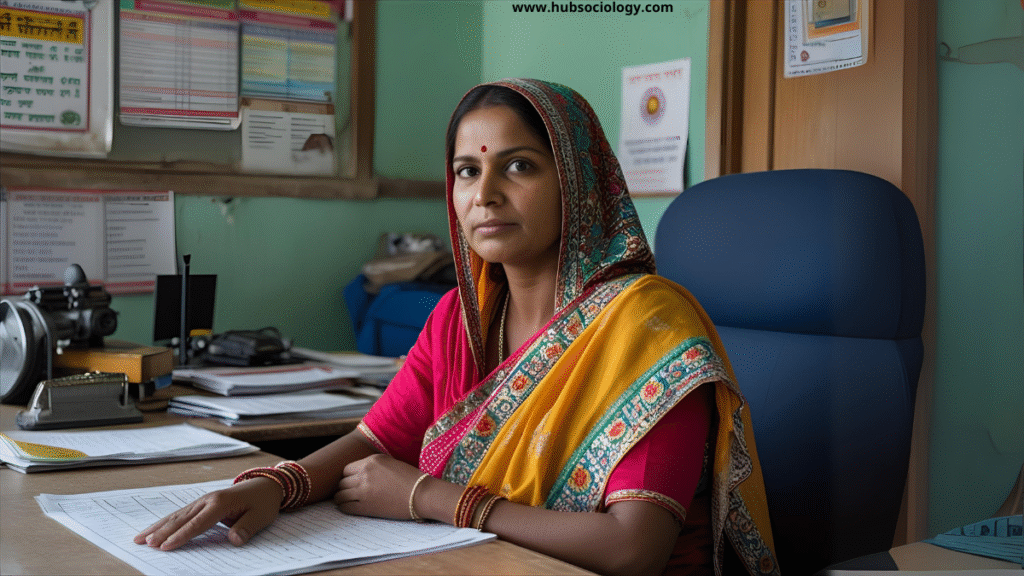
Nuclear families, delayed marriages, and changing aspirations are reshaping traditional roles. However, even modern women face expectations to balance career success with domestic responsibilities.
This shows that social change is uneven and often contradictory.
Education as a Tool for Gender Equality
Education remains one of the most powerful tools for reducing gender inequality. Educated women are more likely to participate in the workforce, make informed health decisions, and challenge discrimination.
Gender-sensitive education can transform attitudes by promoting equality, critical thinking, and respect. Schools and universities can become spaces for social change rather than reproduction of inequality.
The Role of Men in Gender Equality
Gender equality is not only a women’s issue. Men play a crucial role in challenging patriarchal norms.
When men support shared household responsibilities, respect women’s autonomy, and reject harmful masculinity, social change becomes possible.
Sociologically, transforming gender relations requires changing both male and female roles.
Future Challenges and Possibilities
Despite progress, major challenges remain. Economic inequality, digital divides, cultural resistance, and political barriers continue to limit women’s empowerment.
However, growing awareness, youth activism, legal reforms, and global influence offer hope. Social attitudes are slowly evolving, especially among younger generations.
Gender equality is not a destination but an ongoing social process.
Conclusion
Gender inequality in India is deeply rooted in social structures, cultural traditions, and power relations. It affects every aspect of life, from family and education to work and politics.
A sociological perspective helps us understand that inequality is not just about individual behavior but about systems that privilege men and disadvantage women. Laws, policies, and reforms are important, but real change requires transforming social attitudes, institutions, and everyday practices.
True gender equality can only be achieved when women have equal access to resources, respect, opportunities, and decision-making power. It requires collective effort from families, schools, governments, media, and individuals.
In building a more just and inclusive society, gender equality is not only a moral necessity but a social imperative.
FAQs on Gender Inequality in India
- What is Gender Inequality in India?
Gender Inequality in India refers to the unequal treatment and opportunities given to men and women in social, economic, political, and cultural life. - Why does Gender Inequality in India still exist?
It exists due to deep-rooted patriarchy, traditional norms, economic dependence, and limited awareness of women’s rights. - How does family structure contribute to Gender Inequality in India?
Patriarchal families prioritize sons over daughters, restrict women’s freedom, and assign them unpaid domestic roles. - What role does education play in Gender Inequality in India?
Girls often face school dropouts, limited subject choices, and lower access to higher education, reinforcing inequality. - How is Gender Inequality in India linked to employment?
Women receive lower wages, fewer promotions, and limited job security compared to men. - Is Gender Inequality in India visible in politics?
Yes, women are underrepresented in Parliament and leadership positions despite having voting rights. - How does caste affect Gender Inequality in India?
Dalit and tribal women face double discrimination based on both gender and caste. - What types of violence reflect Gender Inequality in India?
Domestic violence, sexual harassment, dowry deaths, and honor killings are major examples. - How does media influence Gender Inequality in India?
Media often portrays women in stereotypical roles, reinforcing traditional gender norms. - What laws address Gender Inequality in India?
Laws like the Domestic Violence Act and Equal Pay Act aim to protect women’s rights. - Why is unpaid domestic work a sign of Gender Inequality in India?
Women’s household labor is not economically valued, increasing their dependency. - How does religion impact Gender Inequality in India?
Patriarchal interpretations of religious texts limit women’s freedom and authority. - What is the role of feminism in reducing Gender Inequality in India?
Feminist movements fight for education, safety, and equal rights for women. - Is Gender Inequality in India changing?
Urbanization, education, and youth awareness are slowly improving gender relations. - How can Gender Inequality in India be reduced?
Through education, legal enforcement, social awareness, and shared responsibilities between genders.
1 thought on “Gender Inequality in India: A Sociological Perspective”