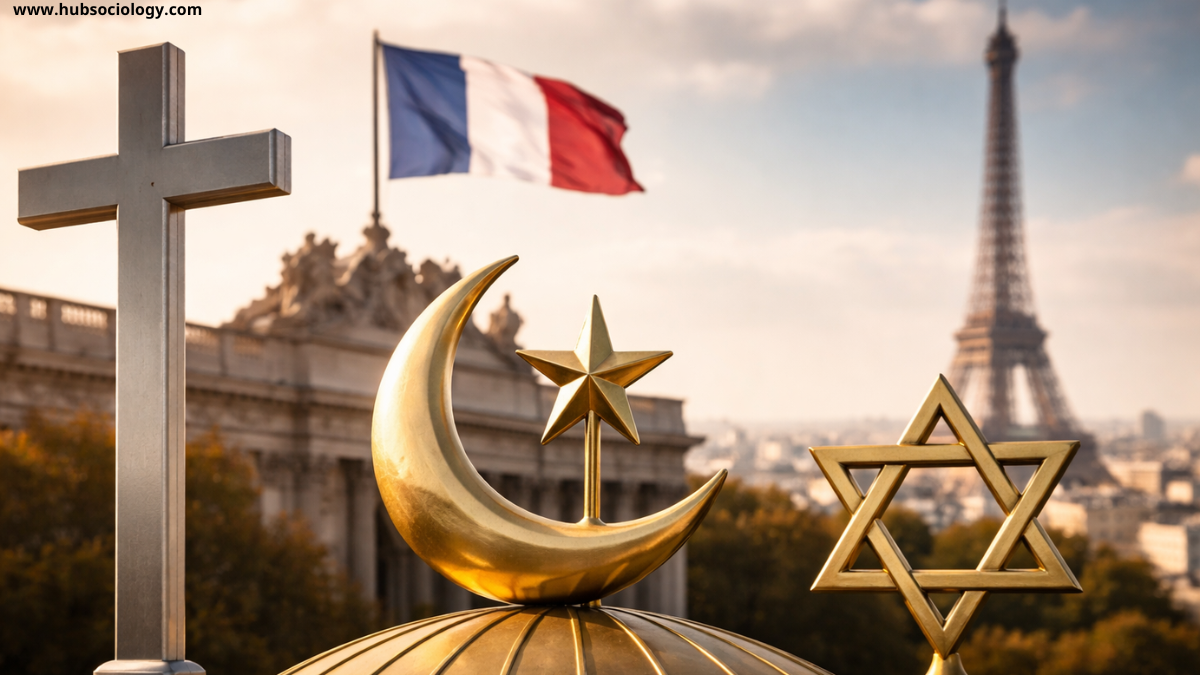
Introduction on Secularism and Religion in France
France is often considered one of the most secular nations in the world. The principle of laïcité—French secularism—shapes public life, politics, education, and the relationship between the state and religion. Unlike countries where religion plays a visible role in public affairs, France maintains a strict separation between religion and the state. This approach has deep historical roots and continues to influence social debates, especially in relation to Islam, multiculturalism, and national identity.
From a sociological perspective, French secularism is not just a legal framework; it is a cultural ideology that defines how religion is perceived, practiced, and regulated. This article explores the historical development of secularism in France and impact religion in France on religious communities, contemporary controversies, and the broader social implications for identity, integration, and social cohesion.
Table of Contents
Historical Roots of French Secularism
The roots of French secularism can be traced back to the French Revolution of 1789. Before the revolution, the Catholic Church held immense power over education, politics, and social life. The revolutionaries viewed the Church as an institution that supported monarchy and social inequality. As a result, they sought to reduce its influence and promote individual freedom and equality.
The idea of separating religion from the state gradually developed throughout the 19th century. This process culminated in the 1905 Law on the Separation of Church and State, which officially established laïcité. The law guaranteed freedom of religious belief while ensuring that the state would remain neutral in religious matters. Public institutions, including schools, were required to be free from religious influence.
From a sociological standpoint, this shift represented a transformation in the power structure of French society. Religion, once a dominant social institution, became a private matter. The state took control of education, social welfare, and moral regulation, reducing the Church’s role in shaping public life.
The Meaning of Laïcité
Laïcité is often translated as “secularism,” but its meaning in France is more specific and rigid than in many other countries. It involves three key principles:
- Freedom of conscience
- Equality of all religions before the law
- State neutrality in religious matters
Sociologically, laïcité reflects the French commitment to universalism. Citizens are expected to participate in public life as individuals, not as members of religious or ethnic groups. This model aims to promote social unity by minimizing visible differences in the public sphere.
However, critics argue that this approach can suppress cultural and religious expression, particularly among minority communities. While laïcité seeks to ensure equality, it may also create tension by limiting how people express their identities.
Religion in Contemporary French Society
Despite its strong secular tradition, France remains a religiously diverse society. Catholicism has historically been the dominant religion, but its influence has declined significantly in recent decades. Church attendance is low, and many French people identify as non-religious.
At the same time, France has one of the largest Muslim populations in Europe, largely due to immigration from former French colonies in North Africa. There are also Jewish, Protestant, Buddhist, and Hindu communities.

From a sociological perspective, this diversity challenges the traditional model of French secularism. The presence of visible religious symbols, such as headscarves, beards, and religious clothing, has sparked debates about national identity, integration, and cultural difference.
Religion in France is no longer just a private belief system; it has become a public and political issue linked to immigration, security, and social cohesion.
Secularism and Education
Education plays a central role in promoting laïcité. French public schools are strictly secular, and religious instruction is not allowed. In 2004, France banned the wearing of “conspicuous” religious symbols in public schools, including Islamic headscarves, Jewish kippahs, and large Christian crosses.
Supporters argue that this policy protects students from religious pressure and ensures equality. Schools, they claim, should be neutral spaces where children are treated as citizens rather than religious members.
Sociologists, however, point out that this policy disproportionately affects Muslim girls who wear the hijab. For many, the ban feels like an attack on their identity rather than a defense of neutrality. As a result, some students feel excluded from the public education system.
This controversy highlights a key sociological tension: whether secularism promotes inclusion or reinforces social exclusion.
Islam and Public Controversies
Islam has become central to debates about secularism in France. Issues such as mosque construction, halal food, Islamic dress, and public prayer have sparked strong reactions.
In 2010, France banned the wearing of face-covering veils (such as the niqab) in public spaces. The government argued that the ban was necessary for security, women’s rights, and social interaction. Critics, however, saw it as a form of discrimination against Muslim women.
From a sociological perspective, these debates reflect deeper anxieties about cultural change, national identity, and social integration. Muslims are often portrayed as “different” or “incompatible” with French values, even though most are French citizens.
Media representation also plays a role. Negative portrayals of Islam can reinforce stereotypes and contribute to social marginalization. This creates a cycle in which religious minorities feel excluded, leading to mistrust and social tension.
Secularism, Identity, and Belonging
In France, national identity is closely tied to secularism. To be “French” is often associated with being secular, rational, and universalist. Religious identity is seen as a private matter that should not define public behavior.
For many minority communities, this creates a sense of conflict. They are expected to integrate into French society by downplaying their religious and cultural differences. While some embrace this model, others feel that it denies them the right to express their full identity.
Sociologists describe this as a tension between assimilation and multiculturalism. France traditionally favors assimilation, where minorities adopt the dominant culture. In contrast, multicultural societies allow different cultural and religious identities to coexist openly.
The French model promotes unity but may also limit diversity. This raises important questions about what it means to belong in a modern, diverse society.
Religion, Politics, and Public Space
Although the French state is secular, religion continues to influence politics and public debates. Issues such as bioethics, family law, immigration, and freedom of expression often involve religious perspectives.
For example, Catholic groups have organized protests against same-sex marriage and abortion rights. Muslim organizations have advocated for religious accommodation in areas like food and dress. These activities show that religion remains a social force, even in a secular state.
However, political leaders are careful to frame debates in secular terms. Religious arguments are often translated into the language of human rights, social values, or national interest.
This demonstrates how religion adapts to secular contexts by changing how it is expressed and justified in public life.
Freedom of Expression and Religious Sensitivity
France strongly defends freedom of expression, including the right to criticize or satirize religion. This principle is rooted in Enlightenment values and the history of resistance to religious authority.
However, this commitment has led to serious conflicts, especially involving depictions of the Prophet Muhammad. Events such as the Charlie Hebdo attacks intensified debates about the limits of free speech and respect for religious beliefs.

Sociologically, these conflicts reveal differing cultural norms. While many in France see satire as a sign of freedom, some religious communities view it as deeply offensive.
Balancing freedom of expression with social harmony remains one of the most difficult challenges for French society.
Social Inequality and Religious Minorities
Religious identity in France is often linked to social inequality. Many Muslim communities live in economically disadvantaged neighborhoods, facing higher unemployment, poorer housing, and limited educational opportunities.
These structural inequalities contribute to social exclusion and reinforce negative stereotypes. When religious identity becomes associated with poverty or crime, it strengthens discrimination.
From a sociological perspective, the problem is not religion itself but unequal access to resources and opportunities. Policies that focus only on secularism without addressing inequality may fail to promote real social integration.
True inclusion requires tackling economic, educational, and social barriers alongside cultural issues.
Changing Attitudes Toward Religion
Younger generations in France are increasingly secular, but they are also more open to diversity. Many young people support freedom of religious expression while also valuing secular principles.
At the same time, global events, terrorism, and migration continue to shape public attitudes. Fear and insecurity can lead to stricter interpretations of secularism.
Sociologists observe that secularism is not fixed; it evolves with social conditions. The future of laïcité will depend on how French society balances unity, diversity, and freedom.
Comparative Sociological Perspective on Secularism and Religion in France
Compared to countries like the United States or the United Kingdom, France has a much stricter approach to secularism. In the U.S., religion is visible in public life, and freedom of religious expression is strongly protected. In the UK, multiculturalism allows religious communities to maintain their traditions openly.
France, by contrast, prioritizes neutrality and uniformity in public spaces. Each model reflects different historical experiences and social values.
This comparison shows that secularism is not universal. It is shaped by culture, history, and social structure.
Conclusion on Secularism and Religion in France
Secularism in France is more than a legal principle; it is a core element of national identity. Through laïcité, the French state seeks to promote equality, unity, and freedom of conscience by keeping religion out of public institutions.
From a sociological perspective, however, secularism also creates tensions. While it aims to treat all citizens equally, it can limit the public expression of religious identity, particularly for minority communities. Debates over Islam, education, and freedom of expression reveal deeper issues related to belonging, power, and social integration.
Religion in France has not disappeared; it has transformed. It now operates within a secular framework, influencing social life in subtle but significant ways. The challenge for French society is to maintain its secular values while embracing cultural and religious diversity.
As France continues to change, the relationship between secularism and religion will remain a key area of sociological inquiry, reflecting broader struggles over identity, equality, and social cohesion in a modern world.
FAQs on Religion in France
- What is the role of religion in France today?
Religion in France mainly remains a private matter, as the state follows strict secularism (laïcité), keeping religion separate from public institutions. - What does secularism mean in relation to Religion in France?
Secularism in France ensures state neutrality toward all religions and prevents religious influence in public governance. - Which is most common religion in France?
Christianity, especially Catholicism, is historically dominant, but Islam is now the second-largest religion in France. - Is France a religious country?
France is largely secular, with many citizens identifying as non-religious despite religious diversity. - How does Religion in France affect education?
Public schools in France are secular, and religious symbols are restricted to maintain neutrality. - Why is Islam often discussed in debates on Religion in France?
Islam is central to public debates due to immigration, cultural identity, and visibility of religious practices. - Are religious symbols allowed in public spaces in France?
Some religious symbols are restricted, especially in schools and government institutions. - What is laïcité in France?
Laïcité is the principle that separates religion from the state and ensures religious neutrality. - How does Religion in France impact national identity?
French identity is closely linked to secular values, often prioritizing citizenship over religious identity. - Is freedom of religion protected in France?
Yes, individuals are free to believe and practice any religion privately. - Why was the veil banned in public spaces?
The ban was justified for security, gender equality, and social integration reasons. - How does the media portray Religion in France?
Media coverage often focuses on Islam, security issues, and cultural conflicts. - Are religious minorities marginalized in France?
Some religious groups face social and economic challenges linked to inequality. - How is Religion in France different from the USA?
France enforces strict secularism, while the USA allows visible religious expression in public life. - What is the future of Religion in France?
Religion in France will continue evolving as society balances secularism with diversity.