
Introduction
The 21st century has been a period of profound social transformation across Europe. Rapid globalization, technological innovation, demographic shifts, political realignments, and cultural diversification have reshaped European societies in complex ways. From changing family structures and labor markets to new forms of identity and political participation, Europe today presents a dynamic social landscape that sociologists seek to understand through classical and contemporary theories.
Social change in Europe cannot be viewed as a uniform process. While countries share certain common trends, historical experiences, welfare regimes, and cultural traditions continue to shape national and regional variations. This article offers a sociological overview of social change in Europe in the 21st century, focusing on key dimensions such as globalization, demographic transformation, economic restructuring, digitalization, migration, culture, and politics.
Understanding Social Change: A Sociological Framework
In sociology, social change refers to significant alterations in social structures, institutions, norms, and patterns of interaction over time. Classical sociologists like Émile Durkheim emphasized the transition from traditional to modern societies, while Max Weber analyzed rationalization and bureaucracy as drivers of change. In contemporary Europe, theorists such as Anthony Giddens highlight reflexive modernity, globalization, and the transformation of intimacy.
European social change today is best understood as multi-dimensional: economic, cultural, political, and technological processes intersect to reshape everyday life.
Globalization and European Society
Globalization has been one of the most powerful forces influencing Europe in the 21st century. Economic integration, cross-border trade, cultural exchange, and global communication networks have reduced national boundaries while increasing interdependence.
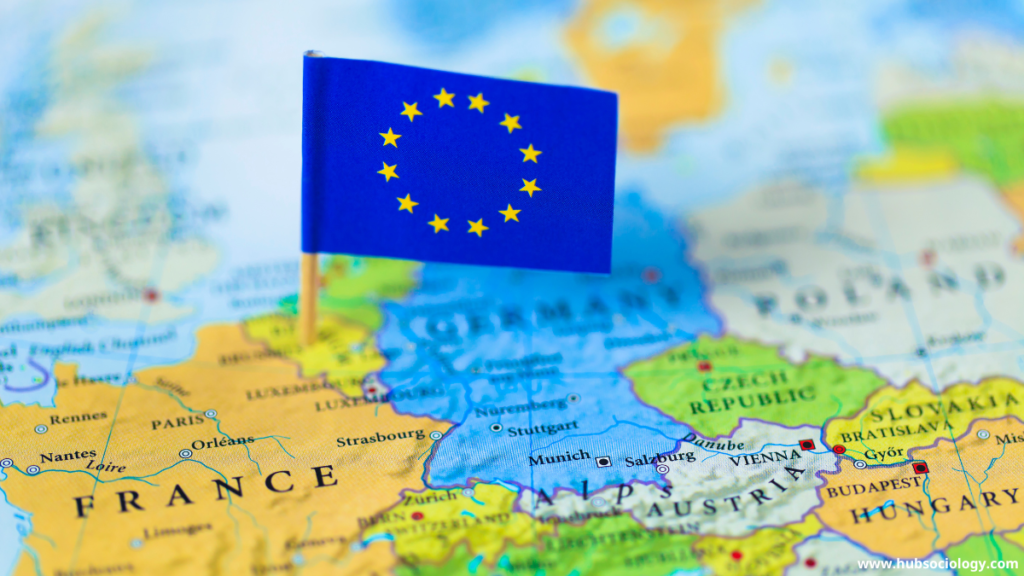
Institutions such as the European Union have played a central role in facilitating economic and political integration. Sociologically, globalization has produced both opportunities and inequalities. On one hand, it has expanded mobility, access to global markets, and cultural diversity. On the other, it has intensified economic insecurity, labor market competition, and social polarization.
Ulrich Beck’s concept of the “risk society” is particularly relevant in Europe, where global risks such as financial crises, pandemics, and climate change have reshaped public trust in institutions and expert systems.
Economic Restructuring and Changing Class Relations
Europe’s transition from industrial economies to post-industrial and knowledge-based economies has transformed class structures. Manufacturing employment has declined, while service, information, and care sectors have expanded. This shift has altered traditional working-class identities and expanded the middle class in some regions, while also producing new forms of precarity.
The rise of the gig economy, temporary contracts, and platform-based work has weakened job security, especially for young people. Sociologists describe this as the emergence of a “precariat,” a class characterized by unstable employment and limited social protection.
Welfare states—once a defining feature of European societies—have undergone reforms due to neoliberal policies, aging populations, and fiscal pressures. While Nordic countries continue to emphasize universal welfare, Southern and Eastern European societies often experience higher levels of inequality and unemployment.
Demographic Change: Aging, Family, and Fertility

Demographic change is one of the most significant social transformations in 21st-century Europe. Low fertility rates and increased life expectancy have resulted in rapidly aging populations. Countries such as Italy, Germany, and Spain face challenges related to pension systems, healthcare, and intergenerational solidarity.
Family structures have also diversified. The traditional nuclear family is no longer dominant; cohabitation, single-parent households, same-sex families, and childfree lifestyles are increasingly common. From a sociological perspective, this reflects broader shifts toward individualization and gender equality.
Women’s increased participation in education and the workforce has reshaped gender roles, although persistent inequalities in unpaid care work and wage gaps remain key issues across Europe.
Migration, Multiculturalism, and Identity
Migration has profoundly influenced European societies in the 21st century. Labor migration, refugee movements, and intra-European mobility have increased cultural diversity, particularly in urban centers. Cities such as London, Paris, Berlin, and Stockholm have become multicultural hubs.
Sociologically, migration has generated debates around integration, citizenship, and national identity. Multiculturalism policies in Western Europe have promoted cultural recognition, yet they have also faced criticism for failing to address social exclusion and segregation.
The rise of anti-immigrant sentiment and right-wing populism reflects tensions between globalization and national identity. These movements often frame migration as a threat to social cohesion, welfare systems, and cultural traditions, revealing deep anxieties about social change.
Digitalization and Social Life
The digital revolution has transformed European society at an unprecedented pace. Internet access, social media, artificial intelligence, and remote work have reshaped communication, education, and labor. Sociologists analyze digitalization as both empowering and disruptive.
Digital platforms enable new forms of social interaction and political mobilization, particularly among youth. However, they also raise concerns about surveillance, data privacy, misinformation, and digital inequality. The “digital divide” persists between generations, regions, and social classes, challenging the idea of equal access to technological progress.

The COVID-19 pandemic accelerated digital transformation, normalizing remote work and online education while blurring boundaries between private and professional life.
Cultural Change and Value Transformation
Cultural change in Europe reflects a shift from traditional authority to individual choice and self-expression. According to value change theories, European societies have increasingly embraced post-materialist values such as environmentalism, gender equality, and human rights.
Religion’s influence on public life has declined in many European countries, a process sociologists describe as secularization. However, religion has not disappeared; instead, it has become more individualized and, in some cases, politicized, especially in debates around migration and national identity.
Popular culture, media, and transnational lifestyles further contribute to hybrid identities, particularly among younger generations who see themselves as both national and European—or even global—citizens.
Political Change and Civic Participation
European politics in the 21st century has been marked by declining trust in traditional institutions and the rise of new political movements. Voter turnout has fluctuated, while non-conventional forms of participation—protests, online activism, and social movements—have gained prominence.
Movements addressing climate change, gender equality, and social justice reflect a shift toward issue-based politics. At the same time, populist parties challenge liberal democratic norms by appealing to national sovereignty and cultural homogeneity.
From a sociological standpoint, these trends highlight a transformation in the relationship between citizens and the state, shaped by globalization, inequality, and perceived loss of control.
Europe in Transition: Continuity and Change
While the pace of social change in Europe has accelerated, elements of continuity remain. Welfare institutions, democratic values, and cultural traditions continue to shape social life. However, the tension between tradition and transformation defines the European experience in the 21st century.
Sociologists emphasize that social change is neither purely progressive nor entirely regressive. Instead, it involves trade-offs: increased freedom alongside insecurity, diversity alongside conflict, and innovation alongside inequality.
Conclusion
Social change in Europe in the 21st century is a complex and ongoing process driven by globalization, economic restructuring, demographic shifts, migration, and digitalization. From a sociological perspective, these changes reshape social institutions, identities, and power relations in profound ways.
Europe today stands at a crossroads, balancing integration and diversity, welfare and competitiveness, tradition and innovation. Understanding these transformations sociologically allows us to see beyond surface-level events and recognize the deeper structural forces shaping European societies. As Europe continues to evolve, sociological analysis remains essential for interpreting its challenges and imagining more inclusive and sustainable futures.
FAQs on Social Change in Europe
- What is meant by Social Change in Europe?
Social Change in Europe refers to long-term transformations in social institutions, relationships, values, and everyday life across European societies due to economic, cultural, political, and technological factors. - Why is Social Change in Europe significant in the 21st century?
Social Change in Europe is significant because globalization, digitalization, migration, and demographic shifts are reshaping work, family, identity, and governance at an unprecedented pace. - How has globalization influenced Social Change in Europe?
Globalization has intensified economic integration, cultural exchange, and mobility, contributing to both new opportunities and growing inequalities within European societies. - What role does migration play in Social Change in Europe?
Migration has increased cultural diversity, transformed urban life, and sparked debates about integration, citizenship, and national identity in Europe. - How has digitalization contributed to Social Change in Europe?
Digitalization has altered communication, employment, education, and political participation, while also creating challenges such as digital inequality and privacy concerns. - How are family structures changing in Europe?
Social Change in Europe includes the decline of traditional nuclear families and the rise of cohabitation, single-parent households, and diverse family forms. - What demographic changes are shaping Social Change in Europe?
Aging populations, low fertility rates, and longer life expectancy are key demographic trends influencing welfare systems and intergenerational relations. - How has Social Change in Europe affected gender roles?
Greater female participation in education and employment has transformed gender roles, though inequalities in wages and care work persist. - What is the impact of economic restructuring on Social Change in Europe?
The shift to post-industrial economies has changed class structures, expanded service-sector work, and increased job insecurity for many workers. - How does Social Change in Europe influence cultural values?
European societies increasingly emphasize individual choice, human rights, and environmental awareness, reflecting a shift toward post-materialist values. - Is secularization part of Social Change in Europe?
Yes, declining religious authority in public life is a key aspect of Social Change in Europe, though religion continues in more individualized forms. - How has Social Change in Europe affected politics?
It has led to declining trust in traditional institutions, the rise of social movements, and the growth of populist and nationalist politics. - What challenges does Social Change in Europe create?
Challenges include social inequality, cultural tensions, political polarization, and pressures on welfare states. - Are all European countries experiencing Social Change in the same way?
No, Social Change in Europe varies by region due to different histories, economies, cultures, and welfare systems. - Why is sociology important for understanding Social Change in Europe?
Sociology helps analyze structural forces, power relations, and social patterns behind Social Change in Europe, beyond surface-level events.