Introduction
Urbanization is one of the most significant social transformations in modern India. From ancient cities like Varanasi and Madurai to contemporary megacities such as Mumbai, Delhi, and Bengaluru, urban centers have long played a crucial role in India’s social and economic life. However, the pace and scale of urbanization after independence, especially since economic liberalization in the 1990s, have been unprecedented. According to sociological analysis, urbanization is not merely the growth of cities or an increase in urban population; it represents a complex process of social change affecting family structures, occupational patterns, social relations, culture, and inequality.
India’s urban population has grown rapidly due to rural–urban migration, natural population increase, and the expansion of urban boundaries. While urbanization has generated opportunities for employment, education, and modernization, it has also produced serious social challenges such as poverty, slums, crime, environmental degradation, and social exclusion.
This article examines urbanization in India from a sociological perspective, focusing on its causes, patterns, and wide-ranging social consequences.
Understanding Urbanization in the Indian Context
Urbanization refers to the process by which an increasing proportion of a population comes to live in urban areas, accompanied by changes in lifestyle, social organization, and economic activities. In India, urbanization has been shaped by historical, economic, political, and cultural factors.
During the colonial period, cities developed primarily as administrative, commercial, and industrial centers serving colonial interests. Post-independence urban growth was influenced by planned industrialization, expansion of public sector employment, and later by globalization and the growth of the service economy. Sociologically, Indian urbanization is distinctive because it coexists with a large rural population, strong traditional social institutions, and deep-rooted inequalities based on caste, class, gender, and region.
Unlike the classic Western model where industrialization led to rapid and relatively uniform urban growth, Indian urbanization has been uneven and often unplanned. Megacities coexist with small towns, and modern urban lifestyles exist alongside traditional practices. This duality is central to understanding the social consequences of urbanization in India.
Causes of Urbanization in India
Several interrelated factors have contributed to the rapid urbanization of Indian society. Industrialization has been a major driving force, as cities offer better employment opportunities in manufacturing, construction, and services. The growth of industries and corporate sectors attracts rural migrants seeking stable incomes and improved living standards.
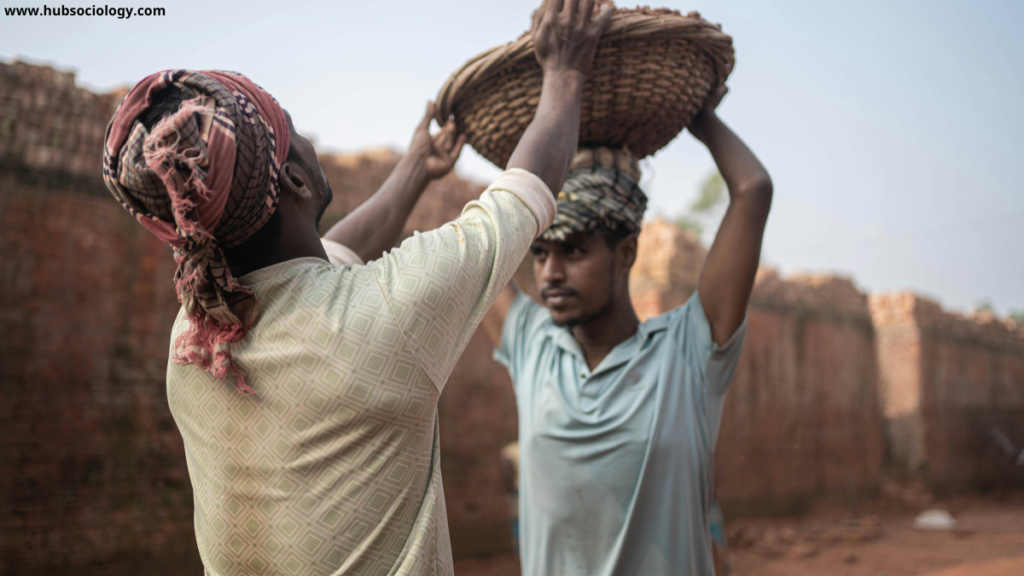
Rural–urban migration is another key factor. Agricultural distress, land fragmentation, unemployment, and lack of basic facilities in rural areas push people toward cities. At the same time, cities pull migrants by offering education, healthcare, and social mobility. This push–pull dynamic has significantly altered India’s demographic composition.
Economic liberalization and globalization have further accelerated urbanization. The expansion of information technology, finance, real estate, and global trade has concentrated economic activities in urban centers. Government initiatives such as the Smart Cities Mission and urban infrastructure projects have also contributed to the growth of cities.
From a sociological perspective, urbanization is not only about economic motives but also about aspirations. Cities symbolize modernity, freedom, and opportunity, particularly for youth and marginalized groups seeking to escape traditional social constraints.
Urbanization and Changing Social Structure
One of the most profound social consequences of urbanization in India is the transformation of social structure. Traditional rural society is characterized by close-knit communities, kinship ties, caste-based occupations, and gemeinschaft-type relationships. Urban society, in contrast, is more individualistic, heterogeneous, and based on contractual and impersonal relations.
Urbanization weakens the dominance of caste as the sole determinant of occupation and status, although it does not eliminate caste entirely. In cities, class, education, and income increasingly shape social stratification. Occupational mobility becomes more possible, allowing individuals from lower castes or rural backgrounds to improve their social position. However, caste identities often reappear in new forms, such as residential segregation, political mobilization, and social networks.
The rise of a diverse urban middle class is another significant structural change. This class plays a key role in shaping consumption patterns, cultural norms, and political discourse. At the same time, urbanization has also expanded the urban poor, leading to sharper class divisions and visible inequalities within cities.
Impact on Family and Kinship
Urbanization has deeply affected family and kinship systems in India. The traditional joint family, common in rural areas, has gradually given way to nuclear and smaller family units in urban settings. Factors such as housing constraints, employment mobility, women’s participation in the workforce, and changing values contribute to this shift.

Urban families tend to emphasize individual choice, privacy, and emotional bonds rather than collective authority and obligation. Marriage patterns have also changed, with a gradual increase in love marriages, inter-caste unions, and delayed marriages, particularly among educated urban youth. However, arranged marriages and family involvement remain significant, reflecting the coexistence of tradition and modernity.
Kinship ties do not disappear in urban areas but become more flexible and selective. Relatives often provide support in migration, job search, and childcare, demonstrating that traditional networks adapt rather than vanish. Sociologically, this highlights the adaptive capacity of Indian social institutions in response to urbanization.
Urbanization, Gender Relations, and Women
Urbanization has had complex and contradictory effects on gender relations in India. On one hand, cities offer greater educational and employment opportunities for women, leading to increased economic independence and social visibility. Urban women are more likely to participate in the workforce, pursue higher education, and challenge traditional gender roles.
On the other hand, urban life also presents new forms of gender inequality and vulnerability. Women face issues such as unsafe public spaces, workplace discrimination, and the double burden of paid work and domestic responsibilities. Urban poverty affects women disproportionately, particularly those working in informal sectors such as domestic work, street vending, and home-based industries.
From a sociological viewpoint, urbanization creates spaces for both empowerment and exploitation. Gender relations in cities are shaped by class, caste, religion, and migration status, making women’s urban experiences highly diverse.
Growth of Slums and Urban Poverty
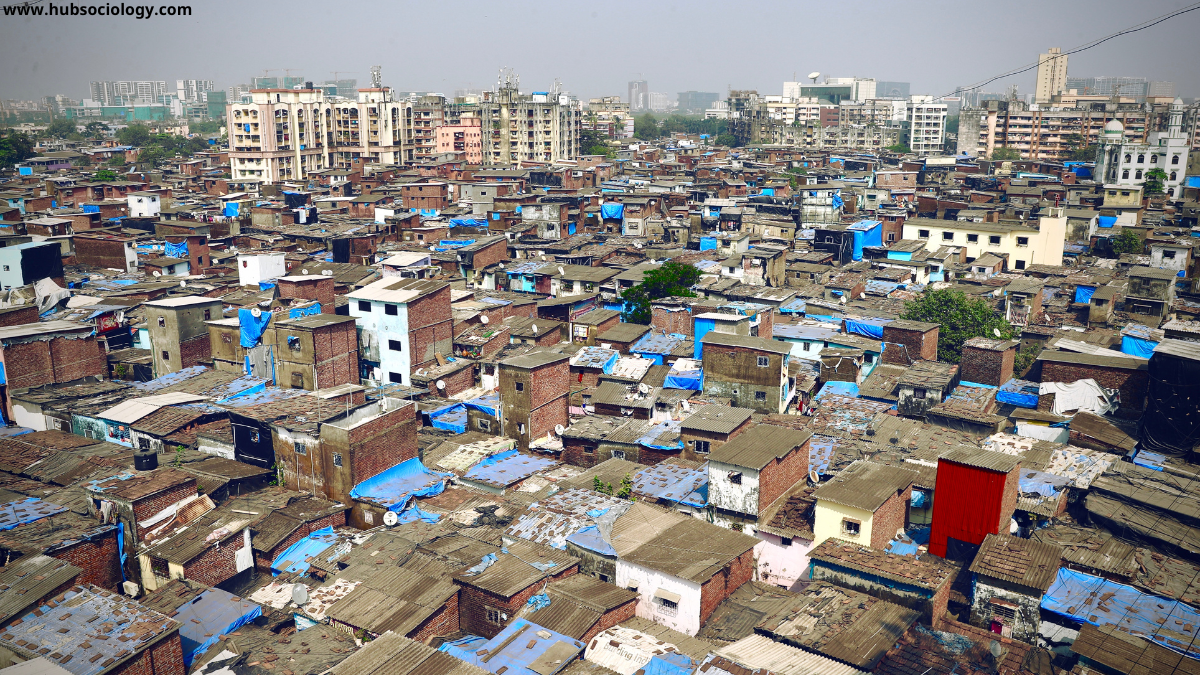
One of the most visible social consequences of urbanization in India is the proliferation of slums and informal settlements. Rapid migration and inadequate urban planning have resulted in a severe shortage of affordable housing. As a result, a large section of the urban population lives in overcrowded and underserved areas with poor sanitation, insecure tenure, and limited access to basic services.
Urban poverty is not simply a lack of income but a multidimensional problem involving health, education, housing, and social exclusion. Slum dwellers often work in informal and precarious jobs, lacking job security and social protection. Despite their contribution to the urban economy, they remain marginalized and stigmatized.
Sociologically, slums represent both deprivation and resilience. They are sites of exploitation but also of strong community networks, collective action, and survival strategies. Understanding urban poverty requires moving beyond stereotypes and recognizing the structural factors that produce inequality.
Urbanization and Social Inequality
Urbanization in India has intensified social inequalities. While cities generate wealth and opportunities, these benefits are unevenly distributed. The contrast between luxury apartments and sprawling slums highlights the stark inequalities within urban spaces.
Class inequality intersects with caste and religion, shaping access to housing, education, employment, and political power. Marginalized groups such as Scheduled Castes, Scheduled Tribes, and religious minorities often face discrimination in urban labor and housing markets. Migrants without social connections or legal documentation are particularly vulnerable.
Urban spaces are increasingly segregated along economic and social lines. Gated communities, elite schools, and private healthcare facilities coexist with overcrowded public services, reinforcing social divisions. From a sociological perspective, urbanization without inclusive planning risks deepening social polarization.
Urbanization and Cultural Change
Urbanization is a powerful agent of cultural change in India. Cities act as centers of cultural exchange, innovation, and diversity. Urban culture is shaped by mass media, consumerism, global influences, and multicultural interactions.
Traditional customs and practices are often reinterpreted in urban contexts. Festivals, food habits, clothing, and language reflect a blend of regional traditions and global trends. Urban youth culture, influenced by social media and popular culture, emphasizes individuality, self-expression, and modern lifestyles.

At the same time, urbanization can lead to cultural alienation and identity conflicts. Migrants may experience a sense of loss or dislocation as they adapt to urban norms. Sociologically, urban culture is dynamic and contested, reflecting ongoing negotiations between tradition and change.
Urbanization, Crime, and Social Control
The rapid growth of cities has implications for crime and social control. Urban anonymity, economic inequality, and social disorganization can contribute to higher rates of crime, including theft, violence, and organized crime. Informal settlements and marginalized neighborhoods often face over-policing or neglect, further complicating issues of justice and security.
However, it is important to avoid simplistic assumptions that cities are inherently more criminal. Sociological studies emphasize the role of structural factors such as poverty, unemployment, and exclusion in shaping crime patterns. Urban communities also develop formal and informal mechanisms of social control, including neighborhood associations, civic activism, and digital surveillance.
Environmental and Health Consequences
Urbanization has significant environmental and health implications. Rapid industrialization, vehicular pollution, and inadequate waste management have degraded urban environments. Air and water pollution, traffic congestion, and loss of green spaces directly affect the quality of life.
Public health challenges such as overcrowding, poor sanitation, and unequal access to healthcare disproportionately affect the urban poor. At the same time, cities offer advanced medical facilities and specialized healthcare, creating stark contrasts within urban populations.
From a sociological lens, environmental problems are not merely technical issues but social ones, rooted in patterns of consumption, governance, and inequality.
Conclusion
Urbanization in India is a transformative process with far-reaching social consequences. It has reshaped social structures, family systems, gender relations, cultural practices, and patterns of inequality. While cities symbolize progress, opportunity, and modernity, they also expose deep social contradictions and challenges.
A sociological understanding of urbanization highlights that its outcomes are not inevitable but shaped by policy choices, social institutions, and collective action. Inclusive urban planning, social justice, and participatory governance are essential to ensure that urbanization becomes a force for equitable and sustainable development.
As India continues to urbanize in the coming decades, the challenge lies in building cities that are not only economically vibrant but also socially inclusive, culturally diverse, and environmentally sustainable.
FAQs on Urbanization in India
- What is meant by Urbanization in India?
Urbanization in India refers to the increasing movement of population from rural areas to cities and the expansion of urban settlements, accompanied by social, economic, and cultural changes. - What are the main causes of Urbanization in India?
The major causes include industrialization, rural–urban migration, employment opportunities, education, economic liberalization, and better healthcare and infrastructure in cities. - How has Urbanization in India grown after independence?
Urbanization in India accelerated after independence due to planned industrial development and expanded rapidly after the 1990s economic reforms. - What is the sociological importance of Urbanization in India?
From a sociological perspective, urbanization in India transforms social structure, weakens traditional institutions, promotes mobility, and reshapes class and caste relations. - How does Urbanization in India affect family structure?
Urbanization in India has led to the decline of joint families and the rise of nuclear families due to migration, housing constraints, and changing values. - What is the relationship between Urbanization in India and migration?
Rural–urban migration is a key driver of urbanization in India, as people move to cities in search of jobs, education, and better living conditions. - How does Urbanization in India impact caste system?
Urbanization in India reduces rigid caste-based occupations but does not eliminate caste. Instead, caste adapts to urban settings through new social and political forms. - What role does Urbanization in India play in women’s empowerment?
Urbanization in India provides women with greater access to education and employment, but also exposes them to new forms of exploitation and insecurity. - Why are slums a major issue in Urbanization in India?
Rapid urbanization in India without adequate planning leads to housing shortages, resulting in slums and informal settlements with poor living conditions. - How does Urbanization in India contribute to social inequality?
Urbanization in India creates economic opportunities but also widens the gap between rich and poor, leading to class-based spatial and social segregation. - What are the cultural effects of Urbanization in India?
Urbanization in India promotes cultural diversity, modernization, and global influences while also creating identity conflicts and cultural displacement. - How does Urbanization in India affect employment patterns?
Urbanization in India shifts employment from agriculture to industry and services, increasing informal and contract-based jobs in cities. - What are the environmental consequences of Urbanization in India?
Urbanization in India leads to pollution, loss of green spaces, waste management problems, and environmental health risks. - Is Urbanization in India linked to crime and social problems?
Urbanization in India can increase crime due to inequality, unemployment, and social disorganization, though structural factors play a larger role than urban life itself. - How can Urbanization in India be made socially sustainable?
Urbanization in India can be made sustainable through inclusive planning, affordable housing, employment generation, environmental protection, and participatory governance.