Introduction
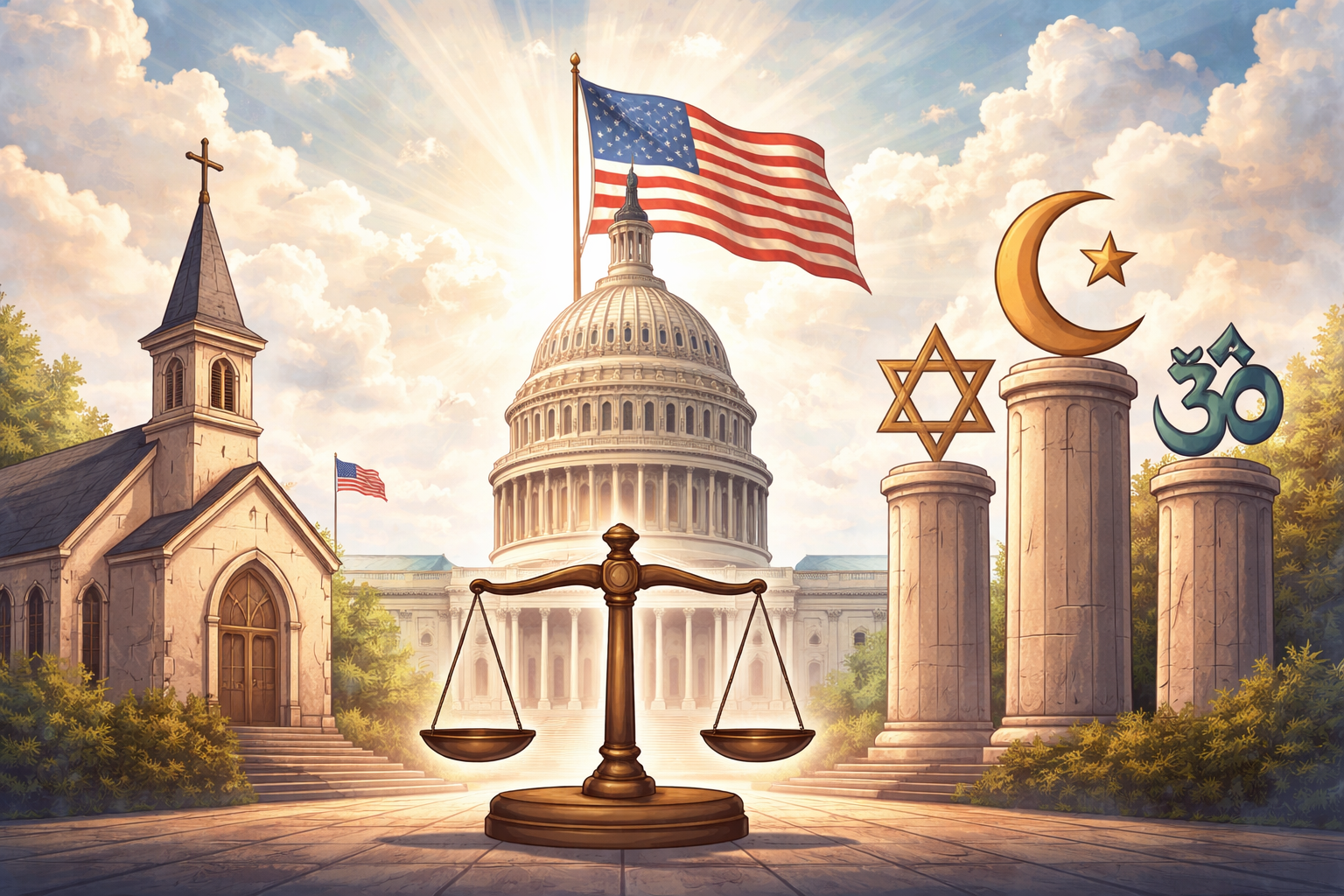
Religion and secularism have coexisted in a complex and often paradoxical relationship within American society. Unlike many modern nations where secularism emerged as a reaction against religious dominance, the United States presents a unique case: it is constitutionally secular yet socially religious. This duality makes America a fascinating subject for sociological analysis. Religion continues to influence culture, morality, politics, and identity, while secular principles shape governance, law, and public institutions. From the early Puritan settlers to contemporary debates over church–state separation, religion and secularism have continuously shaped American social life.
Sociologically, religion is not merely a matter of personal belief but a social institution that interacts with power, inequality, culture, and social change. Similarly, secularism is not the absence of religion but a framework that regulates the public role of religious belief.
This article examines religion and secularism in America through sociological lenses, exploring their historical roots, institutional roles, social functions, conflicts, and contemporary transformations.
Historical Foundations of Religion in America
Religion played a central role in the formation of American society. Many early European settlers migrated to North America seeking religious freedom from state-controlled churches in Europe. Protestant denominations, particularly Puritanism, strongly influenced early social norms, education, family life, and governance. Churches functioned as key community institutions, providing moral guidance, social solidarity, and mutual support.
Despite the deep religious character of early American communities, the founders were wary of religious domination over the state. The principle of religious freedom emerged not to weaken religion but to protect it from political control. This historical compromise laid the foundation for a secular state coexisting with a religious society. Sociologically, this arrangement allowed religion to flourish in the private and civil spheres while limiting its formal authority in political institutions.
Constitutional Secularism and the Separation of Church and State
American secularism is primarily institutional rather than cultural. The Constitution prohibits the establishment of a state religion while guaranteeing free exercise of religious belief. From a sociological standpoint, this arrangement reflects pluralism rather than hostility toward religion. Secularism in America does not demand the exclusion of religion from social life but regulates its influence within public institutions.
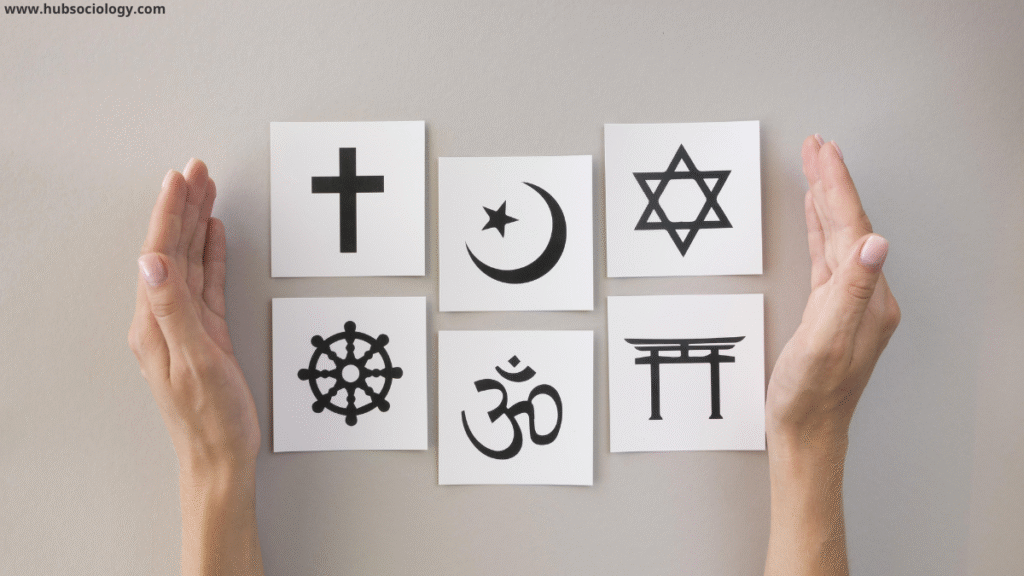
This form of secularism allows diverse religious traditions to coexist without state favoritism. Over time, it has enabled the growth of religious diversity, including Catholicism, Judaism, Islam, Hinduism, Buddhism, and non-religious identities. Sociologically, this pluralism contributes to social complexity and negotiation, as groups seek recognition and accommodation within a shared civic framework.
Religion as a Social Institution
From a sociological perspective, religion serves several core social functions in American society. It provides meaning and purpose, reinforces moral norms, fosters social cohesion, and offers emotional support during times of crisis. Religious institutions also play an important role in socialization, transmitting values related to family, work, discipline, and responsibility.
Churches and religious organizations often function as centres of community life, especially in marginalized communities. They provide education, charity, healthcare, and advocacy. For many African American communities, for example, churches have historically served as spaces of resistance, empowerment, and collective identity. In this sense, religion operates not only as a belief system but as a form of social capital.
Secularization Theory and the American Exception
Classical sociological theories predicted that modernization would lead to the decline of religion. Industrialization, scientific rationality, urbanization, and education were expected to reduce religious influence. While this pattern appeared in many European societies, the United States has often been described as an exception.
Although traditional religious authority has declined in some areas, religion remains socially significant in America. Instead of disappearing, religion has transformed. New religious movements, megachurches, and individualized spirituality have emerged. Sociologists argue that America has experienced religious change rather than religious decline. Secularization in the U.S. is uneven, affecting institutions more than personal belief.
Religious Diversity and Pluralism
One of the defining features of religion in America is diversity. Immigration, globalization, and legal protections have created a multi-religious society. This diversity challenges older notions of a Protestant-dominated moral order and encourages interfaith interaction.
From a sociological perspective, religious pluralism promotes tolerance but can also generate tension. Different belief systems compete for cultural legitimacy and political influence. Debates over religious symbols in public spaces, faith-based education, and moral legislation reflect ongoing negotiations between religious freedom and secular governance.
Religion, Politics, and Public Life
Despite constitutional secularism, religion remains influential in American politics. Religious values often shape political attitudes on issues such as abortion, marriage, education, and social welfare. Religious groups mobilize voters, lobby policymakers, and frame public debates in moral terms.
Sociologically, this interaction illustrates how religion functions as a source of collective identity and political power. However, it also raises concerns about exclusion and inequality. When religious beliefs dominate public policy, minority groups and non-religious citizens may feel marginalized. This tension highlights the fragile balance between democratic participation and secular principles.
Secularism, Morality, and Social Change
A common misconception equates secularism with moral decline. Sociological analysis challenges this view by emphasizing that morality is socially constructed and maintained through multiple institutions, including family, education, law, and media. Secular ethics often draw on principles such as human rights, equality, and social justice.
In contemporary America, moral authority is increasingly decentralized. Individuals negotiate values from diverse sources rather than relying solely on religious institutions. This shift reflects broader processes of individualization and cultural change. Secularism, in this context, allows for moral pluralism rather than moral absence.
Rise of the “Nones” and Changing Religious Identity
One of the most significant trends in recent decades is the growth of individuals who identify as religiously unaffiliated, often referred to as the “nones.” This group includes atheists, agnostics, and those who describe themselves as spiritual but not religious.
Sociologically, this shift reflects generational change, increased education, skepticism toward institutional authority, and changing family structures. However, many of the non-religious still engage in ethical reflection, community service, and spiritual practices. This suggests that secularization does not eliminate the search for meaning but reshapes it.
Religion, Inequality, and Social Stratification
Religion intersects with social class, race, gender, and ethnicity in complex ways. Religious institutions can both challenge and reinforce inequality. On one hand, faith-based movements have played crucial roles in civil rights, labor struggles, and social reform. On the other hand, religious doctrines have sometimes been used to justify patriarchy, racial hierarchy, and exclusion.
From a sociological standpoint, the impact of religion depends on its social context and interpretation. Progressive and conservative religious movements coexist, reflecting broader social divisions. Secularism, by limiting institutional religious power, can create space for contestation and reform.
Media, Technology, and the Transformation of Religion
Modern media and digital technology have significantly altered religious practice in America. Online worship, social media preaching, and virtual religious communities challenge traditional forms of authority and organization. Religion is no longer confined to physical spaces but circulates through digital networks.
This transformation aligns with sociological theories of reflexive modernity, where individuals actively construct their identities. Secular and religious content coexist online, blurring boundaries between belief and disbelief. The digital age has intensified both religious expression and secular critique.
Conflict and Coexistence in a Secular Society
The relationship between religion and secularism in America is marked by ongoing conflict and negotiation. Legal battles over religious freedom, education curricula, and reproductive rights reveal deep ideological divisions. Yet, everyday social life often demonstrates peaceful coexistence.

Sociologically, this coexistence is sustained by shared civic norms, legal frameworks, and cultural tolerance. While conflicts attract public attention, cooperation across religious and secular lines remains common in workplaces, neighborhoods, and social movements.
Conclusion
Religion and secularism in America form a dynamic and evolving relationship rather than a simple opposition. Sociologically, religion remains a powerful social institution, shaping identity, community, and moral discourse. Secularism, meanwhile, provides a structural framework that enables pluralism, protects individual freedom, and regulates power.
The American experience demonstrates that modernization does not necessarily eliminate religion but transforms its social role. As religious diversity increases and secular identities expand, the challenge lies in maintaining democratic coexistence. Understanding religion and secularism sociologically allows us to move beyond simplistic debates and recognize their shared influence on American social life.
In a society marked by diversity, inequality, and rapid change, the interaction between religion and secularism will continue to shape the moral and institutional foundations of America.
Frequently Asked Questions
1. What is meant by Secularism in America?
Secularism in America refers to the constitutional principle that separates religious institutions from state authority while allowing individuals full freedom to practice their religion.
2. How is Secularism in America different from European secularism?
Unlike European secularism, which often limits religious expression in public life, secularism in America allows religion to remain socially visible while restricting its direct control over the state.
3. What is the constitutional basis of Secularism in America?
The First Amendment of the U.S. Constitution provides the foundation for secularism in America by prohibiting state religion and guaranteeing free religious exercise.
4. Does Secularism in America mean opposition to religion?
No, secularism in America does not oppose religion. It ensures neutrality of the state toward all religions rather than promoting atheism.
5. Why is Secularism in America important for democracy?
Secularism in America protects minority rights, promotes equality before law, and prevents religious domination in political decision-making.
6. How does Secularism in America support religious diversity?
By avoiding state preference for any religion, secularism in America allows multiple faiths to coexist peacefully in a pluralistic society.
7. Is Secularism in America compatible with religious freedom?
Yes, secularism in America strengthens religious freedom by protecting individuals from state interference in religious beliefs and practices.
8. What role does Secularism in America play in education?
Secularism in America ensures that public education remains neutral, scientific, and inclusive while respecting students’ diverse religious backgrounds.
9. How does Secularism in America influence public policy?
Public policies under secularism in America are framed using constitutional values and civic reasoning rather than religious doctrines.
10. What challenges does Secularism in America face today?
Challenges include religious polarization, political mobilization of faith groups, and debates over moral legislation in public life.
11. How does Secularism in America affect minority religions?
Secularism in America protects minority religions by ensuring equal treatment and preventing legal discrimination based on belief.
12. Is Secularism in America weakening over time?
Sociologically, secularism in America is transforming rather than declining, as religious influence shifts from institutions to individual expression.
13. What is the sociological significance of Secularism in America?
It highlights the balance between belief and governance, showing how modern societies manage religious diversity and social order.
14. How does Secularism in America relate to social conflict?
Conflicts arise when religious values clash with secular laws, but secularism provides a legal framework for peaceful resolution.
15. Can Secularism in America coexist with a religious society?
Yes, secularism in America allows a highly religious society to function democratically without state control over faith.