Introduction
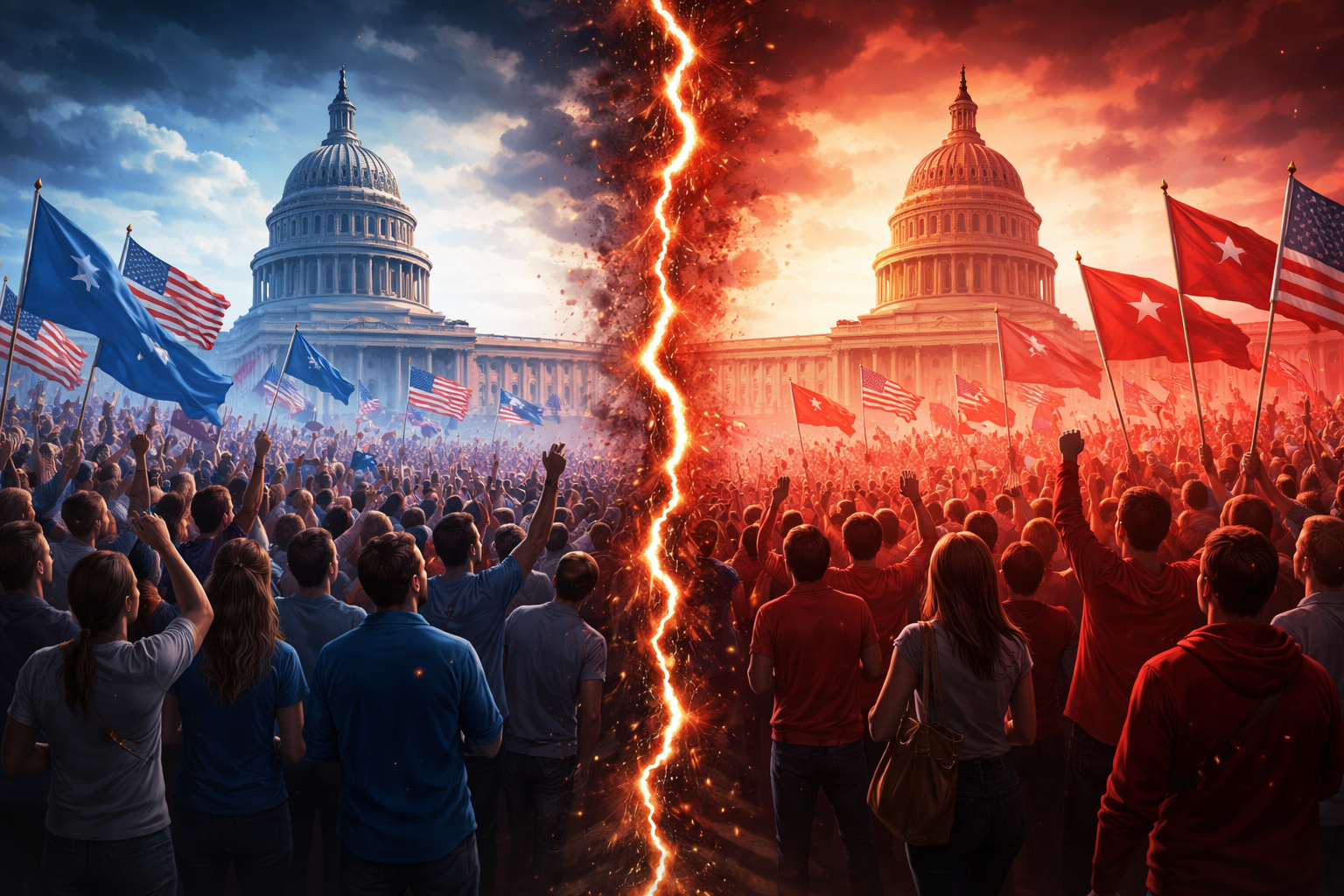
Political polarization in American society has emerged as one of the most defining social phenomena of the twenty-first century. The growing ideological distance between individuals, social groups, and political institutions has reshaped democratic discourse, weakened social trust, and intensified conflicts across cultural, economic, and racial lines. Polarization today extends far beyond electoral politics; it influences family relationships, media consumption, educational spaces, religious institutions, and even everyday social interactions. From a sociological perspective, political polarization is not merely a clash of opinions but a structural outcome of social inequalities, institutional transformations, and cultural fragmentation.
Sociology helps us understand polarization as a socially produced condition shaped by class, race, gender, media systems, and power relations. This article examines political polarization in American society through classical and contemporary sociological lenses, exploring its causes, patterns, and consequences, as well as its implications for democracy and social cohesion.
Understanding Political Polarization Sociologically
Political polarization refers to the process through which political attitudes, beliefs, and identities move toward ideological extremes, reducing the space for compromise or shared understanding. Sociologically, polarization is deeply connected to social identity formation, group boundaries, and power struggles. Individuals increasingly align their political beliefs with broader cultural identities related to race, religion, region, and class.
Polarization is reinforced by social structures that reward conformity within ideological groups while punishing dissent. As political identities become emotionally charged, individuals perceive opposing groups not simply as rivals but as moral threats. This transformation of political disagreement into social antagonism marks a significant shift in American political culture.
Historical Roots of Polarization in the United States
Although contemporary polarization appears unprecedented, its roots can be traced to earlier periods of American history. The Civil War era, Reconstruction, the New Deal realignment, and the Civil Rights Movement all produced moments of intense ideological conflict. However, unlike earlier periods where economic issues dominated political divides, modern polarization is increasingly cultural and identity-based.
The ideological sorting of the Democratic Party and the Republican Party since the late twentieth century has contributed significantly to polarization. Political parties have become more internally homogeneous and externally antagonistic, leaving little room for moderate or cross-cutting viewpoints.
Social Inequality and Class-Based Polarization
Economic inequality plays a central role in shaping political polarization. The widening gap between the wealthy and the working class has produced divergent political interests and experiences. Sociologically, class position influences political ideology, policy preferences, and trust in institutions.
Working-class communities experiencing deindustrialization, job insecurity, and declining social mobility often express political frustration and resentment. Meanwhile, affluent groups benefit from globalization and neoliberal economic policies, reinforcing ideological divides. These class-based differences are often reframed through cultural narratives, deepening polarization without directly addressing structural inequalities.
Race, Ethnicity, and Political Division
Race remains one of the most powerful forces shaping political polarization in American society. Historical legacies of slavery, segregation, and systemic racism continue to influence political alignments and policy debates. Sociologists argue that racial polarization is maintained through institutional discrimination, unequal access to resources, and symbolic politics.
Issues such as immigration, policing, voting rights, and affirmative action often become racialized, mobilizing group identities and reinforcing social boundaries. Political elites frequently exploit racial anxieties to consolidate support, transforming social inequalities into ideological conflicts rather than collective social problems.
Cultural Polarization and Identity Politics
Cultural polarization refers to divisions over values, lifestyles, and moral beliefs. Debates over gender roles, sexuality, religion, abortion, and education have intensified ideological divisions. From a sociological standpoint, these conflicts reflect struggles over cultural authority and social norms.
Identity politics, while empowering marginalized groups to articulate their experiences, has also contributed to polarization when group identities become rigid and oppositional. The emphasis on difference rather than shared social interests can fragment collective action and deepen ideological silos.
The Role of Media and Digital Communication
The transformation of media systems has dramatically intensified political polarization. Traditional mass media once provided a shared informational space, but digital platforms now enable selective exposure to ideologically aligned content. Cable news outlets such as Fox News and CNN cater to distinct political audiences, reinforcing confirmation bias.
Social media algorithms amplify emotionally charged content, encouraging outrage rather than deliberation. Sociologically, these platforms function as echo chambers that reinforce group identities and marginalize alternative viewpoints. Political discourse becomes performative, driven by visibility and engagement rather than rational debate.
Political Leadership and Elite Polarization
Political elites play a crucial role in shaping mass polarization. Leaders often frame political conflicts in moral and existential terms, intensifying group loyalties. The presidencies of figures such as Barack Obama and Donald Trump illustrate how leadership styles and rhetoric can either mitigate or exacerbate ideological divisions.
Elite polarization influences public attitudes by signaling acceptable beliefs and behaviors. When compromise is portrayed as weakness, polarization becomes normalized, reshaping democratic norms and expectations.
Polarization and the Erosion of Social Trust
One of the most significant sociological consequences of political polarization is the erosion of social trust. Trust in institutions such as government, media, science, and education has declined sharply. Interpersonal trust has also weakened, as individuals increasingly view political opponents with suspicion or hostility.
This breakdown of trust undermines social cohesion and collective problem-solving. Sociologists warn that when societies lose the capacity for shared meaning and cooperation, democratic governance becomes fragile and unstable.
Impact on Democracy and Civic Life
Political polarization poses serious challenges to democratic functioning. Legislative gridlock, declining voter confidence, and the normalization of political hostility weaken democratic institutions. Civic engagement increasingly takes the form of protest, online activism, or partisan mobilization rather than deliberative participation.
From a sociological perspective, democracy requires not only formal institutions but also social norms of tolerance, compromise, and mutual recognition. Extreme polarization erodes these norms, transforming democracy into a zero-sum struggle rather than a collective project.
Education, Youth, and Generational Polarization
Educational institutions play a contradictory role in polarization. While education can promote critical thinking and civic awareness, it can also become a site of ideological conflict. Younger generations often express progressive views on social issues, while older generations may prioritize tradition and stability, producing generational polarization.
Sociologists emphasize the importance of education in fostering dialogue, empathy, and social responsibility. Without inclusive civic education, polarization may deepen across generational lines.
Sociological Perspectives on Reducing Polarization
Addressing political polarization requires structural and cultural interventions. Sociological solutions emphasize reducing economic inequality, strengthening democratic institutions, promoting media literacy, and encouraging cross-group interaction.
Polarization is not inevitable. When social policies address material insecurity and promote social inclusion, ideological conflicts can become less intense. Sociologists argue that rebuilding social solidarity is essential for restoring democratic life.
Conclusion
Political polarization in American society is a complex sociological phenomenon rooted in inequality, identity, media transformation, and institutional change. It reflects deeper struggles over power, resources, and cultural meaning. Understanding polarization sociologically allows us to move beyond moral judgments and toward structural explanations.
While polarization poses serious risks to democracy and social cohesion, it also highlights the urgency of addressing long-standing social problems. A sociological approach emphasizes dialogue, inclusion, and structural reform as pathways toward a more cohesive and democratic American society.
Frequently Asked Questions
1. What is meant by Political Polarization?
Political Polarization refers to the increasing ideological distance between social groups in which political opinions move toward extreme positions, reducing consensus and cooperation within society.
2. How does Political Polarization affect American society?
Political Polarization affects American society by weakening social trust, increasing political hostility, and reducing the effectiveness of democratic institutions and civic engagement.
3. What are the main causes of Political Polarization?
The main causes of Political Polarization include economic inequality, identity politics, media fragmentation, racial divisions, and elite political strategies.
4. Is Political Polarization a new phenomenon in the United States?
Political Polarization is not entirely new, but its intensity and social reach have increased significantly in recent decades due to cultural and technological changes.
5. How does media contribute to Political Polarization?
Media contributes to Political Polarization by creating echo chambers, promoting biased narratives, and amplifying emotionally charged political content through digital platforms.
6. What role does social media play in Political Polarization?
Social media intensifies Political Polarization by reinforcing ideological identities, spreading misinformation, and limiting exposure to diverse viewpoints.
7. How is Political Polarization linked to social inequality?
Political Polarization is closely linked to social inequality, as unequal access to resources creates conflicting political interests and deepens ideological divisions.
8. Does Political Polarization threaten democracy?
Yes, Political Polarization threatens democracy by encouraging political extremism, legislative gridlock, and declining public trust in democratic institutions.
9. How does race influence Political Polarization?
Race influences Political Polarization by shaping political identities, policy debates, and voting behavior, often reinforcing historical inequalities and social divisions.
10. What is affective Political Polarization?
Affective Political Polarization refers to emotional hostility toward political opponents, where individuals view opposing groups as immoral or dangerous.
1 thought on “Political Polarization in American Society: A Sociological Analysis”