Intro on “Is American Society Becoming More Polarized?”
American society has long been shaped by differences—of class, race, religion, ideology, and region. However, in recent decades, many scholars, journalists, and citizens have argued that these differences have deepened into sharp divisions. Elections appear more contentious, public debates more hostile, and trust in institutions more fragile. The central question, therefore, is not simply whether conflict exists, but whether American society is becoming structurally and culturally more polarized.
From a sociological perspective, polarization refers to the process by which opinions, identities, and social groups move toward ideological extremes and grow increasingly distant from one another. It is not only about political disagreement; it involves identity, culture, economics, and social institutions. This article explores whether American society is becoming more polarized by examining political ideology, economic inequality, racial and cultural divisions, media fragmentation, and the transformation of social trust. Is American Society Becoming More Polarized? Explore a sociological analysis of political division, economic inequality, racial tensions, media fragmentation, and cultural conflicts shaping modern America.
Understanding Polarization in Sociological Terms
Sociologists distinguish between several forms of polarization. Political polarization refers to ideological distance between parties and voters. Affective polarization describes growing dislike or distrust toward members of opposing political groups. Social polarization includes widening divisions based on race, class, religion, and geography.
Polarization becomes sociologically significant when these differences shape everyday life—where people live, whom they marry, what media they consume, and how they perceive national identity. Theories from structural functionalism, conflict theory, and symbolic interactionism provide useful frameworks for understanding these changes.
Structural functionalists might view polarization as a dysfunction within a system that depends on shared norms and values. Conflict theorists would interpret polarization as an inevitable outcome of economic inequality and power struggles. Symbolic interactionists would focus on how everyday interactions and media narratives reinforce divisions.
Political Polarization and Party Realignment
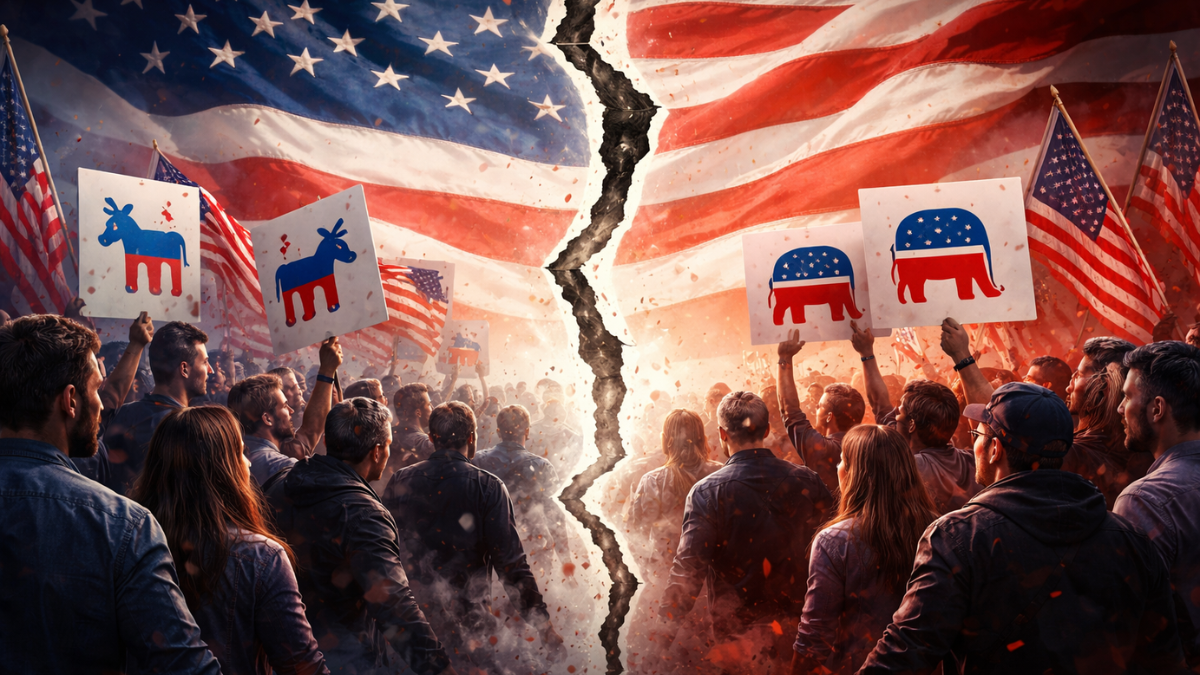
Political polarization has become one of the most visible dimensions of division in American society. Research suggests that ideological overlap between major political parties has significantly declined over the past fifty years. Members of the Democratic Party and the Republican Party now hold more ideologically consistent and opposing positions than in the mid-twentieth century.
This polarization intensified after the civil rights era, when party realignment reshaped the political landscape. Conservative Southern voters increasingly aligned with the Republican Party, while minority communities and urban liberals consolidated within the Democratic Party.
The elections of Donald Trump in 2016 and Joe Biden in 2020 further illustrated ideological divides. Campaign rhetoric emphasized not merely policy differences but conflicting visions of national identity, immigration, race relations, and global engagement. Political identity increasingly became a social identity, shaping friendships, workplaces, and even family relationships.
Is American Society Becoming More Polarized? Explore a sociological analysis of political division, economic inequality, racial tensions, media fragmentation, and cultural conflicts shaping modern America.
Economic Inequality and Class Division
Economic inequality is another critical dimension of polarization. Over recent decades, income and wealth disparities have expanded dramatically. The top one percent controls a growing share of national wealth, while middle-class wages have stagnated in many sectors.
Conflict theory, rooted in Marxist thought, suggests that widening class divisions create structural polarization. Economic inequality fosters resentment, insecurity, and political instability. Working-class communities affected by deindustrialization may feel abandoned by political elites, while urban professionals benefit from globalization and technological innovation.
The 2008 financial crisis exposed deep fractures in the economic system. The bailouts of large corporations contrasted sharply with the struggles of ordinary citizens facing foreclosure and unemployment. This period contributed to distrust in financial and governmental institutions.
Economic polarization also intersects with geography. Prosperity concentrates in metropolitan regions, while rural areas often experience economic decline. Such geographic inequality contributes to cultural and political polarization, reinforcing narratives of “coastal elites” versus “heartland America.”
Racial and Ethnic Divisions
Race remains a foundational axis of American social structure. Although legal segregation ended decades ago, racial inequality persists in housing, education, criminal justice, and employment.
The rise of movements such as Black Lives Matter has brought renewed attention to systemic racism and police violence. Supporters argue that these movements seek justice and equality, while critics sometimes perceive them as divisive. These differing interpretations illustrate how racial issues can deepen polarization.
Demographic change also plays a role. The United States is becoming more racially and ethnically diverse. While diversity can enrich society, it may also produce anxiety among groups that perceive cultural or demographic change as a threat to traditional identities. Sociologist Herbert Blumer’s theory of group position suggests that dominant groups may react defensively when they perceive their status as declining.
Polarization emerges when racial issues become politicized and framed as zero-sum conflicts rather than shared societal challenges.
Media Fragmentation and Digital Echo Chambers
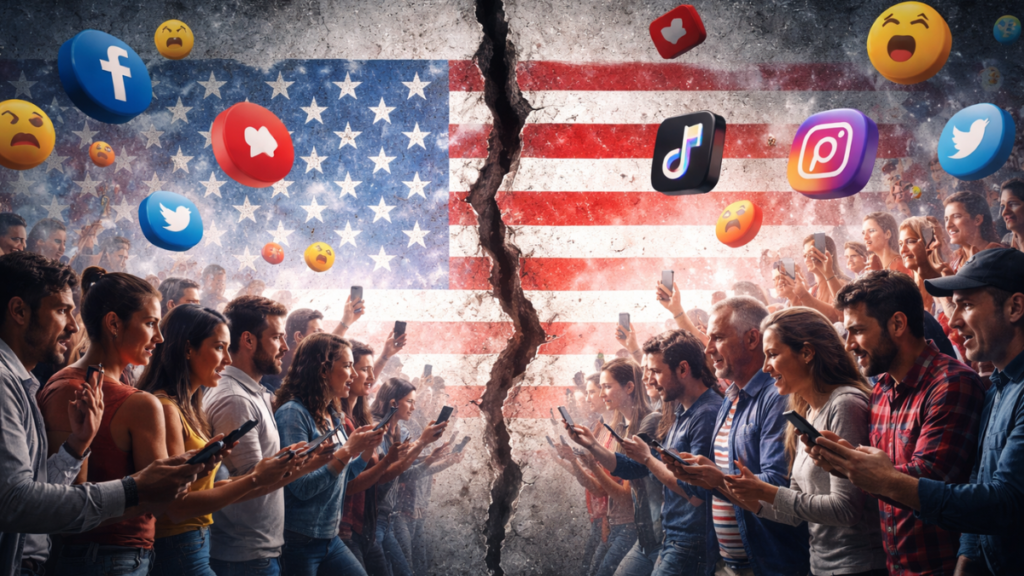
The transformation of media has significantly intensified polarization. In earlier decades, most Americans relied on a limited number of news outlets, creating a shared informational environment. Today, digital platforms and cable news networks allow individuals to select media sources aligned with their ideological preferences.
Social media algorithms often reinforce existing beliefs by promoting content similar to what users already consume. This creates echo chambers where individuals encounter limited opposing viewpoints. The result is not only ideological separation but also the spread of misinformation and conspiracy theories.
Symbolic interactionism helps explain how media narratives shape meaning. Repeated exposure to partisan framing influences how individuals interpret events. When citizens inhabit different informational realities, consensus becomes difficult.
Media polarization also fosters emotional reactions. Anger, fear, and moral outrage drive engagement, which digital platforms incentivize. Over time, emotional responses can replace rational deliberation, intensifying social divisions.
Cultural Polarization and Identity Politics
Beyond politics and economics, polarization extends into culture. Debates over gender roles, LGBTQ+ rights, religious freedom, gun ownership, and reproductive rights reflect deeper disagreements about moral values.
Sociologists note that identity politics has become central to contemporary discourse. Individuals increasingly define themselves by race, religion, sexuality, and political affiliation. While identity-based mobilization can empower marginalized groups, it can also contribute to fragmentation when identities become oppositional.
For example, debates over same-sex marriage, culminating in the Supreme Court decision in Supreme Court of the United States in 2015, revealed deep cultural divides. Although public opinion has shifted toward acceptance, the controversy highlighted generational and regional differences.
Religious polarization also plays a role. Secularization trends contrast with strong evangelical movements, contributing to divergent moral frameworks.
Geographic and Residential Sorting
Polarization is increasingly visible in residential patterns. Americans are more likely to live in communities where neighbors share similar political views. Urban areas tend to vote Democratic, while rural areas lean Republican. Suburban regions have become more politically contested.
This “residential sorting” reduces everyday interactions between individuals of differing perspectives. Sociologist Robert Putnam’s concept of social capital emphasizes the importance of cross-cutting ties—relationships that bridge social divides. When communities lack such ties, polarization intensifies.
Educational institutions also reflect these patterns. Universities often lean liberal, while certain religious colleges emphasize conservative values. These institutional cultures reinforce ideological homogeneity.
Decline of Institutional Trust
Trust in institutions—government, media, corporations, and even science—has declined in recent decades. When citizens lose confidence in shared institutions, social cohesion weakens.
Events such as the COVID-19 pandemic revealed divergent attitudes toward public health measures, vaccines, and scientific expertise. Disagreements over facts themselves indicate deep epistemological divides.
From a functionalist perspective, institutions serve to integrate society. When their legitimacy erodes, polarization may fill the vacuum. Competing narratives about election integrity, public health, and law enforcement contribute to fragmented realities.
Generational Perspectives on “Is American Society Becoming More Polarized?”
Generational change adds another layer. Younger generations tend to express more progressive views on social issues, climate change, and diversity. Older generations often prioritize tradition, economic stability, and national sovereignty.
These generational differences do not always produce conflict, but when combined with economic precarity and rapid technological change, they can deepen polarization. Social media activism among youth contrasts with traditional political engagement among older citizens.
However, generational shifts also suggest potential for transformation. As demographics evolve, new norms may emerge that redefine political alignments.
Is Polarization Overstated?
Some sociologists argue that polarization may be exaggerated by media narratives. While political elites appear highly polarized, ordinary citizens may hold more moderate views. Surveys often reveal that many Americans support bipartisan compromise on issues like infrastructure and healthcare.
Moreover, cross-cutting identities—such as occupation, parenthood, or community involvement—can mitigate ideological rigidity. Civic organizations, local initiatives, and interfaith dialogues continue to foster cooperation.
Therefore, the question is not simply whether polarization exists, but whether it permeates everyday life to the extent that social integration becomes impossible. Evidence suggests increased tension, but also resilience within civil society.
Sociological Theories Explaining on “Is American Society Becoming More Polarized?”
Conflict theory emphasizes structural inequality as a root cause. Economic concentration and corporate influence may produce political alienation.
Structural functionalism views polarization as a sign of institutional strain during periods of rapid social change.
Symbolic interactionism highlights the role of communication and shared meanings. Digital platforms reshape interactions, altering how identities form and conflicts escalate.
Each theoretical lens contributes to understanding polarization as both structural and cultural.
Conclusion on “Is American Society Becoming More Polarized?”
American society appears more polarized than in many previous decades, particularly in political and cultural domains. Ideological distance between parties, economic inequality, racial tensions, media fragmentation, and declining institutional trust all contribute to divisions.
Yet polarization is not absolute fragmentation. Civil society institutions, democratic processes, and everyday interactions continue to provide spaces for dialogue. Sociologically, polarization reflects broader transformations—globalization, demographic change, technological innovation, and shifting cultural norms.
The future of American society depends on whether institutions and communities can rebuild trust, foster cross-cutting relationships, and promote inclusive narratives. Polarization is real, but it is not destiny. Social change remains possible through collective engagement and structural reform.
FAQs – Is American Society Becoming More Polarized?
1. Is American Society Becoming More Polarized in recent decades?
Yes, many sociological studies suggest that American society is becoming more polarized, especially in political identity, cultural values, and media consumption patterns.
2. Is American Society Becoming More Polarized politically or socially?
American society is becoming more polarized both politically and socially. Political parties have grown ideologically distant, and social divisions around race, religion, and culture have intensified.
3. Why is American Society Becoming More Polarized according to sociologists?
Sociologists link polarization to economic inequality, racial tensions, media fragmentation, demographic shifts, and declining trust in institutions.
4. Is American Society Becoming More Polarized because of social media?
Social media contributes significantly. Algorithms create echo chambers where individuals encounter mostly like-minded views, reinforcing ideological extremes.
5. How does economic inequality explain why American Society is Becoming More Polarized?
Widening income gaps create resentment and distrust, deepening class divisions and influencing political alignment.
6. Is American Society Becoming More Polarized along racial lines?
Yes, racial justice debates, demographic changes, and structural inequalities have intensified discussions around identity and power, contributing to polarization.
7. Is American Society Becoming More Polarized between urban and rural areas?
Urban areas tend to lean more liberal while rural areas often lean conservative, reflecting geographic polarization in values and voting patterns.
8. Does media fragmentation explain “Is American Society is Becoming More Polarized”?
Yes, the decline of shared news sources and rise of partisan media outlets has increased ideological separation.
9. Is American Society Becoming More Polarized among younger generations?
Younger generations often hold more progressive views, while older generations may prioritize traditional values, contributing to generational divides.
10. How does identity politics influence whether American Society is Becoming More Polarized?
Identity-based political mobilization strengthens group solidarity but can also intensify “us versus them” thinking.
11. Is American Society Becoming More Polarized in terms of trust in institutions?
Yes, declining trust in government, media, and science has widened divides and fostered skepticism across ideological groups.
12. Is American Society Becoming More Polarized compared to the past?
While America has experienced historical divisions (such as during the Civil War era), contemporary polarization is distinct due to digital media and cultural identity conflicts.
13. Is American Society Becoming More Polarized because of immigration debates?
Immigration has become a symbolic issue tied to national identity, economic competition, and cultural change, increasing polarization.
14. Can dialogue reduce the trend that American Society is Becoming More Polarized?
Sociologists argue that cross-cutting relationships, civic engagement, and institutional reforms can reduce polarization.
15. Is American Society Becoming More Polarized permanently?
Polarization is not necessarily permanent. Social change, generational shifts, and inclusive policies can reshape divisions over time.
16. Is American Society Becoming More Polarized due to cultural value conflicts?
Yes, debates over gender roles, reproductive rights, religious freedom, and LGBTQ+ issues show how deeply cultural value conflicts contribute to polarization in American society.
17. Is American Society Becoming More Polarized because of declining social trust?
Sociologists argue that declining trust in government, media, and public institutions has intensified suspicion and widened ideological gaps, reinforcing polarization.
18. Is American Society Becoming More Polarized through educational differences?
Educational attainment increasingly correlates with political ideology, leading to sharper divides between college-educated populations and non-college groups.
19. Is American Society Becoming More Polarized in terms of national identity?
Yes, competing definitions of what it means to be “American” — including views on immigration, diversity, and patriotism — have deepened identity-based divisions.
20. Is American Society Becoming More Polarized globally compared to other democracies?
While many democracies experience polarization, scholars note that the intensity of partisan identity and media-driven division suggests that American society is becoming more polarized in distinctive ways.