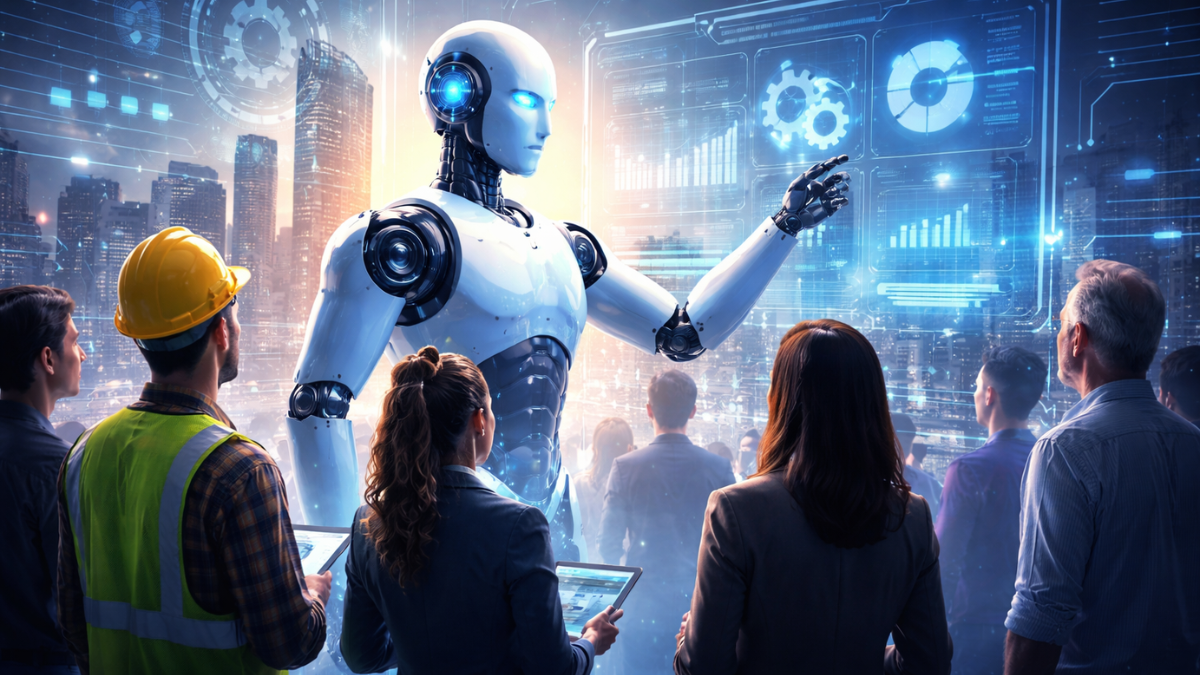
Artificial intelligence (AI) is more than a set of technologies; it is a social force reordering work, institutions, and everyday life. The debate about AI’s effects on employment often narrows to predictions of jobs “lost” or “created.” A sociological lens widens that view: it asks who gains and loses, how work is reorganized, and what social structures—education systems, corporate governance, labor markets, racial and gender hierarchies, and public policy—mediate outcomes. This article maps the contours of AI’s impact on the U.S. workforce by combining recent empirical findings with sociological frameworks. It argues that AI is reshaping work in uneven, stratified ways that amplify pre-existing inequalities while also creating new forms of labor, authority, and social risk.
Explore the Impact of Artificial Intelligence on the American workforce, focusing on jobs, inequality, automation, and sociological change.

A short empirical snapshot
Recent research finds that generative AI and related systems are already changing the tasks associated with a large share of occupations. Analysts estimate that more than 30% of U.S. workers could see at least half of their job tasks disrupted by generative AI, while many more will see portions of their work altered. Brookings Institution has documented this pattern of “task disruption,” emphasizing that the effects are concentrated in cognitive and nonroutine work as well as in clerical roles.
Global employer surveys and scenario exercises likewise point to a sizable reallocation of work: the World Economic Forum projects that, over a five-year window, tens of millions of jobs will be created even as a comparable number are displaced — a net effect that masks important sectoral and regional differences. World Economic Forum’s Future of Jobs analysis finds both job creation (notably in AI- and data-related roles) and job elimination in routine clerical and some service roles.
Long-run modeling studies add scale: management consultancies and think tanks have estimated that hundreds of millions globally may need to change occupations by 2030 under rapid automation scenarios — a reminder that technological change can require mass reskilling even when net employment does not collapse. McKinsey & Company’s influential review offers a range of scenarios in which up to several hundred million workers worldwide may be displaced and need new jobs or tasks.
Public opinion and worker perceptions are also salient: surveys show that a majority of Americans expect AI to reduce the number of jobs over the long term, even as experts are more divided; workers are concerned about hiring decisions, surveillance, and fairness when AI systems are used in personnel processes. Pew Research Center has documented these attitudes, which shape political responses and workplace bargaining.
Taken together, these findings suggest not a single universal outcome but a complex redistribution of tasks, occupations, and power—one that sociologists must unpack in terms of inequality, institutions, and culture.
Theoretical lenses: how sociologists read technological change
Sociologists approach technological change through multiple, overlapping frameworks. Four are especially useful for AI:
- Task-based approach to labor markets. Rather than treating occupations as monolithic, the task-based view asks which tasks are automated, augmented, or remain distinctly human. AI tends to displace specific cognitive or information-processing tasks while augmenting others. This reframing helps explain why some mid- and high-income professional roles (e.g., junior lawyers, entry-level analysts) face disruption alongside lower-wage clerical roles.
- Skill-biased technological change (SBTC). Historically, technologies that complement highly skilled labor increase wage premiums for those workers. Early evidence suggests generative AI may be “skill-biased” in complex ways: it complements some high-skill analytical tasks while substituting for routine cognitive tasks often done by mid-skilled workers, potentially hollowing out middle-skill occupations.
- Institutional and organizational sociology. Firms, industries, and public institutions shape how AI is adopted. Corporate decisions about where to apply AI—customer service, recruitment, back-office automation—determine who faces displacement. Organizational capacities for retraining, management practices, and labor relations (e.g., union strength) mediate outcomes.
- Stratification and intersectionality. Technological change unfolds across existing lines of race, class, gender, age, and geography. Who is reskilled, who is laid off, and who gains new opportunities will reflect structural inequalities. Sociological attention to intersectional effects is crucial: women, racial minorities, older workers, and workers in deindustrialized regions may face distinct vulnerabilities.
These frameworks show why blunt metrics (jobs gained vs. lost) are insufficient. We must ask how AI redistributes opportunity, alters occupational prestige, and reshapes workers’ autonomy and dignity.
Who is most exposed — and why exposure matters
Exposure to AI disruption differs across occupations and demographic groups for reasons rooted in task composition, credentials, and labor market position.
- Task composition. Occupations dominated by routine clerical tasks (data entry, scheduling) or standardized cognitive procedures are highly automatable. Yet generative AI’s encroachment into writing, summarization, coding assistance, and basic decision-making means exposure now reaches into professional and creative jobs that were once thought secure.
- Credential and mobility gaps. Workers with fewer formal credentials or limited mobility face higher risks. For workers in precarious employment or in regions with limited retraining infrastructure, displacement can mean long-term unemployment or downward occupational moves.
- Demographic inequalities. Preexisting inequalities shape vulnerability. For example, women are overrepresented in certain clerical and administrative roles that are AI-exposed; racial minorities are more heavily represented in gig and service sectors where algorithmic management intensifies precarity.
Recent research also stresses adaptability: where workers (and local labor markets) have higher capacity to retrain and transition, exposure does not translate directly into job loss. Studies from labor policy researchers emphasize that adaptability depends on access to education, social insurance, and employer-provided training—unevenly distributed resources that reproduce stratification.
Work reorganization: augmentation, deskilling, and new jobs
AI’s effects take multiple forms within workplaces.

- Augmentation. In many settings, AI acts as an assistant: coders use code-completion tools, journalists use AI for background research, and customer-service agents use AI to fetch information faster. Augmentation can raise productivity and job satisfaction when it reduces drudgery and increases creative work.
- Deskilling and intensification. Conversely, when systems routinize decision-making or require narrow monitoring tasks, jobs can be deskilled. A human worker’s role may narrow to oversight, quality checking, or exception-handling—tasks often lower in pay and autonomy than full professional work.
- Creation of new occupations. Demand rises for AI specialists, data scientists, prompt-engineering roles, and compliance/audit professions charged with algorithmic oversight. The World Economic Forum forecasts substantial growth in AI- and data-related roles even as routine roles shrink.
- Platform and algorithmic labor. AI-enabled platforms mediate gig work, logistics, and delivery, tightening temporal control through algorithmic scheduling and surveillance. This shifts the locus of managerial authority from human supervisors to coded rules, with implications for worker bargaining, discretion, and legal protections.
Power, surveillance, and algorithmic management
AI expands employers’ capacity to monitor performance and manage labor at scale. Tools that track keystrokes, analyze speech for sentiment, or score productivity create new forms of workplace surveillance. From a sociological perspective, algorithmic management:
- Reconfigures authority: managerial discretion is partly embedded in models and scorecards, reducing transparency about decisions (e.g., why someone is flagged for dismissal).
- Erodes worker autonomy: constant metric-driven oversight can reduce discretion, weaken craft knowledge, and heighten stress.
- Raises fairness concerns: biased training data can reproduce discrimination in hiring, promotion, and performance evaluation.
Public worry about AI-driven hiring and surveillance is substantial; many Americans oppose AI deciding hiring outcomes without human oversight. These attitudes shape politics and regulatory debates.
Uneven geography: metropolitan advantage and regional risk
AI adoption clusters where capital, skilled labor, and research institutions concentrate. Metropolitan regions with large tech sectors will likely capture new AI-enabled jobs and startups, deepening urban advantage. Rural and postindustrial regions—already hit by automation in manufacturing and service consolidation—face greater risk if local economies lack the institutions to re-absorb displaced workers. This spatial polarization can amplify political fissures and fuel migration pressures.
Gender, race, and intersectional impacts
AI does not operate independently of social hierarchies. Some observable patterns:
- Gendered exposure. Because women are overrepresented in administrative and clerical occupations—areas heavily impacted by AI—there is risk of disproportionate displacement. At the same time, emerging AI-specialist roles remain male-dominated, potentially widening gender pay gaps unless proactive inclusion policies are pursued.
- Racial inequalities. Historical patterns of occupational segregation mean Black and Latinx workers are overrepresented in service and gig sectors more subject to algorithmic control and precarity. Additionally, biases in datasets can lead to discriminatory outcomes in recruitment and surveillance.
- Age and retraining. Older workers often face greater barriers to retraining and are more vulnerable to long-term unemployment after displacement. Without age-sensitive retraining programs and income supports, AI-driven transitions can exacerbate age stratification.
Institutions and polity: social policies that shape outcomes
Whether AI deepens inequality or is channeled into broadly beneficial productivity gains depends heavily on institutional choices. Key policy levers include:
- Education and lifelong learning. Building modular, accessible retraining pathways—microcredentials, community-college partnerships, employer-funded apprenticeships—can help workers transition. But training alone is insufficient if not coupled with income supports during transitions.
- Social safety nets. Unemployment insurance, wage insurance, and portable benefits for gig and platform workers can reduce the social costs of displacement. Societies with stronger social insurance historically cushion technological transitions.
- Labor law and collective bargaining. Unions and worker representation can shape how firms deploy AI—negotiating for transparency, limits to surveillance, and reskilling commitments.
- Regulation of algorithms. Rules requiring explainability, audits for bias, and limits on fully automated hiring decisions can curtail the most harmful uses of AI and protect civil rights.
- Industrial policy. Public investment to encourage job-creating sectors in lagging regions can mitigate geographic polarization.
Sociologically, public policy is not neutral; it both reflects and reshapes power relations. The distributional impact of AI will be determined by political coalitions, corporate lobbying, and social movements advocating for worker protections.
Cultural effects: identity, meaning, and the dignity of work
Beyond income and employment statistics, AI affects how people experience work. For many, work is central to identity, social status, and daily rhythm. Deskilling, precarious scheduling, or a sense of being constantly monitored can erode job satisfaction and social integration. Conversely, meaningful augmentation—where AI removes drudgery and frees people for creative tasks—can enhance job quality. How societies narrate technological change (threat vs. opportunity) also shapes workers’ responses, political mobilization, and policy priorities.
Labor-market responses: employer strategies and the role of firms
Firms are not passive adopters; managerial decisions determine the social shape of AI’s impact. Four firm-level strategies matter:
- Substitution-first adoption. Firms that deploy AI primarily to cut headcount to reduce costs generate concentrated harm for workers, increasing unemployment and distrust.
- Augmentation-first adoption. Firms that use AI to raise productivity and invest savings in workforce development can produce win-win outcomes.
- Selective reskilling. Employers may reskill high-potential workers while letting lower-skilled workers go—a practice that reproduces inequality if reskilling access is not universal.
- AI-washing and PR narratives. There is growing concern that some firms cite AI as justification for layoffs planned for other reasons. Transparency about the motives and impacts of AI adoption affects public trust and regulatory attention. Recent reporting and commentary from industry leaders have highlighted both genuine AI-driven restructuring and cases where AI is presented as a ready-made explanation for cost-cutting.
Political economy: who benefits?
AI-driven productivity gains will be distributed through markets and institutions. Capital owners—venture-backed startups, large tech firms, and shareholders—are positioned to capture a large share of value unless labor and public institutions bargain for a fairer share. Without policy interventions, the rewards of AI could concentrate in high-skill urban clusters and among capital owners, worsening inequality.

Pathways for more equitable outcomes
Sociological insight suggests several practical, equity-focused interventions:
- Universal access to lifelong learning. Public funding for continuous education, credentials portability, and employer co-financing can reduce skill gaps.
- Wage insurance and transitional supports. Short-term income support for displaced workers linked to retraining participation can prevent downward mobility.
- Algorithmic governance. Mandatory audits, transparency standards, and worker-rights to contest automated decisions protect civil liberties and labor standards.
- Regional development initiatives. Incentives for firms to locate AI-related investments in nonmetropolitan regions and public investment in broadband and local training can moderate geographic divides.
- Strengthening collective voice. Encouraging worker councils, sectoral bargaining, or union representation in tech-enabled workplaces can rebalance power.
These policy mixes are political choices. Sociologists emphasize the need to build coalitions that include workers, civil-society groups, and policymakers to craft durable institutions that steer technological change toward shared prosperity.
What we still don’t know — and where sociological research should go
Despite growing empirical work, key uncertainties remain:
- Long-run labor demand dynamics. How rapidly will employers reorganize work and what net occupational shifts will stabilize by the end of the decade?
- Interaction effects. How will AI interact with other trends—globalization, demographic change, climate policy—to reshape labor markets?
- Microprocesses of deskilling vs. upskilling. We need fine-grained ethnographic and longitudinal studies of workplaces to see how tasks and identities change in practice.
- Political responses. Which coalitions will successfully shape policy—labor, tech firms, voters—and how will that affect distributional outcomes?
Sociology, with its mixed-method toolset, is well positioned to answer these questions by combining statistical, ethnographic, historical, and policy-analytic approaches.
Conclusion: AI as a social, not merely technological, transformation
AI’s effect on the American workforce will be driven as much by social choices as by computational power. Empirical evidence indicates substantial task disruption across many occupations, significant creation of AI-related roles, and considerable public concern about jobs and fairness.
From a sociological perspective, the critical questions are distributive and institutional: who gains job-quality improvements and new opportunities, and who bears the costs of displacement and intensified surveillance? The answers will depend on education systems, employer strategies, labor institutions, regulatory frameworks, and political will. If policymakers and institutions act proactively—investing in retraining, regulating algorithmic practices, and expanding social protections—AI can be channeled to enhance productivity without deepening social fractures. If not, AI risks amplifying existing inequalities, hollowing out middle-skill jobs, and concentrating economic power.
For readers and stakeholders at hubsociology.com, the task is urgent: to document these social processes, center the perspectives of vulnerable workers, and advocate for institutional designs that make technological progress broadly beneficial. The story of AI and work is not prewritten; it will be written in workplaces, courtrooms, classrooms, and legislatures. Sociology’s job is to illuminate the social mechanisms at play so that those choices lead toward equity, dignity, and shared prosperity.
FAQs on Impact of Artificial Intelligence
1. What is the Impact of Artificial Intelligence on the American workforce?
The Impact of Artificial Intelligence on the American workforce includes job automation, task restructuring, new job creation, workplace surveillance, and widening or reshaping social inequalities. It affects not only employment numbers but also work culture, power relations, and income distribution.
2. Does the Impact of Artificial Intelligence always lead to job loss?
No, the Impact of Artificial Intelligence does not always result in job loss. While some routine and clerical jobs are automated, AI also creates new roles in data analysis, AI development, cybersecurity, and digital services.
3. How does the Impact of Artificial Intelligence affect income inequality?
The Impact of Artificial Intelligence can increase income inequality if high-skilled workers benefit more from technological augmentation while low- and middle-skilled workers face displacement or wage stagnation.
4. What is the Impact of Artificial Intelligence on middle-class jobs?
The Impact of Artificial Intelligence on middle-class jobs is significant because many routine cognitive tasks—such as bookkeeping or administrative work—are increasingly automated, potentially shrinking traditional middle-income occupations.
5. How does the Impact of Artificial Intelligence influence workplace power structures?
The Impact of Artificial Intelligence reshapes workplace authority through algorithmic management, data-driven decision-making, and automated performance tracking, sometimes reducing worker autonomy.
6. Is the Impact of Artificial Intelligence gender-neutral?
No, the Impact of Artificial Intelligence is not gender-neutral. Women are overrepresented in certain administrative roles vulnerable to automation, while AI-related technical roles are still male-dominated.
7. What is the Impact of Artificial Intelligence on racial inequality in employment?
The Impact of Artificial Intelligence can reinforce racial inequality if biased data influences hiring algorithms or if minority workers are concentrated in sectors vulnerable to automation.
8. How does the Impact of Artificial Intelligence change job skills requirements?
The Impact of Artificial Intelligence increases demand for digital literacy, critical thinking, creativity, and adaptability, while reducing reliance on repetitive or routine tasks.
9. What is the Impact of Artificial Intelligence on job security?
The Impact of Artificial Intelligence may reduce job security in sectors experiencing automation, especially where workers lack access to retraining or social protections.
10. Does the Impact of Artificial Intelligence affect rural and urban workers differently?
Yes, the Impact of Artificial Intelligence often benefits urban regions with strong tech industries, while rural areas may struggle with limited retraining opportunities and economic diversification.
11. What is the Impact of Artificial Intelligence on workplace surveillance?
The Impact of Artificial Intelligence has increased digital monitoring, including productivity tracking and algorithmic performance scoring, raising concerns about privacy and stress.
12. How does the Impact of Artificial Intelligence influence education systems?
The Impact of Artificial Intelligence pressures education systems to redesign curricula around STEM skills, digital competencies, and lifelong learning models.
13. Can the Impact of Artificial Intelligence improve job quality?
Yes, the Impact of Artificial Intelligence can improve job quality when it removes repetitive tasks and enhances creative or strategic aspects of work.
14. What is the Impact of Artificial Intelligence on labor unions?
The Impact of Artificial Intelligence challenges labor unions to negotiate algorithm transparency, retraining programs, and fair deployment of automation technologies.
15. How can policymakers manage the Impact of Artificial Intelligence effectively?
Policymakers can manage the Impact of Artificial Intelligence through worker retraining programs, wage insurance, algorithm regulation, social safety nets, and inclusive economic planning.
1 thought on “Impact of Artificial Intelligence on the American Workforce — A Sociological Analysis”