
Introduction
The launch of the Digital India initiative marked a decisive moment in India’s journey toward a technology-driven society. Conceived as a comprehensive national program to transform India into a digitally empowered society and knowledge economy, Digital India goes far beyond infrastructure development or e-governance. From a sociological perspective, it represents a powerful force of social transformation, reshaping social relations, institutions, identities, and power structures.
In sociology, social transformation refers to long-term, structural changes in social institutions, norms, and patterns of interaction. Digital India has accelerated such transformations by altering how people communicate, work, learn, access welfare, and participate in governance. This article examines Digital India not merely as a technological project but as a social process influencing inequality, stratification, culture, and citizenship in contemporary Indian society.

Understanding Digital India as a Social Project
Digital India is often discussed in terms of broadband connectivity, digital services, and mobile applications. However, sociologically, it should be understood as a state-led modernization project aimed at integrating technology into everyday life. The program seeks to bridge gaps between citizens and the state, between rural and urban populations, and between formal and informal sectors of the economy.
From the perspective of modernization theory, Digital India aligns with the idea that technological advancement leads to social progress. Yet, critical sociologists caution that technology does not automatically produce equality or justice. Instead, it often reflects existing power relations and social hierarchies. Therefore, the social outcomes of Digital India depend on how digital resources are distributed and used across different social groups.
Digital India and Social Inequality
One of the most significant sociological dimensions of Digital India is its relationship with social inequality. While digital platforms promise inclusion, they also expose and sometimes intensify existing inequalities.
The Digital Divide
The digital divide in India operates at multiple levels—access, skills, and usage. Urban, educated, and middle-class populations benefit more from digital services compared to rural communities, the elderly, women, and marginalized castes. Sociologically, this divide mirrors broader patterns of class, caste, gender, and regional inequality.
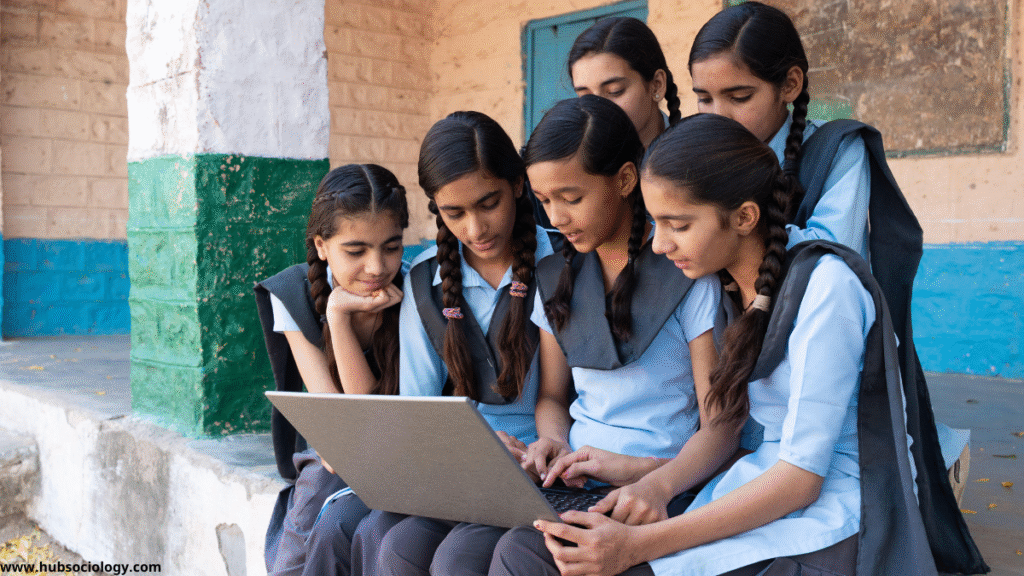
Access to smartphones, reliable internet, and digital literacy remains uneven. Although rural connectivity has improved, meaningful participation in the digital economy requires more than just access. It demands education, language proficiency, and cultural familiarity with technology, which are unevenly distributed across Indian society.
Caste, Class, and Digital Access
Digital India intersects strongly with caste and class structures. Upper-caste and middle-class groups are more likely to possess digital capital—skills, devices, and networks that allow them to benefit from online opportunities. Marginalized castes often face barriers not only due to poverty but also due to historical exclusion from education and institutional support.
Thus, from a sociological viewpoint, Digital India has created a new form of stratification where digital capital becomes an important resource shaping life chances.
Transformation of Governance and Citizenship
Digital India has significantly transformed the relationship between citizens and the state. Through online portals, digital identities, and direct benefit transfers, governance has become more data-driven and centralized.
E-Governance and State Power
Sociologically, e-governance represents a shift from face-to-face bureaucratic interaction to algorithmic administration. This has reduced some forms of corruption and delay, but it has also increased citizens’ dependence on digital systems. Those who lack digital skills may find it harder to access welfare services, creating new forms of exclusion.
The use of digital identification systems has also expanded the state’s capacity for surveillance. While this can improve efficiency and accountability, it raises concerns about privacy, consent, and data security—key issues in the sociology of power and control.
Changing Notions of Citizenship
Digital India has contributed to the emergence of digital citizenship, where participation in public life increasingly occurs online. Citizens engage with government through apps, social media, and online grievance systems. This has expanded avenues for participation but has also privileged digitally literate voices.
Sociologically, this raises questions about whose voices are heard in digital public spaces and whether digital participation truly represents democratic inclusion.
Impact on Education and Knowledge Systems
Education is one of the most visibly transformed social institutions under Digital India. Online classes, digital textbooks, and educational platforms have expanded access to learning resources.
From a functionalist perspective, digital education enhances efficiency and flexibility. Students can access information beyond textbooks, and teachers can use multimedia tools to improve learning outcomes. However, conflict theorists highlight how unequal access to devices and internet reinforces educational inequality.
During periods of crisis, such as pandemics, digital education exposed sharp class differences. Students from affluent families adapted easily, while those from poor households struggled due to lack of devices and connectivity. Thus, Digital India has restructured education in ways that both democratize and stratify knowledge.
Digital India and Changing Work Culture
The world of work in India has undergone significant transformation due to digitalization. Online platforms, remote work, and gig-based employment have altered traditional employment relations.
Rise of the Gig Economy
Digital platforms have created new forms of employment in sectors like food delivery, ride-sharing, and freelance services. Sociologically, this reflects a shift from stable, long-term employment to flexible but insecure work arrangements.

While gig work offers opportunities for income generation, it often lacks social security, labor rights, and collective bargaining. This transformation challenges traditional labor laws and raises concerns about exploitation in the digital economy.
Informal Sector and Digitalization
Digital payment systems and online marketplaces have begun integrating informal workers into the formal economy. However, this integration is uneven. Many informal workers lack digital literacy, making them dependent on intermediaries who may exploit them.
Thus, Digital India has reshaped labor relations, creating both empowerment and precarity.
Gender and Digital Transformation
Gender is a crucial axis of analysis in understanding Digital India. Women’s access to digital technology remains lower than men’s, particularly in rural and conservative social settings.
Sociologically, this gap reflects patriarchal norms that restrict women’s mobility, education, and control over resources. However, where women gain digital access, technology can become a tool of empowerment. Online education, digital banking, and social media platforms have enabled women to access information, build networks, and engage in entrepreneurship.
Digital India, therefore, operates as a contested space where traditional gender norms are both reinforced and challenged.
Cultural Change and Social Interaction
Digital India has transformed cultural practices and everyday social interactions. Social media platforms, online entertainment, and digital communication have reshaped family life, friendships, and community relationships.
Traditional face-to-face interactions are increasingly supplemented by virtual communication. This has expanded social networks but has also raised concerns about isolation, misinformation, and erosion of local cultures.
From a sociological perspective, digital culture in India represents a hybrid form where global influences merge with local traditions. Regional languages, religious practices, and cultural expressions have found new digital platforms, demonstrating that digitalization does not necessarily lead to cultural homogenization.
Digital India and Social Control
Digital technologies have become tools of social regulation and control. Surveillance technologies, data collection, and algorithmic decision-making influence how individuals are monitored and governed.
Michel Foucault’s concept of surveillance is useful here. Digital India enables continuous monitoring through databases and digital records. While this can improve governance, it also raises ethical concerns about autonomy and freedom.
Sociologically, the challenge lies in balancing efficiency with rights, ensuring that digital systems serve citizens rather than control them.
Challenges and Sociological Critiques
Despite its transformative potential, Digital India faces several sociological challenges. Exclusion, data privacy, digital illiteracy, and regional disparities continue to limit its inclusive impact.
Critical sociologists argue that without addressing structural inequalities in education, income, and social power, digital initiatives alone cannot produce genuine social transformation. Technology must be accompanied by social reforms that empower marginalized communities.
Conclusion
From a sociological perspective, Digital India is not merely a technological initiative but a profound agent of social transformation. It has reshaped institutions of governance, education, work, and culture, influencing how individuals relate to the state and to each other.
While Digital India offers immense possibilities for inclusion, empowerment, and development, it also reproduces existing inequalities and creates new forms of stratification. The true success of Digital India depends on whether it can move beyond access to ensure meaningful participation for all sections of society.
For students and scholars of sociology, Digital India provides a rich case study of how technology interacts with social structures, power relations, and cultural norms in a rapidly changing society.
Frequently Asked Questions (FAQs) on Digital India
- What is Digital India?
Digital India is a national initiative aimed at transforming India into a digitally empowered society by expanding digital infrastructure, improving online services, and increasing digital literacy among citizens. - Why is Digital India important for social transformation?
Digital India plays a crucial role in social transformation by changing how people access education, healthcare, governance, employment, and social networks through digital platforms. - How does Digital India affect Indian society?
Digital India affects Indian society by reshaping social interactions, reducing physical barriers to services, increasing transparency, and creating new forms of inequality based on digital access and skills. - What is the sociological significance of Digital India?
From a sociological perspective, Digital India influences social institutions, power relations, social stratification, and citizenship by integrating technology into everyday life.