
Introduction
The relationship between corporate power and workers’ rights has been a central issue in American society since the rise of industrial capitalism. From the early factories of the 19th century to today’s multinational corporations and gig-economy platforms, the struggle between capital and labor has shaped economic structures, political institutions, and everyday social life. In contemporary America, growing corporate influence over markets, politics, and labor conditions has renewed sociological debates about inequality, exploitation, and the erosion of workers’ rights.
This article examines corporate power and workers’ rights in America from a sociological perspective, focusing on how economic systems, state policies, class relations, and globalization influence labor conditions. Drawing on classical and modern sociological theories, it explores how corporate dominance affects wages, job security, unionization, and workplace democracy, while also highlighting emerging forms of resistance and reform.

Understanding Corporate Power in Sociological Terms
Corporate power refers to the ability of large business organizations to shape economic outcomes, labor relations, public policy, and cultural norms. Sociologically, corporate power is not only economic but also political and ideological.
From a Marxist perspective, corporations represent the institutional form of capitalist control over the means of production. Owners and shareholders accumulate profit through the extraction of surplus value from workers, while laborers sell their labor power in exchange for wages. This structural imbalance creates class conflict between capital and labor.
Max Weber’s approach highlights bureaucracy and rationalization within corporations. While bureaucratic organization increases efficiency, it often leads to rigid hierarchies where workers have limited autonomy and decision-making power. Corporations, in this sense, become systems of authority that discipline labor through rules, surveillance, and performance metrics.
Contemporary sociologists also emphasize corporate political power, noting how lobbying, campaign financing, and regulatory capture allow corporations to influence labor laws, minimum wage policies, and workplace regulations in their favor.
Historical Development of Workers’ Rights in America
Workers’ rights in America did not emerge naturally but were the result of long social struggles. During the Industrial Revolution, factory workers faced extremely poor working conditions, long hours, child labor, and unsafe environments. Early labor movements arose in response to these conditions, demanding fair wages, shorter workdays, and basic protections.
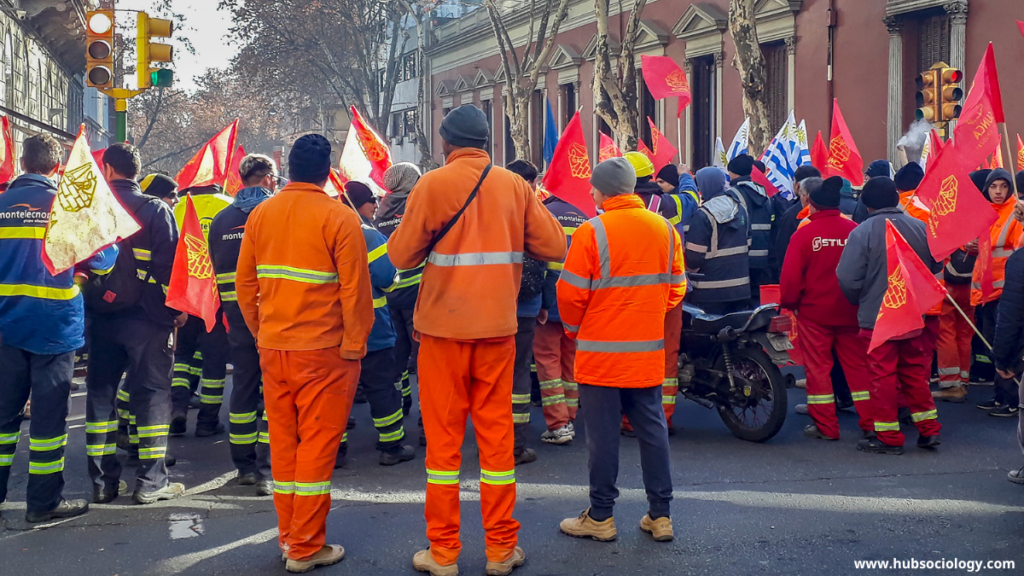
The late 19th and early 20th centuries saw the rise of labor unions such as the American Federation of Labor (AFL) and later the Congress of Industrial Organizations (CIO). Through strikes, collective bargaining, and political pressure, workers secured important rights, including:
- The eight-hour workday
- Minimum wage laws
- Workplace safety regulations
- The legal right to unionize
The New Deal era marked a turning point, as the federal government recognized labor rights through legislation like the National Labor Relations Act. Sociologically, this period represents a partial balancing of power between corporations and workers, mediated by the state.
However, this balance began to weaken from the late 20th century onward due to neoliberal economic policies.
Neoliberalism and the Expansion of Corporate Power
Neoliberalism, characterized by deregulation, privatization, and market-oriented reforms, has significantly reshaped labor relations in America. Since the 1980s, policies promoting free markets and corporate flexibility have strengthened employer power while weakening labor protections.
From a sociological standpoint, neoliberalism reframes workers as individual market actors rather than members of a collective class. Job security is replaced by flexibility, and social protections are increasingly seen as personal responsibilities rather than public obligations.
Corporations have used neoliberal reforms to:
- Outsource and offshore jobs to reduce labor costs
- Replace permanent jobs with temporary or contract work
- Resist unionization through legal and managerial strategies
- Push for labor law reforms favoring employers
As a result, workers face increased precarity, stagnant wages, and reduced bargaining power.
Decline of Labor Unions and Collective Bargaining
One of the most significant indicators of declining workers’ rights in America is the weakening of labor unions. Union membership has fallen dramatically over the past few decades, especially in the private sector.
Sociologically, unions serve as collective institutions that counterbalance corporate power by organizing workers, negotiating wages, and protecting labor rights. Their decline has several consequences:
- Reduced wage growth for non-union workers
- Increased income inequality
- Weak enforcement of labor standards
- Greater managerial control over workers
Corporations often view unions as obstacles to profitability and flexibility. Through anti-union campaigns, legal challenges, and workplace restructuring, many companies discourage collective organization. This shift reflects a broader transformation in power relations, where corporations increasingly dominate labor markets.
Corporate Power, Inequality, and Social Stratification
Corporate dominance plays a major role in shaping economic inequality in American society. Sociologists link rising corporate profits with growing wage gaps between executives and workers. While productivity has increased, wages for many workers have remained stagnant.
From a conflict theory perspective, this inequality is not accidental but structurally produced. Corporate control over labor markets allows employers to suppress wages, reduce benefits, and shift risks onto workers. Executive compensation, shareholder dividends, and stock buybacks further concentrate wealth at the top.
These economic inequalities intersect with race, gender, and immigration status. Marginalized groups are more likely to work in low-wage, insecure jobs with limited protections. Thus, corporate power reinforces broader systems of social stratification.
The Gig Economy and New Forms of Labor Exploitation
The rise of the gig economy represents a new phase in the relationship between corporations and workers. Platforms like ride-sharing, delivery services, and online freelancing companies classify workers as independent contractors rather than employees.
Sociologically, this model allows corporations to avoid providing benefits such as health insurance, paid leave, and job security. Workers bear the risks of unstable income, lack of protections, and algorithmic control over their labor.
While gig work is often promoted as flexible and empowering, sociologists argue that it represents a form of digital labor exploitation, where corporate power is exercised through technology rather than traditional management.
The Role of the State and Labor Regulation
The state plays a crucial role in mediating the relationship between corporate power and workers’ rights. Labor laws, minimum wage policies, and workplace safety regulations can either protect workers or favor corporate interests.
In the American context, political polarization and corporate lobbying have weakened labor regulation. Sociological research shows that corporations exert significant influence over policymaking through campaign contributions and revolving-door relationships between business and government.
As a result, enforcement of labor laws is often inadequate, and violations such as wage theft, unsafe conditions, and discrimination persist, especially in low-wage sectors.
Workers’ Resistance and New Labor Movements
Despite the dominance of corporate power, workers continue to resist and organize in new ways. Recent years have seen renewed labor activism, including strikes, union drives, and public campaigns for better wages and conditions.
Sociologists note the emergence of alternative labor movements that focus on:
- Service-sector and gig workers
- Racial and gender justice in the workplace
- Living wage and dignity at work
- Corporate accountability and ethical labor practices
These movements reflect changing class consciousness in a post-industrial economy, where traditional factory unions are replaced by more flexible and inclusive forms of collective action.
Conclusion
From a sociological perspective, corporate power and workers’ rights in America are deeply interconnected. The expansion of corporate influence has reshaped labor relations, weakened unions, increased inequality, and transformed work into a more precarious experience for millions of workers. At the same time, workers continue to challenge corporate dominance through collective action, social movements, and demands for labor reform.
Understanding this relationship requires recognizing that workers’ rights are not merely legal entitlements but social achievements shaped by power, conflict, and historical struggle. As America faces growing economic inequality and changing forms of work, the question of how to balance corporate power with workers’ dignity remains one of the most pressing sociological issues of our time.
FAQs: Corporate Power and Workers’ Rights in America
1. What are workers’ Rights in America from a sociological perspective?
Workers’ Rights in America refer to legally and socially recognized protections that ensure fair wages, safe working conditions, collective bargaining, and dignity at work, shaped by historical struggles between labor and corporate power.
2. How does corporate power affect Rights in America?
Corporate power influences Rights in America by shaping labor laws, workplace policies, and economic structures that often prioritize profit over worker welfare.
3. Why are labor unions important for protecting Rights in America?
Labor unions strengthen Rights in America by enabling collective bargaining, reducing wage inequality, and limiting exploitative corporate practices.
4. How has neoliberalism changed Rights in America?
Neoliberal policies have weakened Rights in America by promoting deregulation, labor flexibility, and reduced state intervention in worker protection.
5. What role does the government play in safeguarding Rights in America?
The government enforces Rights in America through labor laws, minimum wage regulations, and workplace safety standards, though corporate lobbying often limits their effectiveness.
6. How does corporate power contribute to inequality in Rights in America?
Corporate control over labor markets leads to unequal Rights in America, where low-wage and marginalized workers face weaker protections.
7. What is the relationship between capitalism and Rights in America?
Capitalism structures Rights in America by creating power imbalances between employers and workers, often resulting in labor exploitation without strong regulation.
8. How are gig workers challenging traditional Rights in America?
Gig workers highlight gaps in Rights in America by working without employee benefits, job security, or collective bargaining rights.
9. Why are workers’ Rights in America declining in the private sector?
Rights in America are declining due to union suppression, contract-based employment, and corporate strategies aimed at labor cost reduction.
10. How do race and gender affect Rights in America?
Social inequalities mean Rights in America are unevenly distributed, with women and minority workers more likely to face discrimination and insecure employment.
11. What sociological theories explain conflicts over Rights in America?
Marxist conflict theory and Weberian power analysis explain how class conflict and bureaucratic control shape Rights in America.
12. How do multinational corporations influence Rights in America?
Multinational corporations weaken Rights in America by outsourcing labor and pressuring governments to lower labor standards.
13. Are workers’ Rights in America protected in the gig economy?
Rights in America are limited in the gig economy due to the classification of workers as independent contractors rather than employees.
14. What new labor movements are defending Rights in America today?
Contemporary movements focus on service-sector workers, gig labor, and workplace justice to reclaim Rights in America.
15. Why are workers’ Rights in America a key sociological issue today?
Rights in America reflect broader struggles over power, inequality, and social justice in a rapidly changing economic system.