Introduction
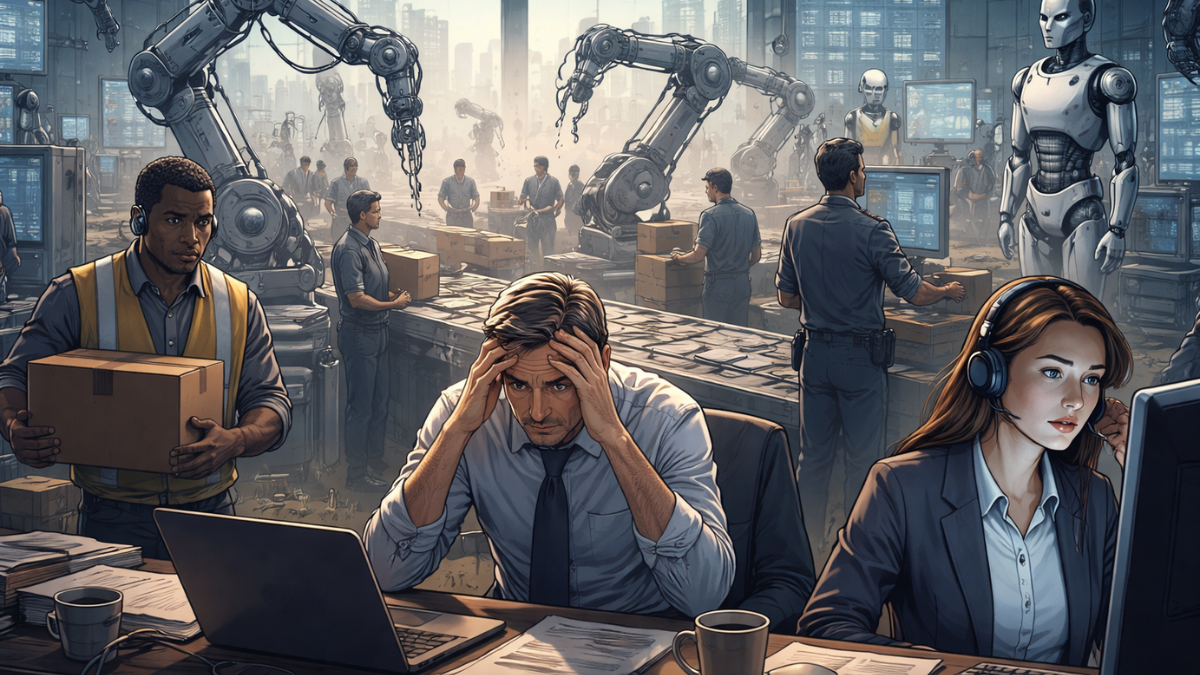
Automation has become one of the defining features of twenty-first-century capitalism in the United States. From self-checkout machines in supermarkets to algorithmic management in warehouses, and from industrial robots in factories to artificial intelligence systems in offices, technological change is rapidly reshaping the American workplace. While automation promises efficiency, productivity, and economic growth, it also generates widespread anxiety about employment stability. Job insecurity is no longer limited to blue-collar workers in manufacturing; it now affects white-collar professionals, gig workers, and even creative sectors.
In sociological terms, automation is not merely a technological process but a social transformation that alters class structures, labor relations, identity formation, and power dynamics. The American workforce, historically shaped by industrial capitalism, union movements, and welfare-state compromises, now confronts a digital transformation that raises fundamental questions about economic security and social justice.
This article explores automation and job insecurity in America through sociological theories, class analysis, labor market restructuring, the gig economy, policy responses, and the future of work.
Understanding Automation in the American Context
Automation refers to the use of machines, robotics, and algorithms to perform tasks previously done by human labor. In the United States, automation has evolved across different historical phases:
- Mechanization during the Industrial Revolution
- Assembly-line production in the early 20th century
- Computerization in the late 20th century
- Artificial intelligence and robotics in the 21st century
The rise of companies such as Amazon, Tesla, and Google illustrates how digital infrastructure and automation are embedded in contemporary corporate strategies. Warehouses increasingly rely on robotics, autonomous vehicles are being tested, and algorithms determine hiring decisions and worker productivity.
Automation today is not only physical but cognitive. Artificial intelligence systems can analyze legal documents, generate reports, detect medical conditions, and even produce creative content. This expansion into cognitive labor distinguishes the current phase from earlier technological shifts.
Sociological Theories and Automation
Karl Marx and Technological Unemployment
From a Marxist perspective, automation is a tool used by capitalists to increase surplus value. Karl Marx argued that technological advancement under capitalism tends to displace workers, creating what he called a “reserve army of labor.” This unemployed or underemployed population puts downward pressure on wages and increases worker vulnerability.
In the American context, automation in manufacturing—especially in the Rust Belt—has contributed to job losses and weakened union power. While corporations benefit from reduced labor costs, displaced workers often face long-term unemployment or precarious service-sector jobs.
Max Weber and Rationalization
Max Weber viewed modern society as characterized by rationalization—the increasing dominance of efficiency, calculability, and bureaucratic control. Automation embodies this logic. Algorithms monitor worker performance, schedule shifts, and evaluate productivity with precision. Workers become data points in highly rationalized systems.
This creates what Weber called the “iron cage,” where individuals experience reduced autonomy and increased control. In American workplaces, digital surveillance and performance metrics intensify job insecurity because workers can be easily replaced or penalized based on algorithmic assessments.
Émile Durkheim and Social Solidarity
Émile Durkheim emphasized the importance of social solidarity. Rapid technological changes can disrupt social cohesion by weakening occupational communities and stable career paths. Automation fragments traditional labor identities, contributing to what Durkheim described as anomie—a state of normlessness and uncertainty.
Deindustrialization and the American Working Class
Automation cannot be separated from deindustrialization. Since the 1970s, many manufacturing jobs have disappeared due to both automation and globalization. Regions once dependent on steel, automobile, and textile industries have experienced economic decline.
The decline of stable factory jobs has reshaped the American working class. Union density has fallen dramatically. Workers who once relied on predictable wages and benefits now face gig-based employment or part-time service jobs. This shift has profound implications for class identity and political polarization.

Sociologically, job insecurity fosters feelings of marginalization and resentment. Economic displacement has been linked to rising populist movements and distrust in institutions. Automation thus contributes not only to labor market changes but also to broader social and political transformations.
Automation and the Rise of the Gig Economy
The growth of digital platforms such as Uber and DoorDash illustrates a new form of labor organization. While these platforms provide flexibility, they also transfer risks from employers to workers.
Gig workers are classified as independent contractors, lacking job security, health insurance, and retirement benefits. Algorithmic management determines work assignments and compensation. Workers can be “deactivated” without traditional due process.
From a sociological standpoint, the gig economy represents a shift from Fordist stability to post-Fordist flexibility. Employment becomes individualized and precarious. Automation and digital platforms create a labor market where insecurity is normalized.
White-Collar Automation and the Middle Class
Initially, automation was associated with blue-collar jobs. However, artificial intelligence now affects white-collar professions such as accounting, journalism, customer service, and legal research.
Chatbots replace customer support agents. Automated financial software reduces demand for clerical staff. AI-generated content challenges traditional media employment. Middle-class workers, once considered secure, now confront uncertainty.
This transformation challenges the American Dream—the belief that education guarantees stable upward mobility. As professional jobs become automated, educational credentials alone may not ensure security. Sociologically, this undermines meritocratic narratives and reshapes middle-class anxieties.
Racial and Gender Dimensions of Job Insecurity
Automation does not affect all groups equally. Sociological research shows that minority communities and women are disproportionately represented in vulnerable occupations.
Black and Latino workers are overrepresented in routine service and production jobs that face higher automation risk. Women dominate clerical and administrative roles increasingly subject to AI replacement.
Structural inequalities in education, wealth, and labor market access amplify these effects. Automation thus intersects with race and gender, reinforcing existing social stratification.
Psychological and Cultural Consequences
Job insecurity produces stress, anxiety, and reduced life satisfaction. Stable employment is not only an economic resource but also a source of identity and social status.
When workers fear displacement, they may delay family formation, reduce consumption, and experience mental health challenges. Communities facing widespread automation may encounter declining social cohesion and rising substance abuse rates.
The cultural narrative of work as central to American identity intensifies these effects. In a society where success is closely tied to career achievement, job insecurity threatens both economic survival and personal dignity.
Education, Skills, and the Reskilling Debate
Policymakers often argue that reskilling and education can solve automation-related job insecurity. STEM education and digital literacy programs are promoted as solutions.
However, sociologists caution against overemphasizing individual responsibility. Structural factors—such as corporate investment decisions and labor market power—play crucial roles. Not all displaced workers can easily transition into high-tech roles. Age, geographic location, and financial constraints limit mobility.

For older workers, particularly those over 60, automation may create severe challenges in re-entering the labor market. Retraining programs must consider life-course inequalities and access barriers.
Policy Responses and Social Protection
The United States has historically relied on market mechanisms more than welfare-state protections. Compared to European countries, American social safety nets are relatively limited.
Proposals to address automation-driven job insecurity include:
- Expanded unemployment insurance
- Universal Basic Income (UBI)
- Stronger labor unions
- Regulation of algorithmic management
- Public investment in infrastructure and green jobs
From a sociological perspective, these policies reflect debates about the role of the state in managing technological change. Whether automation increases inequality or fosters shared prosperity depends on institutional arrangements.
Automation, Capitalism, and Power
Automation is not neutral. It reflects corporate strategies aimed at maximizing profit and shareholder value. Large technology firms accumulate vast amounts of data and market power.
This concentration of economic power reshapes class relations. A small group of technology elites benefits enormously, while many workers face precarious employment. Sociologists describe this as a shift toward “surveillance capitalism,” where data becomes a key source of profit.
Power asymmetries between employers and workers increase when machines replace human labor. Without collective bargaining mechanisms, workers have limited influence over technological decisions.
The Future of Work in America
The future of work remains uncertain. Automation may eliminate certain jobs while creating new ones. Historically, technological revolutions have generated new industries. However, the pace and scope of AI raise questions about whether job creation will match job displacement.
Sociologically, the key issue is not whether automation occurs, but how society manages its consequences. Will economic gains be distributed equitably? Will workers participate in decision-making? Will social protection systems adapt?
If managed inclusively, automation could reduce repetitive labor and improve quality of life. If left solely to market forces, it may deepen inequality and social fragmentation.
Conclusion
Automation and job insecurity in America represent a complex sociological phenomenon shaped by capitalism, technological innovation, labor market restructuring, and social inequality. From Marx’s analysis of technological unemployment to Weber’s rationalization thesis and Durkheim’s concerns about social cohesion, classical theories remain relevant.
Automation challenges the stability of both working-class and middle-class employment. It intersects with race, gender, and regional inequalities. It reshapes identity, community, and political life.
The American response to automation will determine whether technological progress leads to shared prosperity or intensified class divides. Ultimately, the issue is not machines versus humans, but how social institutions govern technological change.
FAQs on Job Insecurity in America
- What is Job Insecurity in America?
Job Insecurity in America refers to the fear or risk of losing employment due to automation, economic instability, corporate restructuring, or technological change. - How does automation increase Job Insecurity in America?
Automation replaces routine manual and cognitive tasks with machines and AI systems, reducing the demand for certain types of labor and creating uncertainty for workers. - Which sectors face the highest Job Insecurity in America?
Manufacturing, retail, transportation, customer service, and clerical work face high Job Insecurity in America due to robotics, self-checkout systems, and AI software. - Is Job Insecurity in America limited to blue-collar workers?
No, Job Insecurity in America also affects white-collar professionals such as accountants, journalists, and administrative staff due to digital automation. - How does Job Insecurity in America affect mental health?
Persistent Job Insecurity in America can lead to stress, anxiety, depression, and reduced overall life satisfaction. - Does Job Insecurity in America contribute to income inequality?
Yes, Job Insecurity in America often widens income gaps because technological benefits mainly go to business owners and shareholders. - How is the gig economy related to Job Insecurity in America?
Gig work provides flexibility but lacks stability, benefits, and long-term security, increasing Job Insecurity in America. - Does education reduce Job Insecurity in America?
Higher education may reduce Job Insecurity in America, but even skilled professionals are vulnerable to AI-driven automation. - How does Job Insecurity in America affect middle-class families?
It disrupts financial planning, delays home ownership, and increases economic stress among middle-class households. - Are minority communities more affected by Job Insecurity in America?
Yes, structural inequalities place many minority workers in routine jobs with higher automation risk, intensifying Job Insecurity in America. - What role does government policy play in addressing Job Insecurity in America?
Policies such as unemployment insurance, labor protections, and reskilling programs can help reduce Job Insecurity in America. - How does corporate restructuring increase Job Insecurity in America?
Downsizing, outsourcing, and mergers often lead to layoffs, contributing to Job Insecurity in America. - Can technological progress eliminate Job Insecurity in America?
Technological progress may create new jobs, but without proper regulation, it can intensify Job Insecurity in America. - How does Job Insecurity in America influence political attitudes?
Economic uncertainty caused by Job Insecurity in America can increase political polarization and distrust in institutions. - What is the future outlook for Job Insecurity in America?
The future of Job Insecurity in America depends on how society balances innovation with worker protection and social welfare policies.
1 thought on “Automation and Job Insecurity in America: A Sociological Analysis”