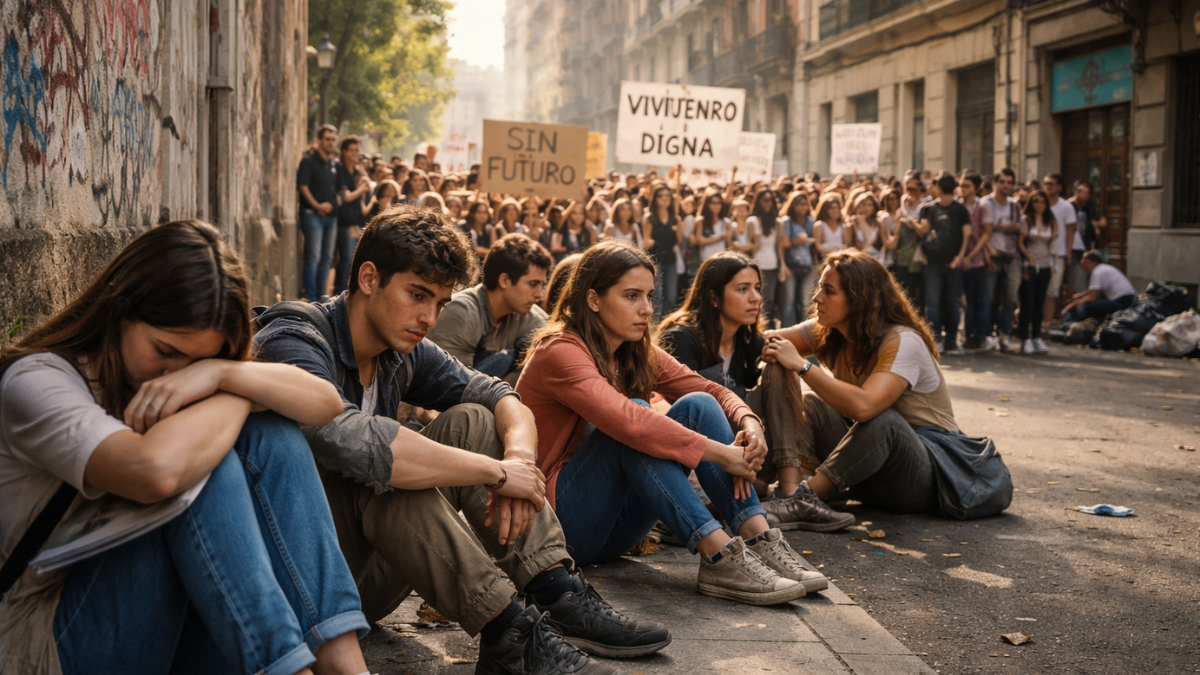
Youth unemployment has become one of the most pressing social issues in contemporary Spain. While unemployment affects various segments of society, its impact on young people is particularly severe and socially transformative. The problem is not merely economic; it is deeply embedded in structures of class, education, family, region, and public policy. From a sociological perspective, youth unemployment in Spain reveals how labor markets reproduce and intensify social inequality.
Spain has experienced dramatic economic fluctuations over the past two decades. The 2008 global financial crisis, followed by austerity policies and later the COVID-19 pandemic, destabilized labor markets. Although recovery phases have reduced overall unemployment rates, youth unemployment has remained disproportionately high compared to the European average. This persistent gap invites sociological analysis: why are young people more vulnerable, and how does unemployment deepen existing inequalities?

Explore Social Inequality in Spain through a sociological lens, examining youth unemployment, class divisions, regional disparities, gender inequality, and the structural factors shaping unequal life chances in contemporary Spanish society.
Structural Roots of Youth Unemployment
Economic Transformation and Labor Market Segmentation
Spain’s economy underwent rapid transformation in the late 20th and early 21st centuries. Heavy reliance on construction, tourism, and temporary services created a segmented labor market. Sociologists describe this as a dual labor market structure: one stable core of protected workers and another peripheral sector characterized by temporary, low-paid, and insecure jobs.
Young people overwhelmingly enter the peripheral sector. Temporary contracts are common, especially in tourism hubs such as Barcelona and Madrid. Employers often prefer short-term hiring, which makes youth employment unstable and cyclical. When economic crises occur, temporary workers are the first to lose their jobs.
This structural vulnerability creates what sociologists call “precarity.” Youth unemployment is not simply a matter of individual failure or lack of skills; it is a systemic outcome of labor market design.
Education and Credential Inflation
Spain has significantly expanded higher education. Universities have produced a generation of graduates with high academic qualifications. However, the labor market has not expanded in proportion to absorb them. This results in credential inflation—where degrees lose their economic value because too many candidates hold similar qualifications.
Young graduates often accept jobs below their skill level, a phenomenon known as “overqualification.” Over time, this mismatch reduces upward mobility and increases frustration. From a sociological standpoint, the promise of education as a pathway to social mobility weakens, undermining trust in institutions.
Social Class and Inequality
Reproduction of Class Privilege
Pierre Bourdieu’s theory of cultural capital helps explain how youth unemployment reinforces inequality. Young people from middle- and upper-class families possess networks, financial support, and cultural resources that ease their transition into employment. They can afford unpaid internships, language training, or international experiences.
In contrast, working-class youth lack these advantages. When unemployment persists, they face economic hardship more quickly. Family background becomes decisive. Sociologically, this demonstrates the reproduction of class privilege across generations.
Family as a Safety Net
Spain’s strong family structure acts as both a protective and restrictive force. Many unemployed young adults continue living with their parents into their late twenties or early thirties. While this reduces extreme poverty, it also delays independence, marriage, and childbearing.

This “extended youth” phenomenon reshapes demographic patterns. Delayed family formation contributes to Spain’s low fertility rate. The family absorbs economic shocks that the welfare state does not fully cover, but this also reinforces inequality between families with stable resources and those without.
Regional Disparities and Spatial Inequality
Youth unemployment varies significantly across Spanish regions. Industrialized areas and large cities provide more opportunities than rural regions or economically weaker autonomous communities. Southern regions historically experience higher unemployment rates compared to northern areas.
These regional differences produce spatial inequality. Young people from disadvantaged regions often migrate internally or abroad. Cities like Valencia and Seville show contrasting employment patterns shaped by local economies.
Migration becomes both a solution and a symptom. When educated youth leave poorer regions, local economies lose human capital, perpetuating regional imbalance.
Gender Dimensions of Youth Unemployment
Youth unemployment is not gender-neutral. Young women in Spain face additional barriers related to gender norms, occupational segregation, and care responsibilities. Although female participation in higher education is high, women often enter sectors with lower pay and less security.
Temporary employment and part-time contracts are more common among young women. Additionally, expectations regarding caregiving influence career continuity. From a feminist sociological perspective, labor market inequality reflects broader gender hierarchies embedded in society.
Migration and the “Lost Generation”
After the 2008 crisis, many young Spaniards emigrated in search of opportunities in other European countries. This phenomenon was widely described as the emergence of a “lost generation.” The term symbolizes not only economic hardship but also collective disappointment.
Emigration affects social identity and national belonging. Young migrants often experience precarious conditions abroad, yet they may find better prospects than at home. The outflow of educated youth also impacts Spain’s demographic and economic future.
Political Consequences and Social Movements
Youth unemployment has political implications. High levels of joblessness among young people contributed to social protests, such as the Indignados movement in 2011. These movements expressed frustration with austerity policies, corruption, and lack of opportunities.
Sociologically, unemployment can weaken trust in democratic institutions. When young citizens feel excluded from economic participation, political alienation grows. However, it can also generate civic engagement and demand for reform.
Digital Economy and New Forms of Work
The rise of the digital economy offers new possibilities but also new inequalities. Gig work, freelancing, and platform-based employment attract young workers. While flexible, these forms of work often lack social protection.
Digital skills create new hierarchies. Youth with access to technological education and urban networks benefit more than those in rural or lower-income settings. Thus, the digital transformation may reproduce existing inequalities rather than eliminate them.
Mental Health and Social Well-Being
Unemployment has psychological consequences. Prolonged joblessness affects self-esteem, social identity, and mental health. For young people, work is not only a source of income but also of social recognition.
Sociologists emphasize that unemployment disrupts the transition to adulthood. It delays financial independence and challenges personal aspirations. Feelings of uncertainty and instability can shape an entire generation’s worldview.
Welfare State and Policy Responses
Spain’s welfare policies aim to address unemployment through training programs, subsidies, and European Union initiatives. However, critics argue that policies often focus on short-term solutions rather than structural reform.
Active labor market policies encourage skill development, but without sustainable job creation, they have limited impact. A sociological approach suggests that meaningful change requires restructuring labor market institutions, strengthening social protection, and reducing segmentation.
Intersectionality: Class, Gender, and Migration
Youth unemployment intersects with multiple dimensions of inequality. A young woman from a working-class immigrant background faces layered disadvantages. Intersectionality highlights how overlapping identities shape life chances.

In urban neighborhoods with high immigrant populations, unemployment rates among youth can be significantly higher. Discrimination, language barriers, and limited networks compound economic exclusion.
Long-Term Social Consequences
The persistence of youth unemployment has long-term implications. It influences life trajectories, earning potential, and social mobility. Early career instability often leads to cumulative disadvantage over time.
Moreover, inequality among young people may intensify generational divides. Older generations with stable employment and property ownership contrast sharply with precarious youth. This generational gap reshapes social solidarity and public debate.
Toward a More Inclusive Future
Addressing youth unemployment requires structural change. Sociologists advocate for:
- Reducing labor market duality.
- Strengthening vocational training linked to industry.
- Promoting regional development.
- Expanding social protection for temporary and gig workers.
- Encouraging gender equality in employment.
However, solutions must also address broader social inequality. Employment policies alone cannot resolve disparities rooted in class, gender, and region.
Conclusion
Youth unemployment in Spain is not merely an economic indicator; it is a mirror reflecting deeper social inequalities. It exposes how labor markets, educational systems, family structures, and regional dynamics interact to shape life chances. Sociologically, unemployment among young people reveals the mechanisms through which inequality is reproduced across generations.
While Spain has shown resilience and adaptability, the challenge remains significant. Ensuring that young people can participate fully in economic and social life is essential for social cohesion, democratic stability, and long-term development. Without structural reforms, youth unemployment will continue to reinforce social inequality, shaping not only individual futures but the trajectory of Spanish society as a whole.
For hubsociology.com, this topic highlights the critical intersection between labor markets and social structure—demonstrating that economic problems are always, at their core, social problems.
FAQs on Social Inequality in Spain
1. What is Social Inequality in Spain?
Social Inequality in Spain refers to unequal distribution of income, employment opportunities, education, healthcare, and social mobility among different social groups based on class, gender, region, and ethnicity.
2. How does youth unemployment contribute to Social Inequality in Spain?
Youth unemployment limits financial independence, delays social mobility, and increases dependence on family support, thereby deepening Social Inequality in Spain across generations.
3. Which regions experience higher Social Inequality in Spain?
Southern regions such as Andalusia and some rural areas experience higher unemployment and poverty rates, increasing Social Inequality in Spain compared to industrialized northern regions.
4. How does education affect Social Inequality in Spain?
Although access to higher education has expanded, overqualification and limited job opportunities mean that education does not always guarantee upward mobility, reinforcing Social Inequality in Spain.
5. What role does family background play in Social Inequality in Spain?
Family resources, networks, and cultural capital strongly influence job access and career advancement, making family background a key factor in Social Inequality in Spain.
6. Is Social Inequality in Spain linked to gender differences?
Yes, women often face wage gaps, temporary contracts, and career interruptions, which intensify Social Inequality in Spain along gender lines.
7. How does migration influence Social Inequality in Spain?
Immigrant communities may face discrimination, unstable employment, and limited access to opportunities, increasing Social Inequality in Spain.
8. Does the labor market structure increase Social Inequality in Spain?
Spain’s dual labor market—stable permanent jobs versus temporary precarious work—widens Social Inequality in Spain, especially among youth.
9. How did the 2008 economic crisis affect Social Inequality in Spain?
The crisis increased unemployment and poverty, disproportionately affecting young and working-class populations, thereby worsening Social Inequality in Spain.
10. What is the relationship between poverty and Social Inequality in Spain?
Persistent unemployment and low wages contribute to poverty risks, which are central indicators of Social Inequality in Spain.
11. How does regional migration relate to Social Inequality in Spain?
Young people often migrate from poorer regions to urban centers or abroad, reflecting and reinforcing regional Social Inequality in Spain.
12. What impact does Social Inequality in Spain have on mental health?
Economic insecurity and unemployment create stress, anxiety, and social exclusion, showing how Social Inequality in Spain affects psychological well-being.
13. How does Social Inequality in Spain affect social mobility?
Limited stable job opportunities and class-based advantages restrict upward mobility, making Social Inequality in Spain persistent across generations.
14. Are government policies reducing Social Inequality in Spain?
While welfare programs and employment initiatives exist, structural labor market issues mean Social Inequality in Spain remains a long-term challenge.
15. Why is understanding Social Inequality in Spain important sociologically?
Studying Social Inequality in Spain helps explain how economic systems, institutions, and cultural factors interact to shape unequal life chances within society.
1 thought on “Youth Unemployment and Social Inequality in Spain: A Sociological Perspective”